
Why Winchester movement strategy should focus on bus use, January 2024
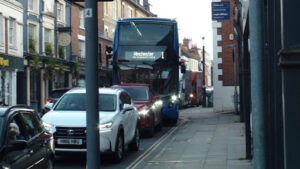
The Winchester movement strategy
Winchester City and Hampshire County Councils published phase 1 of the Winchester Movement Strategy in spring 2019. Winchester Movement Strategy | Transport and roads | Hampshire County Council (hants.gov.uk)
Initially it was a document with “high-level” aims with three priorities:
- Reduce city centre traffic
- Support healthier lifestyle choices
- Invest in infrastructure to support sustainable growth.
Various plans have been drawn up suggesting changes to the traffic flow, possible cycle improvements, and possible walking improvements. However, so far with the exception of bollards in Great Minster Street little has been done.
In July 2022 Hampshire County Council (HCC) published https://documents.hants.gov.uk/transport/WMS-Phase2-SummaryReport.pdf. This assumed continuing traffic growth but has subsequently been superseded by HCC’s Draft LTP4 which proposed a 10% reduction in traffic volumes.
Specific proposals for cycling and walking have been published, but work is currently limited to a section of Worthy Road where detailed plans are being prepared. So far it has not been possible to obtain more general funding.
Proposals have also been put forward for ‘bus gates’ at City Bridge and Southgate Street, and a bid has been made for funding to make Jewry Street bus, cycle and access only. If implemented these schemes would require very significant changes in general traffic routes.
Central Winchester regeneration
Winchester City have appointed development partners (‘Jigsaw’) to redevelop the Bus Station and regenerate adjacent areas including King’s Walk. The remit includes major improvements to the public realm of High Street, The Broadway and adjacent streets, again requiring significant traffic changes.
The current proposal is to replace the bus station with on street stops in the vicinity. Although the redevelopment of the bus station is supported for its wider regeneration benefits the proposed bus terminal arrangements will not provide the high quality environment required to encourage bus use.
At the same time proposals are being developed for improvements at Winchester Station. This gives an opportunity to provide new high quality bus terminal facilities there as part of an Integrated Transport Hub and City Centre Spine (see below).
The urgency for a Winchester Bus Movement Strategy (WBMS)
The CWR proposals provide impetus to take a fresh approach to the Movement Strategy So far there have been proposals for schemes focussed on walking, cycling and general traffic congestion, but despite some proposals in the Hampshire Bus Service Improvement Plan there is no overall strategy to enhance bus provision and help strengthen the case for future funding.
Of course, care should be taken to ensure that other types of movement are well catered for in a complementary way. Once plans have been developed for maximising bus movement it will be easier, then, to consider other forms of movement than it will be to consider bus movement last of all, by which time fundamental necessary changes will no longer be viable.
Reasons to make better use of buses in Winchester
If the conditions are right Winchester Town could benefit substantially from greater use of buses. Greater use of buses would:
- Reduce the volume of traffic in central Winchester
- Reduce the need for parking space
- Reduce particulate and exhaust-pipe pollution and noise levels
- Reduce congestion
- Reduce greenhouse gas emissions
- Free up public space for cyclists and pedestrians and make more public space available for street activities and passive enjoyment of the public realm
- Encourage more walking, cycling and other physical activity
- Help improve social inclusion and mobility for people who don’t have access to cars
- Help reduce the need for car ownership and use.
93% reduction in road space demand
Currently the transport mode share in Winchester is heavily weighted towards car use. The Bushfield Camp outline planning application attempts to reflect the mode share locally by analysing travel behaviour by place of work in the 2011 census. They look at data in east Winchester Town, west Winchester Town, and a large rural area to the south-west of Winchester Town.
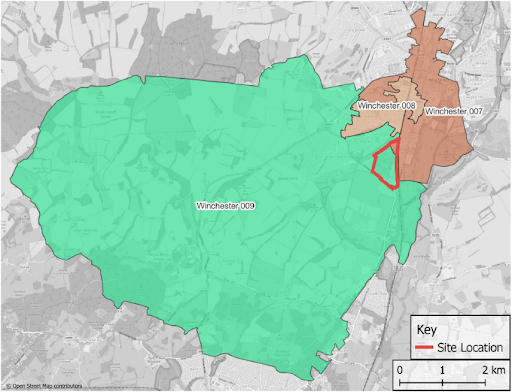
While Winchester 007 and 008 appear the most relevant, Winchester 009 gives us some idea of the modal share in rural areas adjacent to Winchester Town.
| Mode | Winchester 007 East Town | Winchester 008 West Town | Winchester 009 Oliver’s Battery to Hursley | Average Winchester 007 and 008 |
|---|---|---|---|---|
| Underground, metro, light rail or tram | 0.10% | 0.00% | 0.00% | 0.05% |
| Train | 9.20% | 6.80% | 2.00% | 8.00% |
| Bus, minibus or coach | 6.60% | 3.80% | 3.60% | 5.20% |
| Taxi | 0.60% | 0.00% | 0.30% | 0.30% |
| Motorcycle, scooter or moped | 0.80% | 0.70% | 0.60% | 0.75% |
| Driving a car or van | 56.40% | 48.60% | 79.70% | 52.50% |
| Passenger in a car or van | 4.70% | 4.60% | 4.80% | 4.65% |
| Bicycle | 2.50% | 4.30% | 3.20% | 3.40% |
| On foot | 18.80% | 30.70% | 5.70% | 24.75% |
| Other method of travel to work | 0.30% | 0.50% | 0.20% | 0.40% |
| Other method of travel to work | 100.00% | 100.00% | 0.00% | 100.00% |
This table helps us understand how far buses can help remove congestion and pollution in Winchester Town, reduce greenhouse gas emissions, and (once road vehicles have converted to battery power) reduce energy consumption,.
The ratio of car driver : car passenger gives the average car load. The average for east and west Winchester Town journey to work gives an average car load of 1.09 people per car. All travel. Including leisure travel will have higher loads than work travel at about 1.4 people per car, but travel to work gives us a useful insight into peak travel behaviour when congestion problems are most acute.
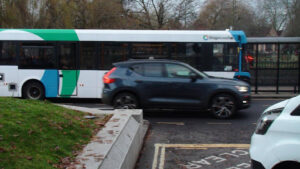
When moving slowly two cars will occupy about the same space as, or more space than, one and a half buses. Buses used in Winchester can carry between 40 and 80 passengers. With improvement in frequency and removal of traffic jams it would be feasible to aim for average all-day bus loadings of about 20 passengers. If this were to happen one bus would be able to carry the passenger load of just over 18 cars and occupy less than 7% of the road space. This would allow sufficient capacity on each bus to cater for peaks in demand, and during peak hours space saving could be at up to twice the rate.
The modal share data reveal that to replace all car modal share bus modal share would need to increase tenfold. Clearly this would not happen because some car mode share could be replaced by walking, cycling and rail, and some would have to remain with cars because of mobility problems or geographic isolation. Initially it would be useful to set a modal capture target of approximately 15%, three times the current modal share. This would involve quadrupling current patronage, and aiming for twice to three-times the current level of service.
60% drop in emissions
More well-filled buses would reduce transport emissions. Emissions are sensitive to average occupancy as shown in table 24 of the methodology paper for 2023 Government Greenhouse Gas Conversion Factors for Company Reporting:

This means that if the movement strategy were to encourage average bus occupancy of 20 passengers per bus, emissions per passenger km would be close to the London figure of 78.06 gCO2e.
This compares with average private car emissions of 211.46 gCO2e / km, and 194 gCO2e / per person km (with an average load of 1.09 people).
There would be a cut of 60% in transport greenhouse gas emissions for every journey transferring to the bus. This could play a significant part in reducing transport emissions in the district.
Once battery electrification of road transport has been achieved green electricity will be at a premium. Demand is likely to outstrip supply. The transfer of journeys to buses would probably then involve a similar 60% reduction in energy use. If the busiest routes across town were wired for direct electrification (trolleybuses) the energy use reduction would be even greater.
What would an excellent bus service look like in Winchester?
To bring about a significant increase in bus use, and reduce emissions and the demand for road space discussed above, it will be necessary to make fundamental changes to the pattern of bus services in Winchester, both within the town and linking the town and district. Some changes to the system of traffic circulation will be necessary to make these changes possible. This could become a vision for promoting the changes with staged development points well publicised to encouraged rapid take-up of new possibilities.
The changes would enable a range of improvements.:
- The ability of every route to serve directly the railway station, the central shopping area, and (as many routes as possible) the Leisure Centre and the General Hospital
- Good connectivity between all bus routes along a central spine from the railway station to City Bridge
- Good connectivity with trains at a new public transport interchange at the railway station
- Planned ‘pulse interchange’ for trains and all routes with a frequency of less than 30 minutes at the public transport interchange
- Comfortable waiting facilities at all connection points
- Comprehensive accessible real-time information, especially including less frequent routes
- Battery-electric buses on all routes
- A daytime frequency of 10-15 minutes for City routes
- A daytime frequency of every 30 minutes for key inter-urban bus routes serving the wider district
- A minimum hourly evening frequency
- A service day from 06:00 to midnight
How would the vision be realised?
Integration of park & ride and town bus services
Currently Winchester is served by 7 City routes and 7 regular inter-urban routes operated commercially by Stagecoach together with the frequent Bluestar route to Southampton. There are a few other infrequent services tendered by Hampshire County Council.
The City Council tenders the frequent ‘Park & Ride’ funded by parking charges. With minor exceptions these buses cannot be used by general passengers because of competition regulations. .Although there are peak times when these buses load well, average loadings throughout the day are low (8 per trip if each bus working from car park to car park is taken to be one trip into town and one trip out of town). Outward journeys in the morning, and inward journeys in the evening are usually very lightly loaded.
Successful Park and Ride is a vital element of a sustainable Winchester Movement Plan and additional P&R sites are planned which will require a substantial increase in P&R buses. Currently 40% of buses departing from the city centre (excluding inter-urban buses) are exclusive P&R services. It is estimated that when the planned additional P&R sites are operational, and assuming a restoration of pre-Covid City bus frequencies, that 50% of departures will be P&R.
Better use could be made of this resource providing wider distribution of the benefits of income from car parking.
It is now possible to develop an integrated plan for bus services in Winchester as set out in the ‘Bus Back Better’ White Paper. This would require either the franchising of bus services giving control to the local authorities as in London and Manchester, or a binding ‘enhanced Partnership Plus’ as is being developed in Leicester.
It should be noted that in addition to the P&R services being funded by Winchester City Council a substantial and growing proportion of ‘commercial’ bus services are also publicly funded through grants, vehicle subsidies, fare subsidy and concessionary fares. This is generally estimated at 40-50%, .
Given the large amount of public funding for bus services there is a strong case for making buses free as an incentive to switch from car use and to support equality and social inclusion objectives. However, this will require complex financial negotiations and is only likely in the longer term.
Car parking tickets could still be used as payment for bus fares on a combined bus network.. This would provide a more frequent bus service for a wide range of passengers at no greater cost.
The Central Bus Spine
A key issue for bus operation is reliability and congestion and unpredictable delay on the current city centre traffic gyratory is a major problem. The volume of traffic in narrow city streets creates an unattractive and unsafe environment for pedestrians and cyclists and detracts from the attractions of Winchester as an important historic town.
This paper suggests a complete rethink of traffic flow arrangements in central Winchester to facilitate the vision of the WBMS providing a bus spine could cross central Winchester, from the hospital to the leisure centre with battery-electric buses providing a cleaner and more pleasant environment.,
Option A

Option B
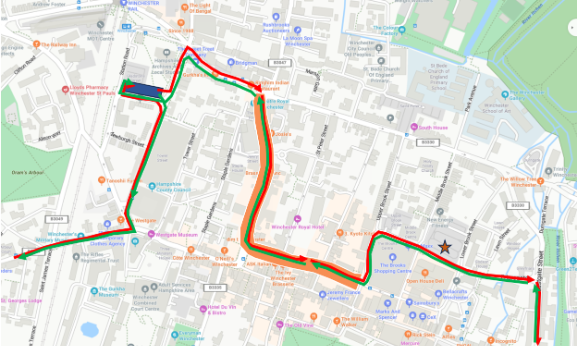

Assumptions:
- North Walls to become two-way, with a shuttle at the east end, made possible by the reduction in traffic
- Jewry Street cycle and electric bus only, bus one-way to the south OR, as an alternative, Jewry Street two-way cycle and battery electric bus serving The Arc in both directions with a traffic-light-controlled toggle at the narrow point and reducing or dispensing with all-day traffic on the western part of High Street to Westgate.
- St George’s Street bus/cycle only with time-limited deliveries
- Westgate traffic-free square to west of Westgate with restored wall to east
- Interchange facilities on Middle Brook St and Gladstone Street car parks
- Sussex Street to become two-way
- Terminating/charging facilities at the Leisure Centre or St Catherine’s Car Park and at the public transport interchange.
- City Bridge to become cycle and bus only.
- Bus routes would be modified to ensure all bus routes would serve much of the central spine, especially the public transport interchange.
The Public Transport Interchange with Pulse Interconnections
The Station public transport interchange would be designed to enable good two-way connections between less frequent bus services and with rail services. Two interchange points per hour would be agreed between all operators. Bus routes could be timetabled to arrive five to fifteen minutes before this time and depart at five to fifteen minutes after this time. This could allow buses to proceed into the centre and return in the period between the two times, or allow rest time for buses terminating that serve areas to the east (e.g. the 64). Precise timings could be adjusted to ensure reliability.
- With fine-tuning, the aim would be to enable good interchange in either direction for any two routes. This would make through journeys much more reliable and attractive. This ‘taktfahrplan’ system works successfully throughout Switzerland, and has been copied in many other places and results in high levels of public transport use. The public transport interchange would need to have sufficient bays for all pulse-connecting services to be accommodated at the same time. It would be important to allow for this in the station area development plans.
Battery-electrification
The most recent order for Stagecoach buses in Winchester is for diesel buses. This is regrettable as accelerating global heating requires different priorities. The initial cost of battery-electric buses is approximately 30% higher than for a diesel bus, but running costs are lower. Government funding is possible via the Zebra project and other cities have already made substantial progress. Inverness, which is of similar size to Winchester, has a 100% electric fleet operated by Stagecoach. In Leicester the First city bus fleet is being converted to electric operation. Whole-life costs are lower, especially when the externalised costs of problems caused by diesel buses are taken into account.
The pace of electrification could be accelerated if Winchester were to follow Oxford’s example and declare a zero emissions zone on a central section of the suggested bus spine.
Modal Capture and Social/geographic Isolation
This paper has concentrated on how relatively busy bus routes can be refreshed so that they become more attractive alternatives to private (car) transport.
Other bus routes are much less frequent, and much less busy. Nothing in this paper is intended to suggest that they too are not important and should not be continued to prevent social and geographic isolation.