
Integration of bus services in Winchester to reduce heavy traffic, congestion and pollution
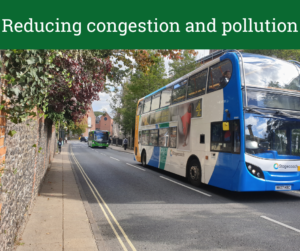
Reducing harmful greenhouse gas pollution (mainly caused by traffic) in Winchester means rethinking how we approach public transport.
People tell us that the current public transport system in Winchester is impractical, unreliable and too expensive particularly for families.
We also know that other areas of the UK have been successful in transforming public transport systems by offering better connections and providing better information about services.
This blog explores how integrating public transport services in Winchester could help cut congestion, heavy traffic and greenhouse gas pollution levels in the city. Future posts will focus on other issues such as interchanges and affordability.
What do we mean by integration of bus services?
At the moment Winchester’s has a patchwork of buses operating across the city and district:
- 5 regular city routes, 4 regular district routes, and 4 less regular district routes are run by Stagecoach on a commercial basis sometimes helped by subsidy from Hampshire County Council, or Winchester City Council.
- One very frequent Bluestar route to Southampton
- A small number of infrequent routes are run by bus companies such as Cresta Coaches for Hampshire County Council
- Winchester City Council funds and operates the Park & Ride (P&R) service, paid for through parking charges.
While the Park & Ride service is vital for reducing the amount of traffic in the city centre, it currently operates separately from the other bus services so as not to ‘poach’ passengers from other services. This reduces the number of passengers that can use it, even though buses often only have a handful of passengers —particularly driving out of Winchester in the mornings and driving into Winchester in the evenings.
For example:
- On average, each P&R bus carries just 8 passengers per trip, despite being a frequent service.
- 27% of buses leaving the city centre (excluding inter-urban routes) are P&R buses.
- With additional P&R sites planned as part of the Winchester Movement Strategy, this figure could rise considerably.
Integrating the P&R bus services with the wider bus network could make much better use of existing resources and create a more frequent and efficient service for everyone.
How can bus services be better integrated?
We suggest there are two main approaches to integrating bus services in Winchester:
- Franchising bus services
The new Mayor and Combined Strategic Authority needs to take full control of bus services as soon as possible. This is what happens in in London and Manchester. Franchising enables coordinated approach to timetables, routes, and fares, ensuring buses work as a single network. - A Tighter Bus Partnership
In other areas, like Cornwall the transport authority has played a much greater role in planning and coordinating bus services. This has resulted in more passengers.
Both approaches would allow Winchester to build an integrated bus network that combines the strengths of existing services, crucially bringing P&R buses into the public transport system.
Why do we think bus integration is so important?
Between grants, vehicle subsidies, fare discounts, and concessionary fares, an estimated 40–50% of bus operating costs in Winchester are already supported by public funds.
With such a large amount of public money being used, we would like to see more people on each bus – to make sure we’re getting good value for money.
In the longer term, we would argue for free bus travel, which would encourage even more people to use buses.
P&R car parking tickets could still double as bus fares on an integrated network. Car parking charges could then be used as a way of subsidising and funding local bus services..
By rethinking how our bus services are funded and managed, we can create a cleaner, more connected city without increasing costs.
Read our paper on why the implemention of Winchester Movement Strategy should focus on bus use here.
Read WinACC’s submission to the Government’s call for ideas on integrating transport here.