
At the recent film screening of ‘System Update‘ a new film by award winning local filmmaker Paul Maple we held a question and answer session. One of the questions was ‘surely if we scare people enough they’ll take action, much like they did during covid?’
This question was put to Denise Baden, a Professor of Sustainable Business at the University of Southampton. Professor Baden has done a huge amount of research into what it takes to tip people into taking action on the climate crisis.
We asked her to write this article, as here at Winchester Action on the Climate Crisis (WinACC) we try to keep our messaging positive and hopeful for the future, in order to inspire action.
If you’ve enjoyed reading this please visit our ‘news, events and blogs‘ page on our website for further reading.
Can we ‘scare people green?’ by Denise Baden
I am a professor of sustainable business, eco-fiction author and founder of the Green Stories project. My research has explored the most effective ways to engage mainstream audiences in climate policies and sustainable practices. In this article I share some of what I’ve learned along the way about what works and what doesn’t.
Question 1. News stories: Which story is more effective in prompting environmental action?


Question 2. In a study comparing short stories with a green theme, which were most likely to prompt pro-environmental intentions: solution focused or catastrophe-focused stories?
Question 3. What kind of business ethics education is most likely to result in ethical intentions in the business domain? Case studies of the terrible consequences of ethics scandals and how they came about or case studies of ethical leaders and sustainable enterprises?
Answer
In each study, solution-focused stories showing positive role models were significantly more likely to result in more ethical/pro-environmental intentions than catastrophe focused approaches.
Reflections on how positive and negative news stories made respondents feel suggest mechanisms underlying these effects. Many respondents felt motivated, empowered or inspired by the positive stories, and there was often an explicit connection between their positive feelings and their behavioural intentions. However, comments relating to the negative news stories were very different. The tone tended to be passive, and it was common for respondents to state how helpless they felt to take action. In addition, it was possible to see how the helplessness was being processed emotionally, for some the negative motions appeared to be turned inwards into depression and guilt rather than outwards to positive action. Another coping strategy seemed to be to adopt a philosophical stance or to just switch off emotionally altogether.
For the study using students on a business ethics course, positive role models were much more likely to lead to ethical intentions than cautionary tales. Those exposed to ethics scandals showed increased cynicism, which led to less ethical intentions due the belief that unethical behaviour was the norm. In contrast, exposure to sustainable businesses showed that business can be successful and ethical and showed how.
For the study on climate fiction, catastrophe-focused stories inspired some to action, but just as many switched off, as indicated by these kinds of quotes:
- This was very frightening and negative.
- It made me angry and I switched off.
- We- the little person – are powerless.
No one switched off from the positive messaging as indicated by the quotes below:
- I think the ones with solutions have more impact than the over-the-top scare mongering.
- The second story felt inspirational. It gave me a simple option that I could take to do something positive for the environment.
The most effective stories were those that included a character that the reader could relate to, engaging in pro-environmental behaviours that readers could easily emulate.
Sustainable hairdressing
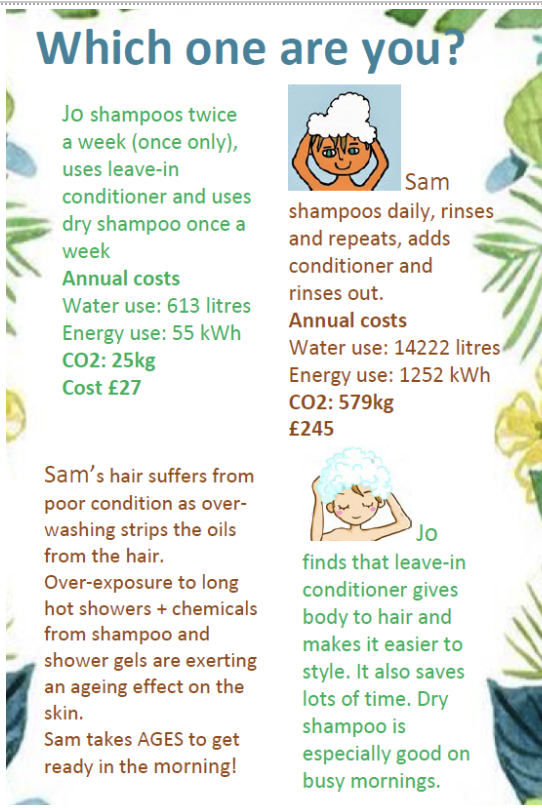
These insights informed an award-winning project using stylists to spread information about sustainable hairdressing. In the posters and marketing materials we created, we used mini character portraits to capture key points. We didn’t need to always play the ‘green card’ as there were clear win-wins – lower resource haircare has positive impacts in terms of hair condition, skin, money and time as well as the planet. We could therefore promote the benefits of water/ energy saving products such as dry shampoo, leave in conditioner etc. in terms of benefits to user.
Using a rom-com to engage mainstream audiences
I drew on this research when I wrote my first novel: an eco-themed rom-com with a hint of cosy mystery called ‘Habitat Man’. This is based on a real-life local Green Garden Consultant. It tells the story of a man who gives up his city job when they turn down his proposal for costing for nature accounting and becomes a wildlife gardener. In the process, he falls in love and digs up a body. Sustainable solutions are scattered through the romcom like seeds. For example, many people wrote to me saying the natural burial scene inspired them to change their will. Results from a study of 50 readers found that 98% changed their attitudes and 60% had adopted at least one green alternative when surveyed one month after finishing the book. For more details, see https://www.dabaden.com/habitat-man-in-research/

Psychology of behaviour
Such results can be explained by the theory of planned behaviour (Ajzen 1991).

This proposes that behaviour results from awareness, social norms and perceived behavioural control, i.e. we know about an issue, see that other people approve of a behaviour and feel able to do it ourselves. Decades of research provide evidence of an attitude-behaviour gap. Awareness and positive attitudes on their own don’t have a large impact on behaviour. What really matters is what we learn from how others behave and feelings of agency. For example, knowing that recycling is a good thing is not enough. More important are social norms (i.e. those around us recycle and would disapprove of us if we don’t) and our ability to carry out the behaviour (i.e. recycling facilities are available).
Trying to ‘scare people green’ without tying awareness to what can be done is a bit like revving an engine while not in gear – it generates a lot of negative energy which isn’t being harnessed towards positive action. Climate anxiety is also a growing issue, especially amongst young people. In terms of the matrix below, we need to move people from the left-hand side of the table towards the bottom right – calm, effective action.
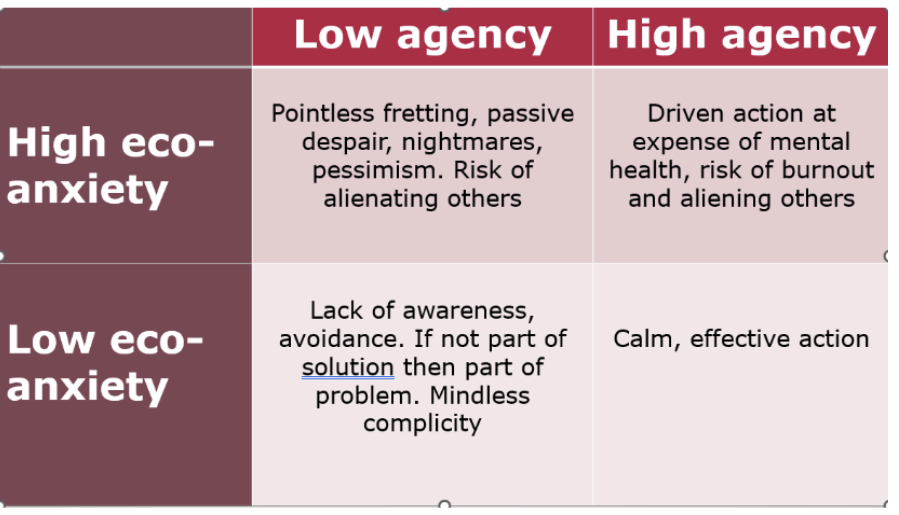
Indeed, raising awareness alone can be counterproductive. The assumption is often that by raising awareness of the catastrophic consequences of not adopting climate-friendly policies, we will all be inspired to pester our politicians for green policies, give up flying and beef, and switch to renewable energy. In reality, the literature on behaviour change, and my own research indicates the opposite. We don’t tend to behave well when scared. Typical responses are denial, avoidance, blaming marginalised groups, voting for populist leaders or even ‘prepping’ – in the UK that may involve buying up all the toilet rolls, in the US getting a gun.
It worries me therefore that most climate communications focus on problems, not solutions. Steve Willis, a climate engineer and author (Fairhaven, Defying Futility) has allowed me to share his diagram of films, books etc, which plots dystopian/utopian visions of the future against plausibility. It’s clear that there’s little that is both positive and plausible.

Green Stories Project
I founded the Green Stories project in 2018 to provide resources and encouragement for fiction authors to write into this space.
For example, in 2022 we teamed climate experts and experienced writers such as Kim Stanley Robinson and Paolo Bacigalupi to create an anthology of 24 short stories, each with climate solutions at their heart. Each story and each climate solution links to webpages where readers can follow up on any solutions that inspire them to see how they can help to make them happen. The anthology was also shared with policy makers at COP27 and COP28.

#ClimateCharacters
In 2023, Green stories teamed with Bafta on a study #ClimateCharacters using humorous social media posts to compare the carbon footprints of fictional characters. The aim was to enable people to join the dots between consumption behaviour and environmental impacts and also to highlight the role that culture plays in our aspirations.

This study taught us that humour can help to bypass defensive reactions. But it wasn’t always enough. The James Bond post with his single-use sports car and walk in wardrobe of suits was funny, but some still responded defensively. Contrasting him with Jack Reacher, who travels by bus and wears second-hand clothes, worked better.
The lesson from this is just telling people what they shouldn’t do, doesn’t work as well as showing what they could do instead. I remember learning this as a mother when playing football with my son. Every time he was in goal, and I scored, he’d have a tantrum and no amount of telling him not to cry worked. What did work was giving him an alternative script, so that when I got a goal past him, I taught him to say, “well done, Mummy, what a brilliant goal!”
You can see more about this study on https://www.greenstories.org.uk/climatecharacters/. Share the posts (on X, Bluesky, Facebook/Insta) yourself.
Green Stories upcoming competition
Green Stories have also run 20 free competitions, resulting in 15 publications, all of which endeavour to engage mainstream audiences in climate solutions and sustainable practices, see https://habitatpress.com/.
The latest competition is flash fiction and asks for up to 500 words on the theme of epiphanies when a moment of epiphany causes one or more characters to change for the greener. The deadline is 27th August 2025, and we plan to publish the best as an anthology. Later this year, we will make the anthology available for a short film competition to adapt the best as short films. More details are here: https://www.greenstories.org.uk/flash-fiction-competition-epiphanies-2/
Summary
In conclusion, yes, some people can and have been ‘scared green’. However, my proposal is that those who are likely to be scared green are already well-served. There is plenty out there in terms of news, documentaries, education, dystopian stories etc. to let you know there’s a problem.
Those who don’t know that climate is a pressing issue by now are most probably choosing not to know. It’s not such an irrational response. Upping the fear for this segment is more likely to lead to counter-productive responses such as avoidance, denial, blaming immigrants or paralysing climate anxiety, than climate action.
The worry that not sounding the alarm will lead to complacency is not well founded in terms of evidence. As discussed above, most research shows that positive role models that showcase sustainable practices are a more effective approach to engage mainstream audiences.
There are many ways in to inspire pro-environmental behaviours without mentioning climate, whether it be promoting the benefits to skin and hair health of shampooing less often, or drawing on love of nature to engage people in wildlife gardening or just making them laugh, while at the same time, norming more sustainable options.
I will finish by practicing what I preach, that is – what should we do?
- Focus on behaviour – not on attitudes/awareness.
- Focus on solutions, not problems.
- Promote benefits of pro-environmental behaviours without feeling you have to mention climate. There are many ways in: health, money, nature etc.
- Last, but not least, please share details of the Green Stories epiphany competition with any aspiring writers; our books for those who enjoy fiction. Check out #ClimateCharacters posts and repost and sign up for the Creative Climate Communications newsletter.
Further resources
Newsletter on creative climate communications to showcase some of the projects and research in this field: see Creative Climate Communication newsletter
You can find more about my research and how to write for a cause here: https://www.dabaden.com/speaking-events/#RC
You can access resources such as details of transformative climate policies and The Climate-Conscious Writers Handbook here https://www.greenstories.org.uk/story-ideasresources/.