
Contents
- Introduction
1.1 Scope
1.2 Funding
1.3 Staffing - Group Support and Development
2.1 Local Groups
2.2 Network Events
2.3 Newsletter - Group Activity
3.1 Energy
3.2 Waste Prevention
3.3 Engaging Residents
3.4 Food - Sharing the Learning
- Value of WeCAN
1. Introduction
1.1 Scope
This supplement documents year 4 (plus Q1 of year 5) of the Winchester Climate Action Network (WeCAN) project, covering project activity from April 2024 to June 2025 and is a supplement to the 3-year Project Report published in March 2024. The 2021-2024 report is here.
1.2 Funding
During this period the WeCAN project was primarily funded by a grant from the South Downs National Park Authority (SDNPA), with some additional funding from Winchester City Council (WCC). Office facilities were provided by the University of Winchester and funding from the Jo-Li Trust for WinACC core costs allowed WinACC to contribute in-kind funding. With support from Winchester City Council and the South Downs National Park Authority, WeCAN has become a powerful partnership for community engagement and action on the climate.
Funding was received from two rounds of the UK Shared Prosperity Fund for a project providing support to community buildings with installing photovoltaic solar panels. Although distinct from the WeCAN project, this was closely linked, building on the relationships established by WeCAN. WinACC also participated in the 2025 Big Give Green Match Fund, with our appeal focused on the WeCAN project.
To extend the learning from WeCAN and build stronger partnerships for community climate action, we led the development and submission of an Expression of Interest to the National Lottery Climate Action Fund under the name ‘Together We Can’, representing community-led climate groups and local authorities across much of Hampshire. Unfortunately, this was not accepted for a detailed submission.
The Lottery prioritises disadvantaged communities, using a definition which in our view gives insufficient weight to the disadvantage experienced by people in rural communities with poor transport and access to essential services.
Unsuccessful funding applications for future WeCAN activity were also submitted to the Esmee Fairbairn Foundation, Centrica’s Energy for Tomorrow grant scheme, the Better Community Business Network and a Hampshire County Council councillor grant.
Going forward: It is difficult to raise funding for building the social infrastructure for increased action on the climate. The challenges are caused by the demands of funders for:
- A short-term benefit, when this is long-term work with sustained change in mind, within a robust context of established and trusted relationships
- A benefit targeted at disadvantaged communities, whereas climate affects everyone (though poor communities suffer more from its impacts)
- Activities that involve excluded communities, when it is people with wealth and influence who have the most influence directly (their own production of greenhouse gases) and indirectly (access to business and political leaders)
WCC has committed £40,000 to WeCAN over 2025-2027.
We continue to seek match funding towards a total budget for the next 3 years of £105,000 in order to grow the work.
1.3 Staffing
The project was delivered during this period by a part-time (2 days pw) WinACC Climate Officer, supported by WinACC’s Executive Director (0.5 days pw).
The Climate Officer continued to provide direct support to the local climate groups, enabling them to further develop their activities and engagement, as well as organising regular network events to bring the groups together.
2. Group Support and Development
2.1 Local Groups
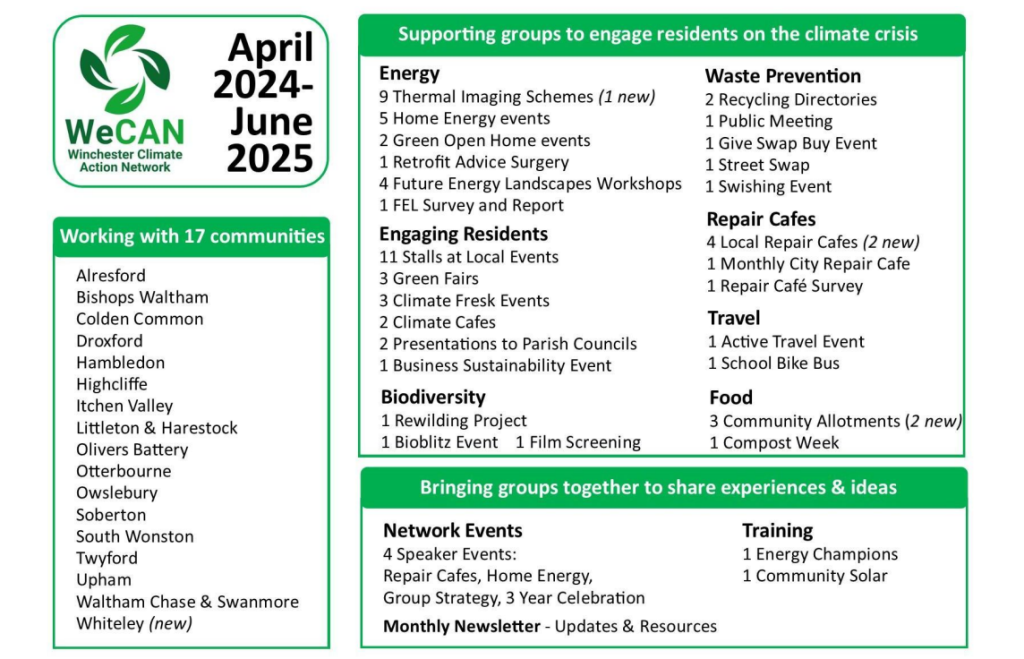
Support continued to be provided to 17 local climate action groups across Winchester District, plus an additional group started by Whiteley Town Council.
Our 2024 research project indicated that WeCAN climate officer support is a key factor in enabling effective group development. Several groups have found that continuing to recruit volunteers and develop activities beyond an initial year or two can be challenging and we have worked with them to develop strategies to overcome this.
We helped Colden Common Climate Action run a stall at a public event, followed by a climate café, to recruit more volunteers and plan new activities. We worked with Upham Action on the Climate Crisis to develop a new repair café that brought in new volunteers and had an impact on waste and emission reduction.
Going forward: Climate officer support continues to be needed to support groups (especially in the natural cycle of groups when energy and motivation waver) and to ‘hold’ the network, and channel in appropriate training and learning.
2.2 Network Events
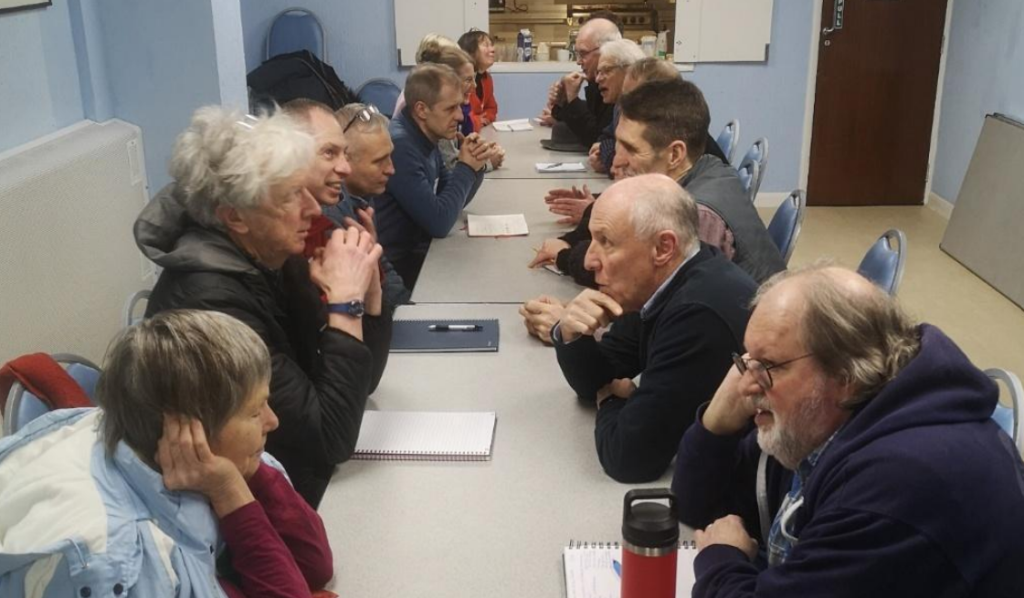
Regular in-person network-wide events were organised to both inform groups and to provide an opportunity for them to meet and share experiences and ideas.
During this period the following network events were held:
How to set up a Repair Café: speakers from 3 local repair cafes. 15 attendees from 8 groups.
Home Energy Event: speaker from the Environment Centre. 17 attendees from 10 groups.
Funding, Data and Comms: speaker from Winchester City Council. 10 attendees from 7 groups.
3-year Celebration Event: speakers from 3 WeCAN groups. 34 attendees from 14 groups.
Two training sessions were also delivered:
- Solar feasibility studies
- Home energy advice
Going forward: peer learning, support and inspiration through the network is key for individual groups and to increase skills and action on particular issues.
2.3 Newsletter
A monthly email WeCAN newsletter was distributed to members of WeCAN groups, all WCC city councillors and all parish council clerks (total 204 contacts).
Going forward: feedback about the level of information in the newsletter show it is a valued resource.
3. Group Activity
Local groups continued to be supported to develop a wide range of engaging and impactful activities, covering a range of sectors.
3.1 Energy
Energy continues to be a key focus for many groups, encouraging residents to reduce their energy use and decarbonise their homes.
While most groups focused on domestic energy use, including running thermal imaging loan schemes and green open home events, several also looked at larger scale renewable energy with Future Energy Landscapes workshops. South Wonston Sustainability were supported to carry out a village-wide survey on the workshop proposals – 209 (nearly 10%) responded with 68% in favour of a community owned solar farm and/or wind turbine.
Going forward: There is great potential for developing work on energy as WCC develops the country’s first digital Local Area Energy Plan, and a pilot Community Led Energy Plan, and there is increased activity around Community Energy projects. Also, there is much public support for renewable energy generation locally – 66% of Winchester district residents support the building of onshore wind farms in this area (data from localintelligencehub.com).
3.2 Waste Prevention
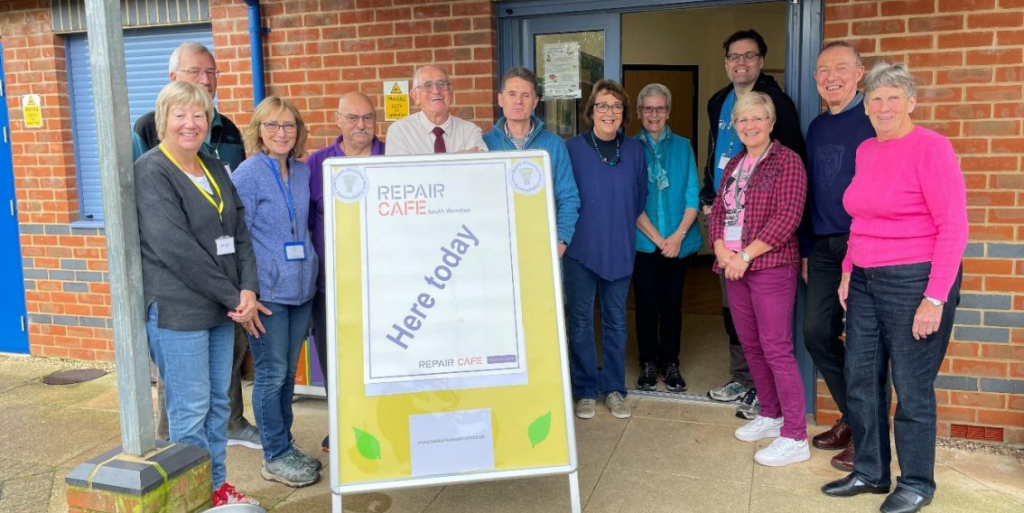
As well as a range of recycling projects, several groups were supported to develop repair cafes. Alongside the benefit of reducing waste and the associated carbon emissions, these events have strong community benefits and can provide many different involvement opportunities. They are also popular with local communities – the Littleton & Harestock group had 60 positive responses to a campaign to attract volunteers for their first repair café. The WeCAN Climate Officer supported groups in South Wonston and Upham to set up new repair cafes.
3.3 Engaging Residents
Groups ran their own events, held stalls at community events and gave presentations to other organisations.
The WeCAN Climate Officer provided intensive support to Denmead Greening around the organisation of their Eco Fun Day, attended by 400 people. She then produced a detailed event planning checklist as a resource for other groups.
3.4 Food
With the help of four food and climate project toolkits produced by Winchester Food Partnership, several groups ran food-based projects. Groups in Owslebury and Alresford set up new community allotment projects, engaging residents in reducing food miles as well as composting food waste.
4. Sharing the learning
We have begun to work with SDNPA on how to map the WeCAN activities onto the One Planet Platform.
We have had a lot of interest in the innovative nature of the WeCAN project from organisations across the UK and beyond, and have shared our information and research on the project with:
Hampshire Association of Local Councils – presentation at HALC County Forum.
The Climate Coalition – presentation to member meeting (May 2025), information stall at July 2025 mass lobby of Parliament attended by constituents from across the UK.
Positive Tipping Points Toolkit Community of Practice – Having been in the PTP Community of Practice, WinACC’s Executive Director, using the WeCAN case study, has been one of 20 people from around the world creating a Positive Tipping Points toolkit through the Huddlecraft Toolkit design process https://www.huddlecraft.com/huddles/positive-tipping-points , delivered a PTP Toolkit workshop at Conference 2025 – Global Tipping Points in Exeter, and launched the toolkit globally in October 2025 https://ptptoolkit.notion.site/.
West Berks Climate Action Network – information share
Going forward: We want to make the most of opportunities for sharing the WeCAN approach more widely, especially in the context of local authority reorganisation and devolution. The Climate Change Committee 7th carbon budget advice for the UK Government (published Feb 2025) says that while electrification and decarbonisation of the electricity supply will make up 60% of emissions reduction by 2040, ⅓ of emissions reduction by 2040 will be from households. It suggests that by leading on communication, education, advocating for local-led initiatives, and increasing access to expert knowledge and peer learning, Councils can build trust, empower communities, and drive long-term support for net zero policies. WeCAN is a vehicle through which all this happens.
5. Value of WeCAN
WeCAN group activities enable communities to learn about the climate crisis and the role they can play in response. They are cutting their emissions from transport, buildings and consumption. They are acting on the economy, biodiversity, and renewable energy generation.
This is important work considering Winchester’s emissions are higher than the national average (Impact carbon calculator). Currently 51,000 of the Winchester District population of 130,000 have access to a local climate action group through WeCAN. WinACC’s new five-year strategy sets an ambition to increase this to half the District’s population by 2030.
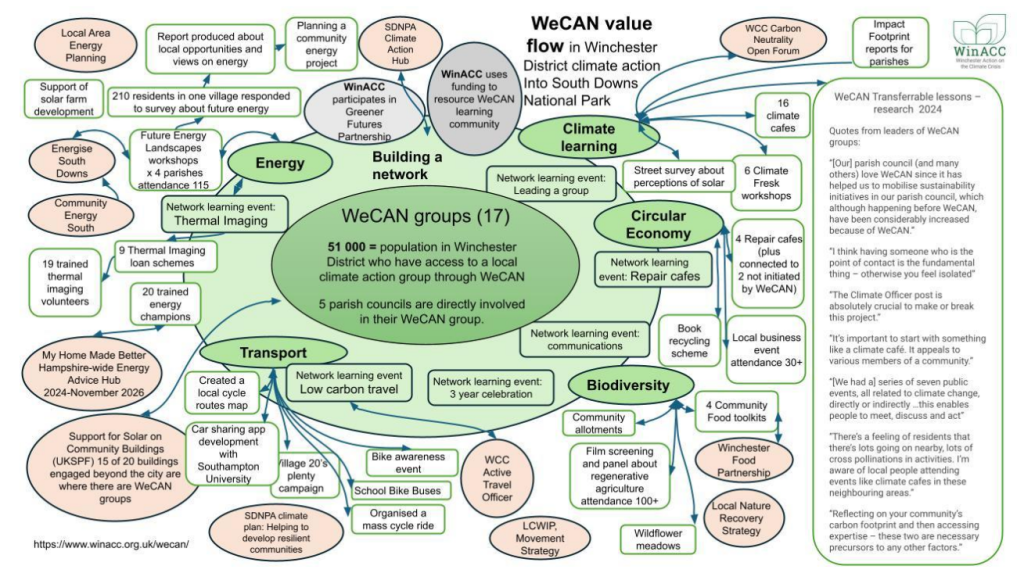
Key: White = WeCAN group activities; Green = WinACC, Grey = partnerships; Orange = organisations external to WinACC that engage with WeCAN
WeCAN lays the foundations for success for other projects.
Examples are
- UK Shared Prosperity Fund funded support for communities to install solar on community buildings
- £30,000 to WinACC for this support facilitated 9 solar installations (exceeding the target of 4), resulting in 14.7 tonnes of CO2e estimated carbon dioxide equivalent reductions as a result of support (exceeding target of 3.75 tonnes of CO2e) applications for other funding, and 29 communities seeking advice through the programme. WinACC’s success with this project was due to already having established relationships with community groups across the District.
- Future Energy Landscapes workshops preparing for Local Area Energy Planning, community energy schemes, and public support for large scale renewable energy generation.
- WinACC already works with Energise South Downs to facilitate Future Energy Landscape Workshops – 5 to date: South Wonston, Upham, Waltham Chase & Swanmore, Otterbourne and Denmead.
- WinACC’s Renewable Energy Action Group has more than a decade of experience at preparatory work linking communities, developers of large scale solar and local authority planners to support information flow before decision points.
- WeCAN will be the main route to engage people in the new retrofit advice hub, My Home Made Better https://myhomemadebetter.org/ in 2025 and 2026.
- This will support thousands of householders with retrofit queries at all levels, and train energy champions to support householders across Hampshire, Portsmouth and Southampton to reduce home energy use.
WeCAN creates a route to engagement for local authorities working on energy, active transport and other priorities. In the future, WeCAN can support the Greener Futures Partnership to facilitate collaborative projects which might open new funding streams for communities to take climate action.
WeCAN is attracting interest as a model to replicate in other places. This started with other groups in Hampshire. Now, the national Climate Coalition (which has 130 organisational members) wants to explore how learning from WeCAN might transfer to enable community engagement nationally.
WeCAN connects agents of change across organisations, giving local residents a voice to connect with positive change.
WeCAN appears to be gathering momentum as relationships are strengthened and experience grows. The findings of our research indicate that the WeCAN model is being effective in achieving the objectives intended and is therefore worth replicating in other areas. Climate action planning, advocacy and delivery is hard work. Participants’ responses show that a network like WeCAN has significant value in mutual encouragement and empowerment.
This report can be downloaded in PDF format here.
Further supplementary research is available here.