
Local Government Reorganisation is not the same as devolution. Click here to read about devolution.
Local Government Reorganisation is the abolition of county councils and district councils. New unitary councils larger than districts will take their place. All local authorities across Hampshire, Portsmouth, Southampton and the Isle of Wight, including districts as well as the county council and the current unitaries, will be combined into larger unitaries.
What will our new unitary councils be?
Judicial review?
Immediately he was appointed to be the next Leader of Hampshire County Council, at the Council Council meeitng on 21 May 2026, Cllr Nick Adams-King announced that the County Council intended to go for a judicial review of the Government’s decision on Local Government Reorganisation.
What is the County Council seeking review of?
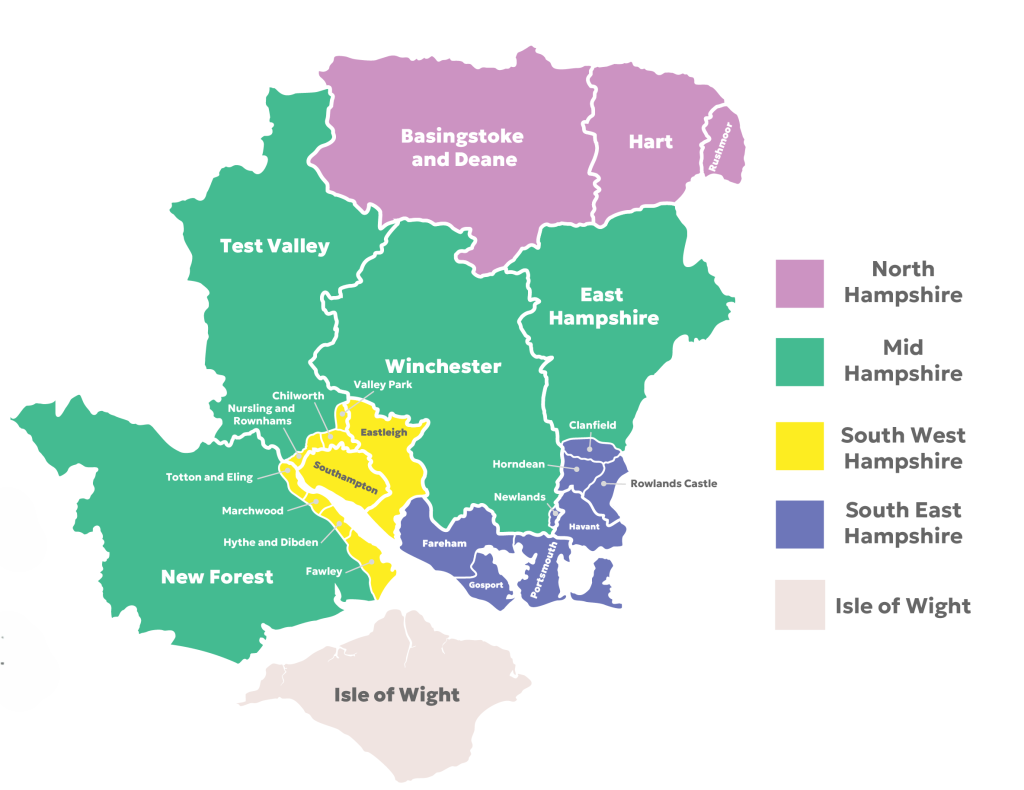
On 25 March 2026, the Government announced their decision (Govt statement in full) about the unitary councils. Unless overturned by a judicial review, the boundaries will be:
- North Hampshire Council (current local government areas of Basingstoke and Deane, Hart and Rushmoor)
- Mid Hampshire Council (current local government areas of East Hampshire, New Forest, Test Valley and Winchester, less the 11 parishes that move to SE or SW Hampshire)
- South East Hampshire Council (current local government areas of Fareham, Gosport, Havant, Portsmouth, plus the parishes of Clanfield, Horndean and Rowlands Castle from East Hampshire and Newlands parish from Winchester)
- South West Hampshire Council (current local government areas of Eastleigh, Southampton, the parishes of Totton and Eling, Marchwood, Hythe and Dibden and Fawley from the New Forest, and Chilworth, Nursling and Rownhams, and Valley Park from Test Valley
- Isle of Wight Council will remain as a separate unitary authority.
This is one of the options in the proposal for five unitary councils which was submitted by Eastleigh, Fareham, Hart, Havant, Portsmouth, Rushmoor and Southampton councils. See the full proposal, and supporting appendices. The Hampshire Chronicle website in March published a collection of comments from local bodies.
What happens next?
In May 2027, elections will appoint new Councillors to each “shadow” unitary council. These elections for new authorities in 2027 will replace any existing local elections planned.
Elections in May 2027 will appoint new Councillors to each unitary council. The first year (2027-2028) they will be “shadow” Councils/ Councillors. The unitaries will be “vested” in 2028 – ie they start to be legally responsible for services in their patch. The Unitary Councillors elected in 2027 will continue for four years. There won’t be elections again for Unitary Councillors in 2028.
Unitary Councillors will be elected all at once every four years from 2032 onwards. The system in some Districts, where one-third of the Councillors are elected each year, will end.
District and county councils will cease to exist on 31 March 2028.
Details about what the Government tells Councils to do in the lead-up to the May 2027 elections to shadow unitaries are in Local government reorganisation: implementation guidance for the first transition period
Details about what the Government tells Councils to do in the shadow year between the May 2027 election to shadow unitaries and the vesting of the new Unitary Councils on 1 April 2028 is in Local government reorganisation: implementation guidance for the second transition period
How will local people engage with the new unitaries?
The Government emphasises that it wants local people to be able to have their voice heard. How this will be arranged is not yet clear.
On one hand, there’s potential for parish and town councils to play a larger role. See more about what parish councils have been thinking nationally.
More parish / town councils may be created – for example, Winchester City Council has consulted on whether to create a Town Council for Winchester town, the only part of Winchester District which doesn’t already have its own parish council.
On the other hand, the Government is suggesting that the unitary councillors in local areas might form a committee for that area.
LGA Devolution and local government reorganisation FAQs quote the Government: “Local authorities undergoing reorganisation should develop structures that ensure all communities can have a greater say in the services that matter most to them… We expect new neighbourhood structures with a strong role for frontline ward councillors to make improvements in their local areas and to allow local people to raise the issues that matter most to them with their local authorities.” “Town and parish councils are no substitute for the effective neighbourhood governance arrangements which the government expects local authorities to implement. These should enable local people to take issues or concerns to their local ward councillors, who will have a clear and accountable route to act on them”.
How should climate community groups respond to all these changes?
See some of the thinking about how we respond, to take advantage of opportunities and reduce risks.