
WinACC has reviewed this planning application and at present neither support nor object to this application.
On this page we have:
- The WinACC response to the planning application
- Analysis of strengths of the application
- Aspects of the application challenged by WinACC and responses from the applicant
- Other matters – comment on the preapplication consultation exercise
Like many people across the Winchester district we support solar farms as an important part of the mix of renewable energy we need to generate to help prevent further pollution to our environment by the use of fossil fuels.
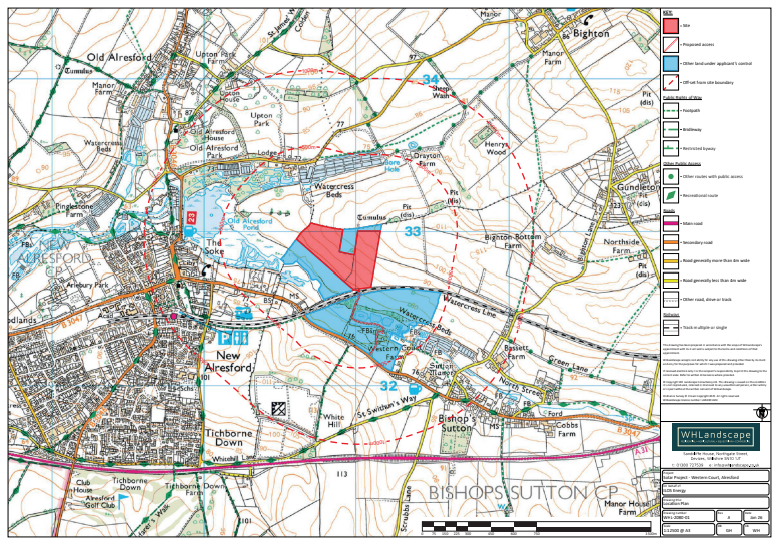
About the Solar Farm (at Western Court, New Alresford)
Solar Capacity: 5.4 MW, small scale solar farm
Land area of panels: 12.68 hectares (31 acres).
Duration: The application proposes a consent for a solar farm for a [?] year period, after which it would be removed and the land returned to its current use. Whilst this is a standard plan period, any owner of a solar farm or wind turbine/wind farm is able to apply for planning consent beyond 40 years, as that period comes to an end.
WinACC Response
This is WinACC’s response to the application. You can contact us at renewables@winacc.org.uk.
******
We currently neither support nor object to this application for this small solar farm at the proposed location though have spent much time in evaluating it, prior to arriving at our decision, for reasons evident in the following paragraphs. We would consider changing our response to one of support if the applicant is able to strengthen the case on the matter of the site selection, including possible alternatives and the specific point on agricultural land classification of the proposed site by providing further justification to support the site selection. We believe the latter point should also include testimony from the farmer to support what we understand to be significant practical encumbrances to agriculture which we understand has resulted in the land at that site, not being cultivated for crops for many years and instead used only for sheep grazing.
Our broad conclusion is that the site appears very suitable for solar production of much needed renewable electricity, in the national and global interest. There is minimal impact on visual receptors from this proposal and the nearby connection point to the national grid, enables the installation to become quickly operational in generating much needed renewable electricity.
WinACC has been engaged in dialogue with the applicant over several months where we have questioned and pointed to several shortcomings in the application documents to which the applicant has been very responsive in noting and addressing, including updating application documents to our general satisfaction, other than on the Agricultural Land Classification value of the site. On that point, we have challenged the applicant to provide further evidence to support the unusually high Land classification value of the site where 98% is agriculturally Best and Most Versatile, Grade 3a and why the encumbrances to agriculture which the applicant explained to us are significant to the extent to which this has restricted the use of the land only to sheep grazing for a period of at least the last 13 years. The consultant report which was presented by the applicant identified 98% of the land as agricultural classification BMV (Best and Most Versatile) Grade 3a which implies it has fewer limitations on its use for farming and should support a wide range of crops. However, the applicant has informed us that the farmer is very surprised at the land classification report and claims it is very difficult to use as arable farmland and, as a consequence for a period of the last 13 years has been used only as land for grazing of sheep, implying the land is considerably more encumbered in its use for agriculture than the formal land classification suggests.
On the use of agricultural land for solar farms, we are clear that National policy, including NPS EN-3 (paras 2.10.29–34) and the May 2024 Ministerial Statement, establishes a preference to avoid the use of BMV land where possible. We are also aware that Policy CN5 of the Winchester Local Plan similarly identifies the loss of BMV land as a material consideration, though does not impose an absolute prohibition on other uses. Consequently, Planning officers can exercise a balanced assessment, taking account of site-specific constraints, availability of alternatives, and the broader public benefits of renewable energy generation. In offering evidence for the balanced assessment, the applicant has offered the three following points, with which we broadly agree, that this site demonstrates that:
- There is a constrained availability of grid-connected, deliverable sites within the relevant area.
- Alternative sites of lower agricultural classification are either unavailable, technically unsuitable, or constrained by landscape, heritage, or ecological designations.
- The site benefits from proximity to grid infrastructure, reducing the need for extensive cabling and associated impacts.
We have suggested to the applicant that by providing further evidence from the farmer of this land, of the practical restriction of land use for more agriculturally beneficial arable crop production, would help to explain the basis of why land of otherwise higher productive agricultural value is being promoted as suitable for a solar farm even though the applicant suggests that opportunities for continued agricultural use (e.g. sheep grazing) will be maintained, preserving some of the agricultural productive capability. In previous solar farm applications which we have evaluated, we have not seen the proportion of Grade 3a land exceed more than 50% of the site, hence the current 98% is unusual (albeit a small acreage) and something we believe requires further explanation in order that WCC Planning Officers can reasonably exercise a balanced assessment, taking account of site-specific constraints.
——————————————————–
Analysis of the Strengths of the Application
Climate and Renewable Energy
Winchester City Council declared a Climate Emergency in 2019, with a target for district-wide carbon neutrality by 2030. National policy (NPPF December 2024 Para 168, Clean Power 2030 target) strongly supports renewable energy. The case that this development is consistent with Winchester’s own commitments is well made. The need to act with urgency is all too clear
Existing grid connection
The applicant proposes to use an existing approved Point of Connection which is an overhead power line pole on the site requiring no off-site grid works and represents a genuine practical advantage. New grid connections are a major national constraint on solar development, sometimes with several years to achieve a connection. We believe this is a legitimate differentiating factor that should be noted by the Planning Officer.
Biodiversity Net Gain
The applicant claims a net gain of +91.5% in habitat units and +12.3% in hedgerow units which substantially exceeds the mandatory 10% BNG requirement. Even if this net gain is not delivered in full, the applicant is clearly intent on making a genuinely significant ecological improvement over the baseline. We note the ecological management plan, with wildflower meadows under panels, native woodland creation, hedgerow strengthening all aligns with best practice.
No trees removed; no TPOs; no Ancient Woodland
The tree survey confirms no trees need to be removed, and it appears no Tree Preservation Orders apply, and there is no Ancient Woodland on or adjacent to the site.
Reversibility
Solar panel infrastructure is reversible, and the solar panels, frames, fencing, and substations can all be removed at the end of the 40-year life.
————————————————————-
Aspects of the application challenged by WinACC and responses from the applicant
Noise Impact Assessment: to which the applicant has provided an updated assessment which addresses errors.
Archaeological Assessment: We queried the archaeological assessment with what we determined was a small error, though we do not consider this error material enough to require a formal document update.
Flood Risk Assessment: the applicant acknowledged some administrative oversights and has committed to address drainage risk to the SSSI through the Construction Environmental Management Plan (CEMP).
Agricultural Land Use: Best and Most Versatile Land (BMV) assessed as 98% of the site. This is discussed in the introductory sections above, though where the applicant considers that, when weighed against the substantial and nationally significant benefits of renewable energy generation, including contributions to legally binding net zero targets and energy security, the use of BMV land in this instance is justified. We broadly agree with this assessment, though would welcome corroboration from the farmer that land use for arable crop production is significantly encumbered. This corroboration should include a specific point raised by the applicant that the railway tunnel providing access to the farmland is too narrow for modern combine harvesters.
Proximity of Sensitive Sites: the proximity of the Alresford Pond SSSI and River Itchen SAC is a very material factor and had not seemed to have been mentioned in several of the documents presented. We challenged the applicant as to the extent to what measures would be taken to ensure that any potential drainage risk in relation to the Alresford Pond SSSI and River Arle/Itchen system was addressed. The applicant assured us that a CEMP together with operational safeguards will be secured to ensure protection of water quality (via condition unless specifically requested prior to determination by the WCC ecologist prior to determination). We have noted this response, which seems satisfactory though no doubt the WCC ecologist will assure themselves on this matter.
Landscape and Visual Impact Assessment, LVIA: we identified that Parts 2 and 3 of the LVIA appeared to be missing. The applicant took action to correct that and provided us with those, for our ref which assisted our scrutiny and conclusion that there is minimal impact on visual receptors from this proposal.
Ecological surveys: we identified that the following protected species had not been explicitly mentioned in the survey and conclusions:
- Marsh Harrier: where we commented that it did not appear that any specific Marsh Harrier nest check condition or construction timing protocol was proposed in the application. The applicant responded to assure us that given the proximity of suitable habitat at Alresford Pond SSSI that a:
- pre-construction breeding bird checks will be undertaken.
- precautionary exclusion zone and timing restrictions will be implemented if nesting is confirmed.
- the Construction Environmental Management Plan (CEMP) will include specific measures for Schedule 1 species protection.
The applicant has assured us that these measures can be secured via management plans/conditions, which we trust that officers at WCC will ensure.
- Great Crested Newt (GCN): we observed that the planning constraints record confirms a GCN Vulnerable Occupation Area: Central Cluster designation applies to the site — one of the most sensitive GCN risk classifications, indicating a well-established local population. We queried the extent to which a dedicated GCN survey (eDNA or egg searches) was conducted and included in the documents submitted. The applicant assures us that they will clarify with their ecologists, but commented that irrespective, they are mandated to attempt to survey (subject to access being allowed by the landowner) all ponds within a 250m radius of the red line boundary.
- English Elm specimens: We observed that the Tree Survey submitted in November 2025) records two English elm specimens (T5 and T6) described as “unusual to see… of this size.” T5 is 13m tall with a 750mmstem; T6 is 9m with a 600mm stem. We observed that surviving large English elms are rare following the Dutch elm disease epidemic of the 1970s and asked why these hadn’t been flagged in the ecological assessments, given they may support bat roost features and invertebrate habitat of nature conservation interest, warranting specific protection and management provisions in the ecological management plan. The applicant has assured us that the trees will be retained and protected during construction through root protection areas and buffer zones. They further added that their potential to support bat roosts and invertebrates will be considered within the Habitat Management and Monitoring Plan (HMMP) and that long-term management and monitoring provisions will be included. The applicant also commented that this will be a conditioned point, given an HMMP is required where Biodiversity Net Gain (BNG) is involved under the Environment Act framework.
Pre-Application Consultation
We note the applicant issued ~1,312 letters issued to local residents and businesses and that they have had some engagement with local Parish Councils and local councillors and posted a Notice in Hampshire Chronicle (23 September 2025).
The applicant indicates they have placed posters at local locations; project website (live 28 Oct–28 Nov 2025), though had only one public event at Bishop’s Sutton Village Hall, Tuesday 28 October 2025, 3pm–7pm where approximately 75 attendees were said to have been in attendance. We noted that the response volumes were very low, with only 3 feedback forms from the event with only 11 total written responses being received. We note that principal concerns from respondents were the loss of land from agricultural use linked to concerns linked to food security, visual/landscape intrusion, and the countryside location being unsuitable. There were also concerns relating to construction traffic on narrow rural roads, claims of biodiversity evidence being weak, and inadequate site alternatives assessment.
At the request of WinACC, the applicant met with us in February 2026 (post-consultation, pre-application submission) and have been in periodic communication with them since then, especially concerning the documents submitted to the Planning Portal where we had several concerns which are outlined above and where the applicant has responded to our concerns and addressed these.

Join Us?
If you feel you can make a contribution to our solar farm advocacy and other energy projects, please consider joining our Renewable Energy Action Group.
We especially welcome knowledge and skills as follows:
- Technical, commercial and local planning experience of renewable technologies at small/medium scale, especially solar
- GIS software skills relevant to local area energy planning
- Event delivery and marketing
- Current and ex-parish councillors or community leaders in a position to help WinACC reach local communities for engagement with energy projects
Meetings are held every other month in Winchester, or virtually, usually on Monday evenings. Contact renewables@winacc.org.uk.