
This blog was written by Robin Speed, Chair of WinACC Scientific and Technical Advisory Panel (STAP) in June 2026.
The rapid introduction of Artificial Intelligence (AI) systems available to all has taken many people – including myself – by surprise.
One significant area of concern is the carbon footprint of AI. Not only do AI systems appear to use a lot of energy, but even simple internet queries are being channelled through AI systems reportedly using many times as much energy as previously.
This energy comes from electricity, increasing our carbon footprint and putting pressure on the electricity supply near AI data centres.
Is AI’s carbon footprint significant and if so why?
In 2020 WinACC concluded that although the use of information technology was expanding rapidly, contributing about 2% to global emissions, that technology was keeping pace in the form of improved communication technology and innovations in cloud computing.
Communication bandwidth has kept pace with movie streaming and video conferencing without big increases in carbon footprint – partly due to the magic of the glass fibre internet backbone. Also, data centres efficiently share computers using ‘virtualization’. A potential issue was seen in computation-intensive tasks such as (completely worthless) Bitcoin ‘mining’.
Since then, AI systems have been launched, and these seem to have an almost limitless need for computing power. This power is used in AI company data centres, not on the user’s computer or in the internet because usually very little data is transmitted or return.
It is suggested that United States data centres could be using around 13% of all the country’s electricity by 2028 for example. In addition, one study suggests that the energy (electricity) used by AI data centres is around 48% more carbon-intensive than (the US) average electricity supply
CarbonBrief has attempted to put this into context predicting that data centre electricity use will increase rapidly but pointing out that this is starting from a base of around 1% global electricity consumption and 0.5% of global carbon emissions in 2024.
How much energy am I using when I make an AI request?
A much-quoted MIT study has tried to quantify the energy cost of simple user queries and the AI systems that process them. Although there is considerable secrecy around these systems the authors were able to use some ‘open source’ systems to produce some broad conclusions:
- Depending on the AI model being used and the complexity of the request the energy cost can vary by a factor of thousands. Generally, the more complex the model (the number of potential factors – ‘parameters’ – it considers) the greater the energy use.
- Specific figures were 117 joules* (J) for a simple system (around 8 billion parameters), 6706 J for a system with 50 times as many parameters.
* Individually these are actually quite small amounts of energy which is why they are quoted in joules (J). To put this in context it takes around 226,000 J to boil a litre of water. There are 36 million joules in a kilowatt hour (one unit of electricity).
BestAIfor suggests around 18,000 J for an AI query using one of the commercial systems – around 17 times the energy cost of a simple Google search, or the energy used for sending 1,250 emails.
Table 1 below compares the energy use of video, google searches and AI queries using estimates. The main point is that AI is increasing the amount of electricity consumed by data centres. The energy used by the user’s device obviously depends a lot on what it is and how long it is turned on.
Table 1. Estimated energy use for video, Google and AI queries. Estimates from IEA (2020) and bestAIFor (2026). One Wh (Watt hour) is 1/1000 of a ‘unit’ on your electricity bill, or 3600 joules. The picture at the top of the table was generated using AI (ChatGPT).
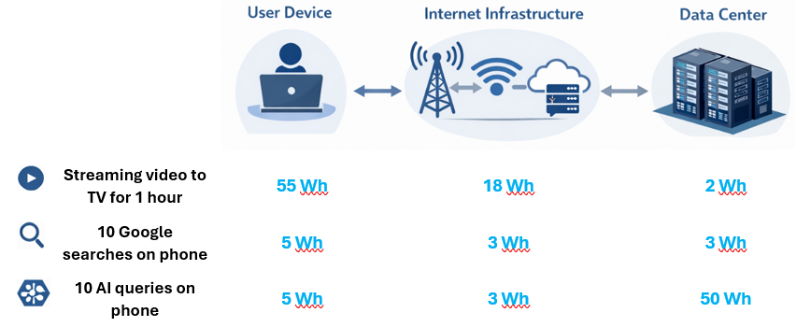
As an example of using AI the picture at the top of the table was generated by typing the following into the ChatGPT App:
“Please create a schematic showing the elements of an internet query. This should show the user’s device, the internet infrastructure and a data center. The diagram should label each element with energy consumption for a traditional query, video streaming and an AI query and use appropriate royalty-free graphics”
I then replaced the table ChatGPT made with my own table using my own figures (quicker than trying to edit the image ChatGPT created which is done by describing in English what changes you want) but retained the top of the image for the headings.
Can AI help with climate change?
While indiscriminate use of AI seems unhelpful in the contexts of emissions AI may prove useful in areas such as increasing energy efficiency, technology innovation in areas such as batteries and improving climate resilience. However, it seems likely that AI-related emissions will dwarf those it can save notwithstanding UK government optimism.
Who is paying for this?
Clearly this doesn’t cost nothing. AI companies are offering users subscriptions for enhanced functionality and to keep their queries and data private. These cost, for example, between $20 and $200 per month in the USA so by no means cheap – but don’t seem to be tied to usage. Anecdotally many workers are now being given AI accounts by their employers and are expected to use them in their work. People may come to rely on these systems and especially on their personalized usage. Nevertheless, most people are using these services for free – sometimes without really wanting them.
The electricity demand of these data centres can put a strain on local electricity grids. The apparently stalled UK pitch for AI investments seems to indicate that AI companies may expect countries to subsidize electricity for hosted AI infrastructure. A recent report says many data centres will be powered by electricity generated from gas.
How can I control my own AI carbon footprint
Because web searches or queries are done at data centres there is no direct way to know when AI is being used or how much energy they consume. The simplest solution for all would seem to be for AI companies to charge for services based on the energy they consume as well as the quality of the results. However, this doesn’t seem to be about to happen. Instead charging seems to be based more features like allowing users to keep their data or results private or providing better quality.
Many internet queries are automatically routed through AI by your search engine. If you want to turn this off, changing your search engine to one that doesn’t automatically use AI – for example to DuckDuckGo – may help. Here is the menu for doing this on my system accessed through browser settings:


If you use a direct link to a website you want to access (for example https://winacc.org.uk or any of the links in this article) this will usually not involve AI. The internet was built for these kinds of link and is incredibly efficient at accessing them. So saving a list of links you commonly refer to, or even starting to type the name of the website in your browser’s address bar and using autocomplete, can avoid AI – for example . You can then access the services you want on the site including any built-in search facilities without further AI interference.
Unfortunately, systems seem to be evolving all the time without any apparent customer input so it looks like it will be a constant battle to avoid AI.
Using AI requests more effectively may cut down the number of questions you have to ask and hence the energy required to get the answers you want. BBC bitesize for example has some suggestions and WinACC has developed some guidelines.
What now?
AI is here to stay. Greenpeace describes some of the current battlegrounds and possible threats to democracy. Many, including WinACC members and staff, already use AI in their work and day-to-day life.
Data centres supporting AI have significant potential to increase electricity prices and can cause water shortages and increase carbon emissions. There are currently around 450 large data centres in the UK and it is estimated that data centres in the UK already use 5% of total electricity and 6% in the USA It therefore seems important to scrutinize plans for new data centres.
Personally, I think engaging with AI can be very useful. However, this may also have personal downsides or forfeit opportunities for developing personal skills.
Robin Speed June 2026