
From a garden-hedge conversation to a village energy project
Broughton Community Energy (BCE) is developing a community-owned renewable energy project to cut carbon emissions, strengthen energy resilience and create lasting value for the village.
How Broughton is building local support for community-owned renewable energy
| 450 Households | £40,000 Stage 1 funding | 192 Survey responses | 90% Support for solar | 6 MW Planned solar |
The Challenge
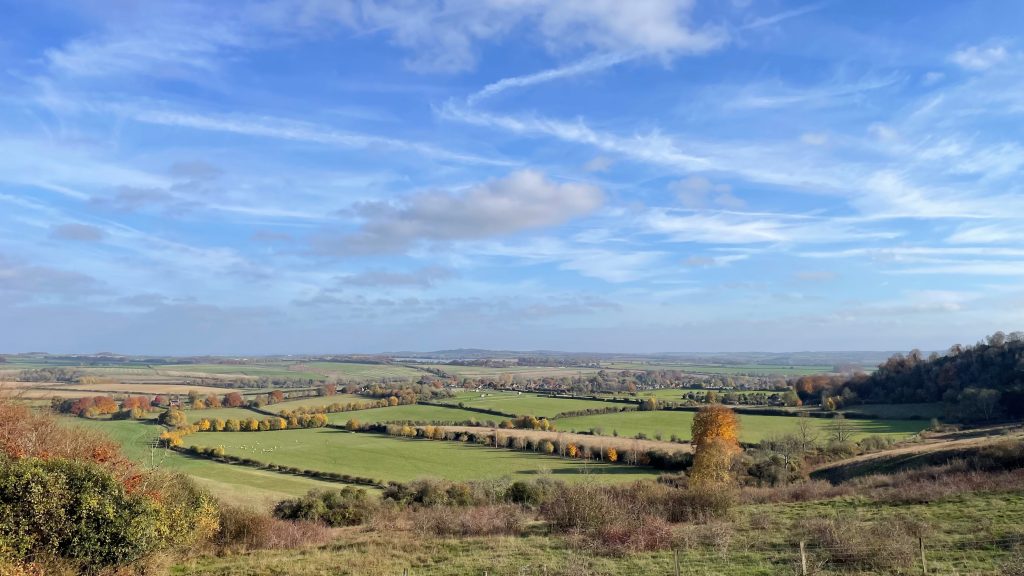
Broughton is a rural village and civil parish nestled in the Test Valley between Winchester and Salisbury. It has approximately 1,000 residents in 450 households. With no mains gas, many homes rely on heating oil or LPG, creating significant carbon emissions and exposure to volatile fuel prices.
BCE began with a conversation between neighbours over their garden hedge. One of them managed a heating oil buying group and calculated that the oil purchased over the previous seven years could fill the village hall. That striking image prompted a question: could the community work together not only to buy energy more cheaply but also to change how it is produced and used?
Turning an idea into a community project
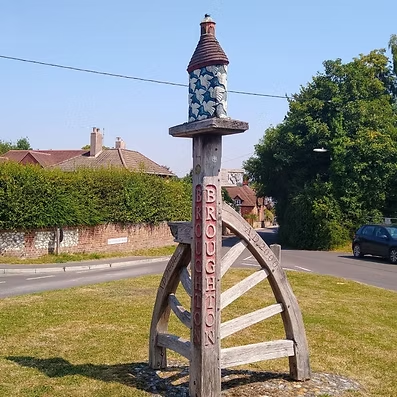
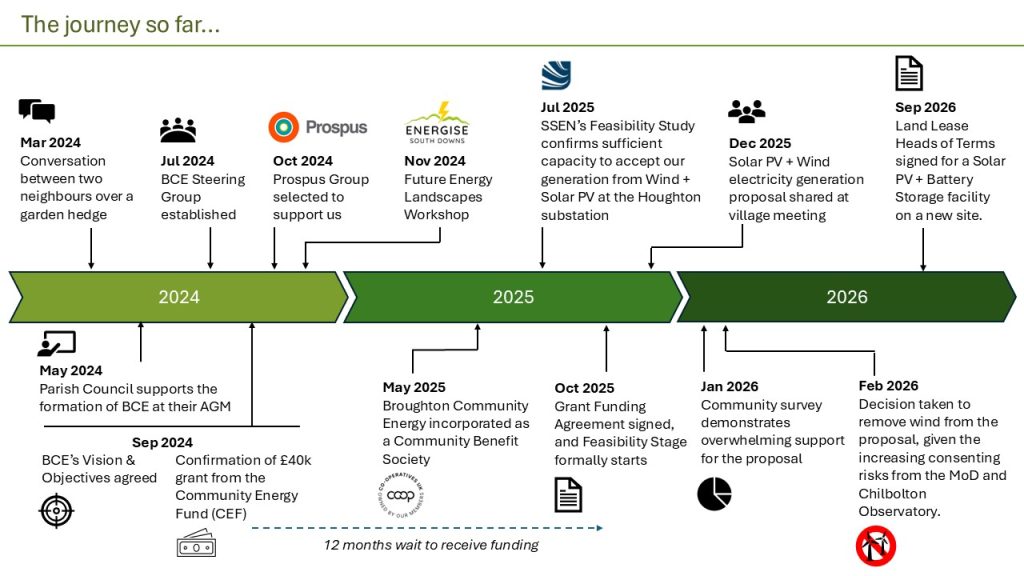
A small group of residents explored the idea, presented it at the Parish Council’s annual meeting and secured unanimous support for a working group. Two parish councillors joined the BCE Steering Group, linking the project to local democratic structures.
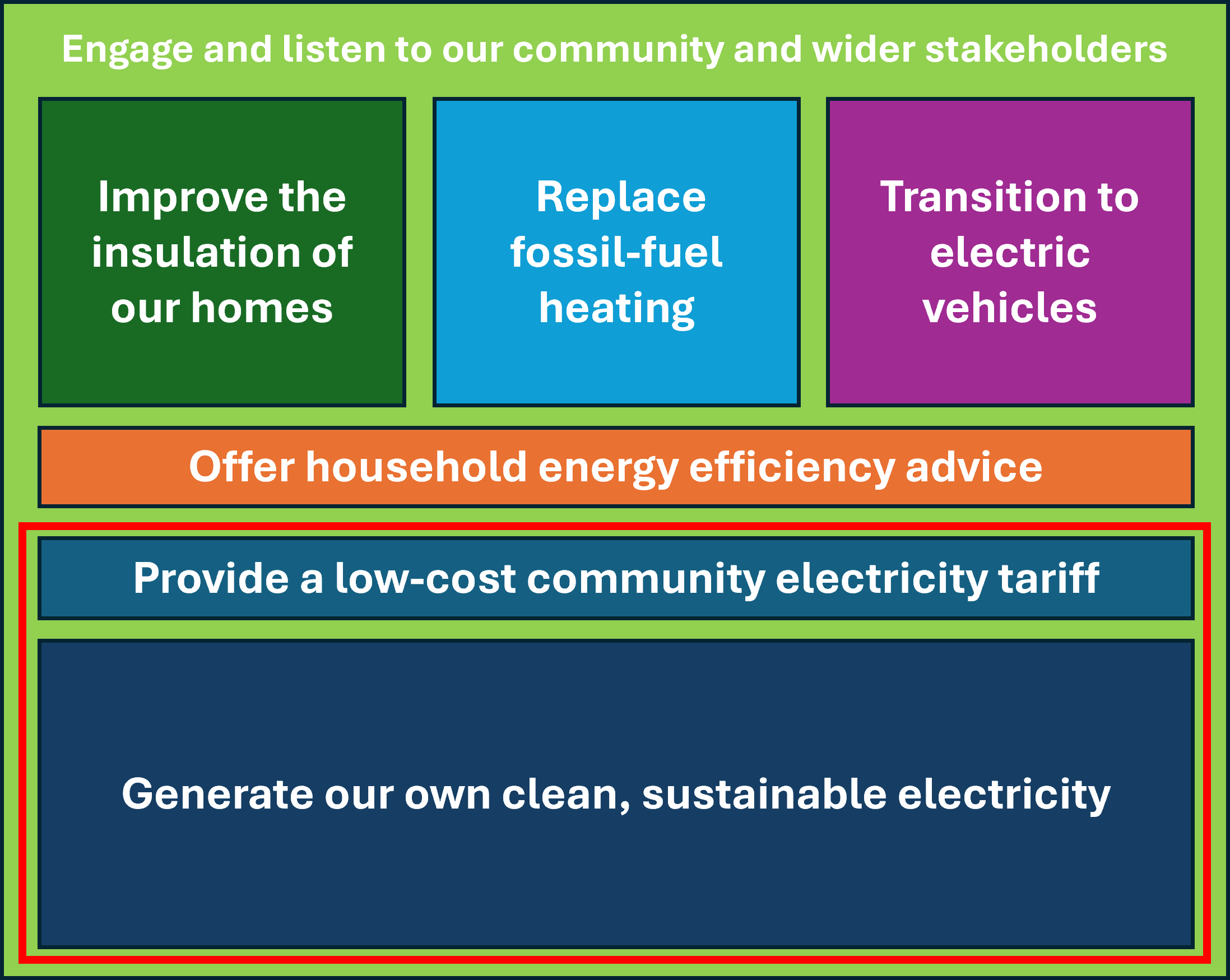
The group agreed on the vision, objectives and a high-level decarbonisation strategy. It prioritised renewable electricity generation, providing the foundation for wider action on energy efficiency, low-carbon heating and electric transport. The Parish Council also reflected BCE’s ambitions in the new Neighbourhood Plan.
Testing the opportunity
With a supportive landowner, BCE initially identified a site for a 2.3 MW wind turbine and 4 MW solar farm. Its early-stage assessment considered grid capacity, solar irradiation, wind resource and commercial potential.
Encouraging results supported an application to the Community Energy Fund. A £40,000 Stage 1 award enabled BCE to appoint Prospus Consulting to support a detailed feasibility study and to prepare a Stage 2 application.
Building informed community support
Community engagement has been a core workstream from the outset. BCE asked Energise South Downs to run a Future Energy Landscapes workshop, at which residents explored how renewable generation could fit the landscape and meet local energy needs.
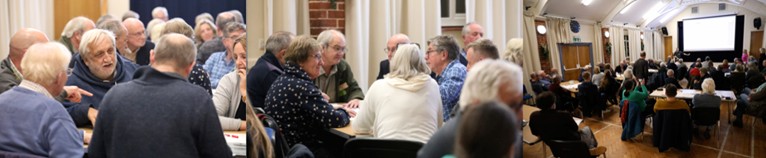
In December 2025, BCE presented its plans for clean electricity and a lower-cost community tariff at a village-hall meeting. Despite poor weather, around 40 people attended and were broadly supportive. A follow-up survey, offered online and on paper, received 192 responses: 90% supported solar and 79% supported the wind turbine.
Adapting when constraints changed
The wind proposal encountered significant constraints. Chilbolton Observatory raised concerns about effects on its radio telescope and weather observations, while the Ministry of Defence identified possible radar impacts. Consequently, a difficult decision was made to remove wind from the design to minimise the planning consent risk.
Revised modelling showed the distance of the original site from the electricity substation and the high connection costs meant it was not viable without wind. Further discussion with the landowner identified a better site for a larger, 6 MW solar farm. It is closer to the village and prospective grid connection, with limited visual impact from Broughton. The revised scheme includes 2 MWh of battery storage and a planned 5 MW export limit to avoid delays of a national impact assessment by NESO.
Creating a model for long-term community benefit
BCE has established a Community Benefit Society: a democratic, asset-locked structure able to issue community shares. During early development, the Parish Council has submitted funding applications, allowing eligible project VAT to be recovered.
The group is also exploring a local tariff so residents can share more directly in the project’s value. It would require an appropriately licensed supplier, and its design and benefits will depend on the market and regulatory arrangements in place when the scheme begins operating.
Lessons learned
- Engage the community from the outset. Early dialogue has built understanding and measurable support.
- Confirm sufficient generation grid capacity is available at the relevant substation as soon as funding is available. A formal Feasibility Study was commissioned from SSEN.
- Agree the Heads of Terms for the Land Lease and the associated costs early in the process. The Heads of Terms were more complex and time-consuming to negotiate than expected, despite the apparent support of a landowner passionate about the environment.
- Test constraints early to reduce risks and stay flexible. Removing the wind turbine changed the economics, but a viable alternative site was identified.
- Establish governance before major fundraising. The Community Benefit Society enables democratic ownership and future community investment.
- Be clear about what assumptions are being made from the outset and keep track of their validity. Grid, planning, tariff and regulatory arrangements will evolve as the project develops.
Next steps
- Sign the Heads of Terms for the Land Lease.
- Re-engage the community to gauge support for the revised proposal and new site.
- Submit a Pre-Planning Application to Test Valley Borough Council.
- Apply for £100k of Stage 2 funding from the GB Energy Community Fund.
Project documents
- Vision, Objectives, KPIs and Principles
- High-Level Decarbonisation Strategy
- Strategy Building Blocks
- Future Energy Landscapes Report
- Generation Project Stages
- BCE Wind + Solar Proposal
- Report on the Proposal Meeting
- Proposal Survey Results
Case study written September 2026.
Broughton Community Energy is part of the Hampshire & Solent Community Energy Network. Read more about the network here.