
Running right through the centre of Winchester, the River Itchen is perhaps taken for granted by many of us.
Rising from its source just south of Cheriton and running for 28 miles down to Southampton Water, this chalk river is a rare habitat, home to many at-risk species of wildlife and designated as a Site of Special Scientific Interest. The Itchen is world-famous for its watercress industry and fly fishing, and we will let go of the fact that ex-US Presidents George Bush Snr and Jimmy Carter found the angling opportunities on the River Test even more enticing. Chalk streams such as the Itchen and Test are particularly sensitive to river flows and pollution – the former being a growing concern with our increasingly volatile climate and the latter issue being investigated in a recent edition of Countryfile on BBC One.
 Dawn on the River Itchen near Shawford (credit: Andy Smale)
The Itchen, its tributaries and in particular the chalk aquifers that supply them, are important in another way – they supply drinking water to those who live and work in central Hampshire. Nationally, water supplies are coming under increasing pressure from the growth in population and climate change. Such is the level of concern that in March of this year, the chief executive of the Environment Agency said that the country was facing the “jaws of death” within 25 years, when demand is expected to start to outstrip supply.
The majority of the domestic supply for homes in the District comes from boreholes in the chalk aquifers – natural underground reservoirs of water filtered through the chalk bedrock of the Hampshire downland. The aquifers act as a buffer against short-term variations in rainfall, providing a relatively consistent flow into the Itchen, and are usually replenished with winter rainfall.
Improving the resilience of our supply
This year, however, we are facing the prospect of hosepipe bans later in the summer after a comparatively dry winter has meant that the aquifers have not been topped up as much as they typically are. Water shortages are forecast to become more frequent as the climate changes and the winter rains become less reliable. In addition, the growth in population in the region is forecast to contribute to in an increase in demand of 7% by 2040.
In recent years our local supplier, Southern Water, has introduced compulsory metering and this action, in conjunction with other water efficiency measures, has seen per-capita water use drop by 16% in seven years to around 125 litres per person per day. Southern Water has set a target for average per-capita consumption to drop to 100 litres by 2040, upping the ante for us all to do more to reduce wastage.
In its long-term plan, Southern Water also lays out options for improving the resilience of the water supply. Aside from water efficiency measures within the home, the company is looking at ways in which water can be distributed more effectively around the region. For example, constructing pipelines to move water between adjacent catchments can help with distribution when there are imbalances between availability and demand across the region. To this end, Southern Water are looking at pipelines that connect the Avon, Test, Itchen and Meon valleys, and has a shared interest with neighbouring Portsmouth Water in constructing a new storage reservoir near Rowlands Castle.
Other options being considered including the recycling of waste water directly back into the mains supply, and even the implementation of desalination technology that uses seawater rather than abstracting from our rivers. Desalination is an expensive and energy-intensive process, but may become necessary if river flows consistently drop due to lack of rainfall.
How we use our water… and how we can save more
Water leaks in the distribution network are a reality for all water companies. Southern Water loses around 33 litres per person per day through leaks in the pipes connecting our homes with the treatment works – a little under a quarter of all water supplied. Leakage is clearly undesirable, however it would be very expensive and disruptive to try and fix every single small leak, so a pragmatic level of compromise is agreed with the water regulator Ofwat, and performance against is regularly monitored.
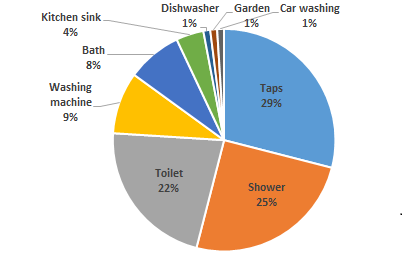 In the home, typical water use is broken down as follows:
- Taps 29%
- Shower 25%
- Toilet 22%
- Washing machine 9%
- Bath 8%
- Kitchen sink 4%
- Dishwasher 1%
- Garden 1%
- Car washing 1%
The introduction of more efficient appliances has gone a long way to reducing water consumption in recent years. The best washing machines can now use as little as 30 litres per cycle for a 5kg load, and the most water-efficient dishwashers as little as 7 litres per cycle.
Much else can be done to reduce water use without any major compromises. On a personal basis, I have consistently achieved close to the 100 litres-a-day target for many years whether as part of a family or living on my own, through the use of low-flow showers, dual-flush toilets, efficient appliances and the installation of water butts. I am now aiming to save another 30 litres a day or more by strictly following the “if it’s yellow, let it mellow” protocol for flushing the loo (a bit icky for some, maybe), and managing a two-minute shower that only uses eight litres (my resolve sometimes fails on this, especially if it’s a bit chilly…). I can go further still by watering plants with washing-up water and am looking at putting a diverter on the drainpipe to use washing machine rinse water in the same way.
In future we may all need to start reassessing our modern obsession with cleanliness if water shortages really start to bite. Most of us probably do not need to shower or bath every day, let alone wash clothes after just one wearing (underwear aside, perhaps!). Just as with household energy use, cutting our current water consumption by 50% is probably achievable if we have the will. In the meantime I guess we should all be grateful for the persistent June rain that is falling outside the office window as I type.
– Andy Smale – WinACC Energy Consultant and Technical Director, Expert Energy