
The United Nations says to limit a climate change catastrophe will ‘require rapid, far-reaching and unprecedented changes in all aspects of society’.
The 1.5C temperature rise could be exceeded in just 12 years, in 2030. We can stay below it – but it will require urgent, large-scale changes.
What’s the UK doing?
UK government
A national climate emergency was declared by the UK Parliament on 1 May 2019, the first country in the world to do so. The motion was called by Labour Party leader Jeremy Corbyn but accepted by the Conservative Government without calling for a vote.
Theresa May, in one of her last acts as prime minister, has now made a commitment to reach net zero carbon emissions by 2050. The 2050 net zero target was made legally binding by an amendment to the Climate Change Act 2008, replacing the previous target to reduce carbon emissions by 80% (compared to 1990 levels) by 2050. This makes Britain the first large economy to legislate for 2050 net zero.
What’s been happening at a local level?
On 22 June 2019, Climate Emergency’s website listed 89 “first tier” Councils (unitary, county, and metropolitan) and “second tier” (district and borough) who’ve declared a ‘Climate Emergency’. 60 of these have set a target date by 2030, 21 haven’t yet set a date, and 8 are aiming for zero carbon by 2050. They represent many different political standpoints, demonstrating that the climate is too important for party politics.
Hampshire County Council
Hampshire County Council Cabinet on 17 June 2019 declared a climate emergency. The new Conservative Leader of the Council, Keith Mans, committed to establishing a clear action plan, working with partners, businesses and communities “to establish effective ways action can be taken and results can be realised”.
Speakers from WinACC, Hampshire Climate Action Network, Friends of the Earth and Extinction Rebellion all spoke in support, with many suggestions of practical actions that the County Council could do quickly.
Watch the presentations and discussion, and see the news release.
Cllr Mans didn’t set a date to make Hampshire carbon neutral, nor did he agree the six month deadline to report to full Council on the immediate actions the Council will take to address this emergency”, as the original motion asked.
Cabinet reports to full Council on 18 July at 10.00. Look out on social media to hear whether activists will be there to ask for a stronger position, and a 2030 target date.
Winchester City Council
Winchester City Council declared a climate emergency on 5 June 2019. The new Lib-Dem administration brought the proposal forward. WinACC, Friends of the Earth Winchester and Extinction Rebellion Winchester spoke in support, as did speakers from the Conservative party (which lost control of the City Council in the May election). See the City Council news release and watch the Council leader’s video.
The City Council set a target for Winchester District of 2030, while aiming to make itself carbon neutral by 2024. An action plan, setting out how this will be achieved, will follow the declaration.
Winchester Friends of the Earth presented a petition with 598 signatures to Winchester City Council on 26 June at 7pm.– see full text. Some of their demands have already been met, but they also call upon the Council to:
- Establish a Citizens’ Assembly to promote dialogue and generate ideas, including school and college students.
- End Council investment in fossil fuel companies.
- Ensure all Council suppliers reduce their carbon footprint.
- Call on the UK Government to provide the necessary powers and resources to enable the Council to achieve their climate objectives.
Net zero, ok – but when by?
Many demand that the UK must enact legally binding policies to reduce greenhouse gas emissions to net zero more quickly than 2050. Many argue for a 2030 target deadline, while Extinction Rebellion and others want 2025.
Two-thirds of the declarations by local Councils are aiming for 2030 (including Winchester City Council); less than one in ten is aiming for zero carbon by 2050, the rest (like Hampshire County Council) haven’t set a date.
Is a closer target realistic?
I think that’s not a question that campaigners need to answer.
It’s the job of politicians to work out how to do what’s needed to keep below 1.5 degrees of heating. It’s the job of activists to motivate politicians and hold them to account.
It’s important to show that there are votes in tackling the climate crisis.
Politicians tend to focus on what is politically possible to do, rather than what need to be done. So we activists need to demonstrate that ordinary people want politicians to act.
Studies have shown that politicians tend to underestimate voters’ desire for action. For example, seven in ten people believe Britain needs to cut its carbon emissions to zero far faster that the Government target of 2050. Nearly 70% of British people want urgent political action to according to research by the Climate Coalition .
Is a closer target possible to achieve?
What does “possible” mean?
Yes, it’s, scientifically possible.
“Possible “without reducing consumption – no.
Possible without losing votes? That depends on us.
Politicians often fear that if they set a target and fail to meet it, they will be attacked. I ask: what’s better? Set a challenge that needs to be met, focus all your efforts on it, and risk getting only 90% done? Or set a challenge that’s too small, and congratulate yourself for achieving it 100%
Remember Kennedy setting an “unrealistic” target to get to the moon.
Should a Citizens Assembly decide what to do?
On 20 June, six select committees of the House of Commons announced plans to hold a Citizens’ Assembly on combating the climate emergency.
So far, neither Winchester City Council nor Hampshire County Council has decided to set up a Citizens Assembly, though both have said they want to work with local people and partners.
What is a Citizens Assembly?
They are used to tackle important issues where opinions vary widely. Their supporters argue that people can be trusted to make thoughtful decisions if they are given time to think, consider expert evidence, and listen to opposing views. Back in the 1980s, Oregon Health Decisions used a citizen-based approach to resolve problems about autonomy, equity, and cost in health provision. In Ireland, a citizens’ assembly was established in 2016. The impact of its conclusions on abortion is often quoted as significant. It also addressed climate change. This led via a Joint Committee on Climate Action to the declaration by the Dáil of a climate and biodiversity emergency in 2019, [followed by a government action plan.
Marcin Gerwin, a specialist in sustainable development and deliberative democracy who has coordinated citizens’ assemblies in Gdansk, suggests basic standards for Citizens’ Assemblies.
Of these, I think the most important are:
- Random selection – all members of a Citizens’ Assembly are selected by lot (“sortition”).
- Demographic representation– the Citizens’ Assembly should broadly match the demographic profile of the community, such as age, gender, ethnicity, geographic area, etc.
- Inclusion of the widest possiblerange of perspectives, and openness – everyone should be able to provide input to the Citizens’ Assembly. It can also invite experts of its choice.
- Sufficient time for reflection and discussions which include listening to others mindfully and weighing options.
The Commons plan is for a Citizens Assembly that suggests the pathway to net zero carbon emissions by 2050. Many feel this is too late. Why not ask assembly to decide the target date themselves, based on the latest science and expert opinion?
In addition, the suggested assembly does not have any powers, so people fear the Government will ignore its advice and conclusions. To build trust, Government must be led by the decisions of the assembly. “It would be a shame if the voices of ordinary people were only ever used cynically to legitimise the Government’s unambitious targets”, as this view was summed up by Extinction Rebellion.
So what should each of us do now?
Should we panic? No. But because it won’t help, not because it isn’t very frightening.
Should we be sad? Absolutely. Humans have destroyed so much of the wonderful life around us, and there will be more extinctions to come. But don’t let grieving be an excuse for inaction. Use your grief to energise you to act.
Should we give up? There’s no point in giving up. Maybe it’s too late, maybe it isn’t, but wouldn’t you prefer to go down fighting?
Should we feel guilty? No. It isn’t our fault. It isn’t anyone’s fault.
The internet, newspapers, the websites of environmental organisations, publish story after story after story about “what you can do about climate change.” Change your lightbulbs. Bring reusable bags. Cut back on meat.
It’s preposterous to think that this enormous, existential problem could have been fixed if we just tweaked our consumption. Climate change could never have been fixed by ordering a less take-aways, using fewer plastic bags, turning off more lights or planting a few trees.
The vast majority of global greenhouse gas emissions come from just a handful of corporations — aided and abetted by the world’s most powerful governments.
Don’t let them make you carry the guilt of the oil and gas industry’s crimes, powerfully explained in this blog I work in the environmental movement. I don’t care if you recycle.
So what can we do?
- Think before you act. Use your energy on what will make the most difference.
- Hold the true culprits accountable.
- Push for action by people with power – Councils, Government, and business.
These are my top suggestions on business:
- Take your savings and your pension out of any institution that invests in fossil fuels – writing to them first to tell them you will unless they disinvest (if you are in Hampshire Pension Fund email me at chris.hollaway@winacc.org.uk – a group of us are pressing them to divest from fossil fuel).
- Better still, turn up at the organisation’s AGM and tell them to put their money into renewable energy instead.
- Join campaigns against fossil fuel sponsorship of the arts (BP sponsors the British Museum National Opera House, RSC Mark Rylance resigns from RSC over BP sponsorship and the National Portrait Gallery’s Portrait Award – exhibited at Winchester Discovery Centre to 26 June 2019
These are my top suggestions on politicians:
- Show national politicians that they’ll get more votes if they act on the climate crisis.
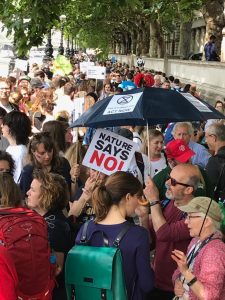
- Join campaigns such as the recent ‘The Time is Now’ mass lobby of MPs. Over 12,000 people went to Parliament on 26 June to tell MPs take action for our climate and environment.
- Attend rally’s such as the one outside HCC Full Council meeting on 18 July
- Show local politicians that they’ll get more votes if they act on the climate crisis.
- Email your Winchester City Councillor to welcome the declaration.
- Ask them to involve us all in deciding what to do in Winchester – a Citizens Assembly seems a good mechanism.
- Campaign for central government to take these 10 steps to zero-carbon:
- Set a zero net emissions target of 2030
- Stop all fracking
- Stop all new coal-mining
- Give tax breaks to renewable energy, not fossil full companies
- Support large-scale renewable schemes such as onshore wind, and over-rule NIMBY local objections to local renewable energy schemes
- Spend not a penny more on air travel – no new runways anywhere
- Invest in electrifying the railway, Increase tax on petrol and stop spending on private cars – transport causes about half the UK emissions
- Work with farmers to cut the carbon footprint of agriculture, encourage wild-life and plant more trees
- invest in making existing housing carbon-neutral, with much better insulation
- Require all new buildings to be zero-carbon
Chris Holloway