
Blog series ’15 minute checks’.
We may all be finding ourselves spending more time than usual in our homes, and you might find yourself doing those projects around the house that you don’t ordinarily have time for.
In Winchester, our homes are a major source of the carbon emissions that contribute to the climate crisis as shown by our annual greenhouse gas emissions report. We’d like to share a series of quick ’15 minute checks’ that we can all take at home to help make our homes as energy efficient as possible, and therefore having the least impact on climate change.
These ’15 minute checks’ can be carried out by anyone living in a property, whether you are a renter, landlord or homeowner. These should also save you money, alongside making your home more energy efficient. If you have any comments or questions regarding any of these blogs please email us at contactus@winacc.org.uk and we’ll do our best to answer them.
Checking for draughts
Draughts arise wherever there is a hole or gap in the external ‘envelope’ of a home.
Like heat loss, mentioned in an earlier blog, draughts can appear from any direction, from above, below or sideways (through the walls).
If there is at least a small difference in air pressure between the inside and outside of a house, for example when there is a gust of wind or even a steady breeze, draughts are likely to be created. These draughts allow cold or cooler air to enter your home.
Of course, it is important that the indoor air gets changed regularly, to stop condensation and the build-up of damp, but this can be done in a controlled way with a small number of fans.
How can you find out where the draughts in your home are? Well, the wet back of your hand can work well (the draught will cause the water to evaporate and cool your skin) or try using a tea or night light candle and watch out for flickering of the flame in a draught (taking great care with the flame).
Let’s start with the outside walls. Perhaps the most likely and obvious source of draughts in an older house is fireplaces. If you don’t use your fireplace regularly then you have a choice of either blocking off the chimney permanently, in which case you’ll need a builder, or else you can block the flue with an inflatable ‘balloon’ which can be removed later if you wish.
A central heating boiler won’t cause drafts because the flue actually contains two pipes, one to let in air to aid burning of the fuel and the other to allow burnt gases to escape.
The other place to find drafts in a wall is badly fitting windows and outside doors. Here taking a careful look, plus feeling for draughts around window frames and the gaps around doors, should be all you need to do. Make a note of where the draughts are for later attention when life returns to normal.
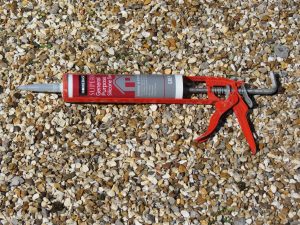
There are many draught-proofing products on the market which can be used on doors and windows. If you find a draught from around the edge of a window, or even a door frame, this can be treated by injecting proprietary filler with a caulk gun.
Another very common source of draughts is letter boxes.
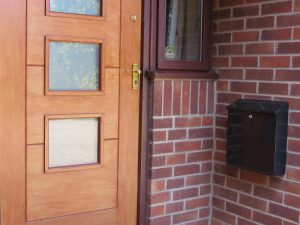
It seems illogical to me to spend money on a well insulated front door and then to cut a hole in it to fit a letter box, simply because I have yet to find a practical letterbox that doesn’t leak air. The answer, if you already have a letter box opening in your front door is to block it off, buy a wall mountable mailbox and install it just outside the door.
A similar problem arises with cat-flaps but if you are attached to your moggie there is no obvious solution.
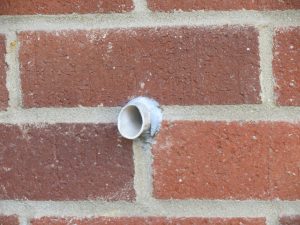
Finally, you may find that there are gaps around pipes or even wires that penetrate an outside wall. This is another case for the judicious use of the caulk gun, if possible use it both inside and out, to close off the gap.
Some, mostly older, houses have suspended wooden floors. These floors have a void (empty) space beneath them which you can spot by walking round the outside and looking for air bricks or air vents just below the damp proof course. Clearly, if the planks of the wooden floor have moved away from the walls, or shrunk leaving gaps between them, you can have a serious source of draughts. The remedy will depend on the size of the gaps and whether you plan to insulate under the planks at the same time. Just laying a carpet over the wooden floor may not be sufficient, the underside of the carpet will feel cold. Don’t, under any circumstances, block off the air vents.
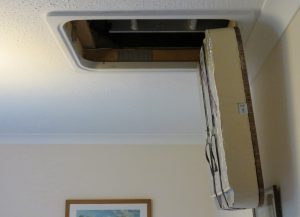
Lastly, we should consider draughts from above. A starting point is checking for draughts around the edges of hatch(es) that allow you to enter a loft space. If you find a draught there may be several options to block it, possibly using some of the products designed for windows and doors. Ceiling light fittings under the attic are also potential sources of draughts if they have not been fitted with care. Another use for the caulk gun perhaps.
You may not be able to stop your draughts immediately but these quick checks will help you draw up a list of jobs for attention when life returns to normal.
Bob Whitmarsh
More information at https://lowcarbonhousehold.weebly.com/
All profits from sales of Bob’s book goes to WinACC.
These blogs are written in good faith and the author/WinACC cannot be responsible for the consequences of following the advice offered. If in doubt get professional advice