
Blog series ’15 minute checks’.
We may all be finding ourselves spending more time than usual in our homes, and you might find yourself doing those projects around the house that you don’t ordinarily have time for.
In Winchester, our homes are a major source of the carbon emissions that contribute to the climate crisis as shown by our annual greenhouse gas emissions report. We’d like to share a series of quick ’15 minute checks’ that we can all take at home to help make our homes as energy efficient as possible, and therefore having the least impact on climate change.
These ’15 minute checks’ can be carried out by anyone living in a property, whether you are a renter, landlord or homeowner. These should also save you money, alongside making your home more energy efficient. If you have any comments or questions regarding any of these blogs please email us at contactus@winacc.org.uk and we’ll do our best to answer them.
A quick check of your indoor lighting
Indoor lighting is an often overlooked but essential part of modern life. We tend to ignore our light bulbs and only replace them when they fail. But in fact it is worth taking 15 minutes to review all the light bulbs in your home because, by replacing the least efficient, you can save money on your electricity bills and energy too. Take care if you have to stand on a chair or stool and get someone to help you if need be.
There are three main sorts of light bulb. The first is the filament or incandescent bulb. This took over from the candle around the middle of the nineteenth century but their sale has been banned in the UK since 2012. They were very inefficient and had relatively short lifetimes; some of them may have contributed more to heating than to lighting! So, if you find any of these bulbs in your home, either in use or lurking in a dusty cupboard somewhere, they are not worth keeping.
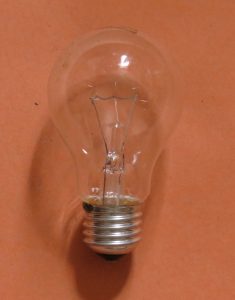
Halogen bulbs are similar and are well worth replacing too. Today there are many much better alternatives as we’ll see.
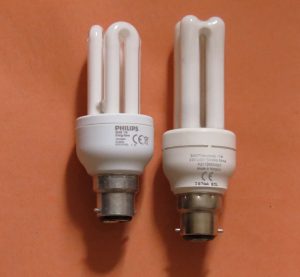
The second sort of light bulb is a descendant of the strip light still found in many buildings (actually modern strip lights are quite efficient). These are sometimes called fluorescent tubes because the inside of the tube is coated with a chemical called phosphor. This glows, or lights up, when excited by ultraviolet light produced by the electrodes inside the tube. By shortening and twisting or bending the glass envelope of the bulb so-called compact fluorescent lamps, known as CFLs, were created which approximated the size of the old incandescent bulbs. However, CFLs are much more efficient, by four to five times, and last longer, maybe 10,000 hours (that’s nine years at three hours
a day)! These bulbs also contain mercury which will escape into the air if the glass bulb is broken.
This brings us to the latest type of light bulb called a light-emitting diode or LED. They have a life- expectancy of 50,000 hours which, at three hours per day, would last over 45 years! The Energy Saving Trust says that “LEDs are available to fit most fittings and are particularly good for replacing spotlights and dimmable lights, they are more efficient than CFLs and will save you more money in the long term. By replacing all bulbs in your home with LED alternatives, you could save about £35 a year on your electricity bills.” LEDs also exist as alternatives to ceiling lights. Need I say more?
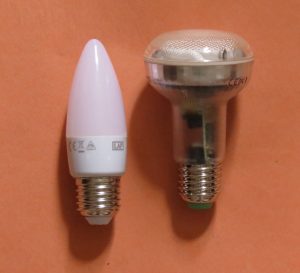
Well, one more thing, LEDs are also safer than CFLs because they don’t contain mercury.
So, now’s the time to briefly check your light bulbs especially in the rooms or spaces where lights are used the most. Today (5 May 2020) many hardware stores have re-opened after lockdown so you could even go out and buy some LED light bulbs right now.
One last thought, it is even easier to save energy by always turning off the lights as you leave an empty room. However, in the long run, it makes sense to update all your bulbs to LEDs.
Bob Whitmarsh
More information at https://lowcarbonhousehold.weebly.com/
All profits from sales of Bob’s book goes to WinACC.
These blogs are written in good faith and the author/WinACC cannot be responsible for the consequences of following the advice offered. If in doubt get professional advice