
This page explains why WinACC supports high quality planning applications for solar farms in Winchester District. We also offer answers to your common concerns.
We encourage you to consider supporting new applications.
Reasons to support solar farms
Solar farms offer an solution during challenging times for climate action. They do not require public funding; they don’t effect our lifestyle, and they deliver clean, renewable energy quickly with carbon-saving results fast.
We have several solar farm applications currently in our District’s planning pipeline.
Every 100 megawatts of new solar farm capacity installed in Winchester District produces about 18% of the District’s total electricity consumption.*
Subject to the detail of each planning application, these are WinACC’s principal reasons for supporting solar farms:
- a rapid increase in UK-based solar and wind energy generation is part of the solution to the current energy crisis and the unaffordable price of electricity
- The City Council’s Carbon Neutrality Action Plan 2020-2030 includes “large scale renewable generation project(s), eg. solar farms” within its scope
- The UK government’s British Energy Security Strategy envisages a fivefold increase in solar capacity by 2035. Located in the warm south, Winchester District has an obligation to deliver its fair share
- A solar farm provides significant public benefits by quickly and substantially contributing to local and national climate plans without requiring capital costs from the local authority or central government. Additionally, the local authority gains a substantial boost in business rates.
- In a climate emergency, it’s time to generate our fair share of electricity, especially in a District where household carbon footprints are significantly above the national average
* assuming a load factor of 11.7% and based on the District’s domestic and commercial electricity consumption in 2021
Answering your concerns about Solar Farms
We’ve looked at the concerns raised in response to planning applications for solar farms and tried to address them here. We also recommend two publications by Solar Energy UK, the trade association for the solar industry:
Everything Under the Sun: The facts about solar energy – a briefing that addresses misconceptions about solar farms
Solar Farms: 11 Commitments – best practice guidance observed by solar farm developers who are members of Solar Energy UK
Will the views from our public footpaths and roads be spoiled?
Rural communities should be reassured that planning regulations, both national and local, fulfil a brief to protect visual amenity (how the landscape looks).

Solar farm sites must be well-screened by natural contours and vegetation (planting). The local planning authority will almost certainly require a Landscape and Visual Impact Assessment (LVIA) to be submitted with a solar farm application.
These assessments are compiled in accordance with professional guidelines. They will define a series of specific viewpoints, ranging from a footpath within the site to distant vantage spots. A structured methodology evaluates the impact of the solar farm on the visual amenity of each of these viewpoints, both initially and after a period of years. The assessment is likely to be supported with maps, photographs and photomontages.
The LVIA will then describe the measures to be taken to mitigate any harm to visual amenity. These may include planting of hedges, coppice and trees, and careful siting of the solar panels. And there should be reassurances that the screening benefits of existing vegetation and trees will be preserved.
A solar farm within the South Downs National Park is extremely unlikely to receive planning approval. The Park overlaps with about 40% of the area of Winchester District.
Shouldn’t farmland be used for farming?
Solar Energy UK has calculated that the amount of land required to meet the solar contribution to UK net zero by 2050 is less than the land currently occupied by golf courses.
The UK farm economy is particularly vulnerable. Leasing land for a solar farm provides farmers with a stable, long-term revenue stream, reducing the risk from volatile crop yields and prices, particularly those impacted by extreme weather events.
Solar farms are temporary structures, typically 30-40 years. There is no permanent loss of farmland. Indeed, many solar sites fulfil a dual role through seasonal grazing of sheep and other livestock.
National planning guidance for solar farms stipulates that any use of high quality farming land – called “Best and Most Versatile Agricultural Land” (defined as Grades 1, 2 and 3a) for solar farms must be justified by submitting a detailed report identifying and assessing alternative sites nearby.
In Winchester “most of the (open arable) agricultural land is grade 3,” according to the 2022 Landscape Character Assessment for Winchester City Council. Farming on low grade land can cause issues which have been identified as:
- increased risk of soil erosion resulting form exposed shallow soils and prolonged periods of arable cultivation
- harm to water quality and aquifers through the effects of run-off from agricultural pollutants including nitrate leaching
- low biodiversity value of land through widespread use of fertilisers, herbicides and pesticides
- loss of hedgerow and tree cover
Run-off pollution of our rare chalk streams is a recurring concern. The fields that we prize for their contribution to scenic views are not always as green as they seem.
For more information about the relationship between solar farms and food security, visit Solar farms: win-win for farmers, food and energy and watch this video.
Will wildlife and biodiversity be harmed?
Although it seems counter-intuitive, a solar farm will almost certainly enhance local habitat, for both passive and proactive reasons. The land is rested from the normal cycle of intensive farming. The long term degradation of soil and biodiversity described in the Landscape Character Assessment (above) will be halted for a generation.
The Winchester District Local Plan sets out its expectation that developments will deliver a net gain in biodiversity. Recent legislation stipulates that this net gain must be at least 10%, a threshold that solar farms should comfortably exceed.
Solar farm applications must therefore submit a biodiversity management plan that quantifies improvements and demonstrates how they will be achieved. Typically, measures will include installing bird boxes, selective seeding of grasses and wild flowers, and reinforcing hedgerows and wetlands.
The Natural Capital Value of Solar, from Solar Energy UK
Biodiversity Guidance for Solar Developments, from BRE
As industrial developments, shouldn’t solar farms be built on brownfield sites?
Owners of brownfield sites are more interested in housing development than a solar farm, for strong financial reasons. There is intense pressure on land for housing in Winchester District, as central government raises quota expectations. This pressure draws attention to brownfield sites for housing, increasing their value still further.
The City Council’s Brownfield Register 2022 contains 23 addresses, all of which are earmarked for residential development and all of which are too small to be viable for private sector investment, in current market conditions.
In its projections of future solar capacity, Solar Energy UK (representing the solar trade) does not recognise a separate category for brownfield sites.
Why can’t solar panels be put on buildings instead?
Roof-top solar installation features in all projections of renewable energy and should be strongly encouraged. But not as a substitute for solar farms.
The economies of scale in purchasing materials and professional services for solar farms are extreme in relation to rooftop solar. This explains why private capital is currently driving an unprecedented pipeline of solar farm applications.
By contrast domestic rooftop solar is unaffordable without subsidy for the vast majority of homeowners. The government shows little inclination to provide subsidy for this sector on any meaningful scale. Financial models for commercial rooftops are more promising but are currently unviable unless the business consumes most or all of the electricity generated by the installation. Relatively few businesses are in this position.
A 2019 report for SSEN estimated that rooftop solar for the City of Southampton would reach total capacity of 36MW by 2032, on its most optimistic assumptions. A single solar farm can exceed that capacity.
For example, the medium-sized 25 MW solar farm recently operational at Christmas Hill in Headbourne Worthy parish comfortably exceeds the capacity of Winchester District’s entire portfolio of rooftop solar (16 MW) developed over the last 20 years.
Will promises made by the developer be fulfilled?
Maintenance standards of some early generation solar farms have prompted concern about the implementation of planning conditions, in particular that the site will be cleared and returned to its original land use when the operational lifespan of the solar farm is complete.
The two solar farms most recently approved in Winchester District are both subject to several pages of planning conditions. Both begin with a condition which records the agreed period of operation (35 and 40 years) and stipulates that a “decommissioning plan” must be submitted for approval by the local authority on expiry of this period. There is also a “catch-all” clause which commits the development to be consistent with the content of key documents submitted in the application.
These planning conditions are published on an open platform. According to government guidelines, any failure to comply “constitutes a breach of planning control against which enforcement action may be taken.” These guidelines make it clear that responsibility for enforcement lies with the local authority.
For certain requirements, the authority may strengthen a planning condition by executing a deed, known as a Section 106 agreement. For the solar farm at Locks Farm, Bishop’s Waltham, a Section 106 agreement has been executed between the City Council, landowner and developer, in relation to the long term implementation of the landscape ecological management plan.
What about the impact on the climate of manufacturing the solar panels, and what happens to them when they stop being used?
Life carbon assessment (the carbon emissions resulting from the materials, construction and the use of a product over its entire life, including its demolition and disposal) is important for all industrial products and developments, and solar farm installations are no exception.
Solar Energy UK puts the average carbon payback period for manufacturing solar panels at 1-4 years, a small fraction of their operational life expectancy which now stretches up to 40 years.
In operation, solar panels generate electricity with no moving parts, no emission of pollutants, and no residue waste. The action of sunlight on the panels is soundless and any electromagnetic radiation is far below levels that might be regarded as cause for concern. If the land beneath the panels is given a rest from farming, regeneration of the soil will capture carbon from the atmosphere.
The inverters that convert the solar energy into current suitable for feeding into the grid do create a humming sound, as does battery storage installation that is included in some plans. Studies have shown that these sounds do not exceed background noise levels beyond distances appropriate to the scale of a solar farm.
The UK has established capacity for recycling solar panels. Typical components are all suitable for recycling and reuse, apart from the encapsulant (a thin layer of protective coating).
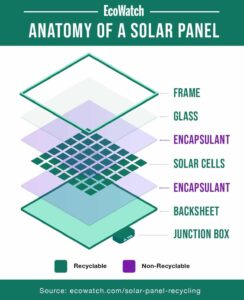
Solar panel life carbon assessment is the subject of frequent scientific reports, often with diverging conclusions. The topic is included in periodic reviews by the Intergovernmental Panel on Climate Change which continues to endorse solar photovoltaic technology as a vital contributor to the global transition to clean electricity.
Will our community be consulted?
Solar farm developers who are members of Solar Energy UK are expected to comply with its guidance for good practice. This includes an approach to the local community in advance of submitting a planning application, listening to concerns and suggestions, with an open mind to amending plans in order to secure local support.
WinACC is unlikely to support a planning application which overlooks this guidance, ideally through a village hall presentation of the plans, interactive online content and meeting the parish council.
Can we keep control of energy produced on land in our community?
Energy produced by a solar farm is normally fed into the national grid and sold by the developer on whatever terms it can negotiate, possibly packaged up with other solar farms that it controls.
The local community is unlikely to be in a position to influence these transactions. The developer has committed many millions of pounds to the investment and carries all the business risks involved.
There are smaller models of ground and roof-based solar pv which are within the scope of local ownership. Where it’s possible to share ownership through a cooperative “community energy” structure, the model creates investment opportunities for local households, alongside the potential to reinvest profits in community facilities.
WinACC encourages parishes to explore ideas for community solar projects, to operate in parallel with the solar farm model. We also encourage community discussion with developers of solar farms to explore whether there are ways in which the larger project can support the smaller. It may also be possible to negotiate a donation to a parish community fund, upfront or annually over the term.
Can we depend on intermittent solar energy?
The uneven supply of some renewable technologies is a challenge that the national grid is resolving through energy storage and development of carbon capture solutions.
The UK Climate Change Committee has sufficient confidence in the combination of these technologies to recommend that UK electricity production should be zero carbon by 2035, despite anticipating an increase in electricity demand of 50% by that date.
Why do we need solar if the UK government is so committed to offshore wind?
It is true that a former Prime Minister recently promised: “in ten years’ time, offshore wind will be powering every home in the country.” But powering every home represents only a fraction of total demand, omitting requirements of manufacturing and service industries, public sector, electric transport and agriculture.
The UK’s 6th Carbon Budget, published in December 2020 by the Climate Change Committee, recommends that new solar capacity should expand over the next decade at a rate similar to offshore wind, on average 3 gigawatts per annum.
How to Comment (support or object) on a solar farm planning application
- Go to the City Council’s Planning home page and Log In (Register first, if you haven’t already done so)
- Enter the Planning Reference Number in the search box.
- Click on Comments, and post your comment in the text box as directed