
Net Zero
It’s a phrase that we’ve all heard of and its recent ubiquity in public conversation about climate change even led it to be named one of 2020’s Words of the Year. But what does “Net Zero” actually mean? And why is it so important? If you’re unsure or confused about the term and some of the language that surrounds it then we’re here to help.
Let’s start with a definition from Oxford University’s Oxford Net Zero initiative: Net zero refers to a state in which the greenhouse gases going into the atmosphere are balanced by removal out of the atmosphere.
Sounds simple doesn’t it? When governments and policy makers talk about net zero it is this definition they are usually referring to. In this (future) state the atmosphere is in balance.
Sadly as we know human related activity has long been causing more greenhouse gases (GHGs) to enter the atmosphere than the biosphere naturally removes. The most commonly measured GHG is carbon dioxide, which is now at a concentration of 418 parts per million — it’s highest level in human history.
The planet’s oceans, forests and other flora that naturally absorb carbon dioxide can no longer keep up. It is this atmospheric imbalance that is driving climate change.
A useful analogy is to think of a bath being filled with water, with the water representing GHGs and the bath as the atmosphere. The taps are on and the plug is out. The level of water in the bath is determined by the flow out of the taps relative to how quickly it drains away.
Why is Net Zero so important?
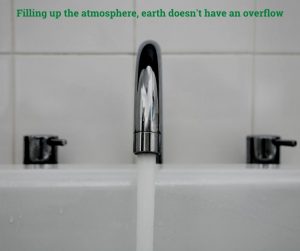
Filling up the atmosphere. Earth doesn’t have an overflow…
At the moment we’re collectively filling up the bath ever faster and if we don’t do something drastic — and soon — it will eventually overflow.
When we consider how the climate is changing, the planet’s temperature increase is the key indicator. The 2015 Paris Agreement specified that to avoid catastrophic ecological, environmental and social damage “countries should limit warming to 2 degrees, and pursue efforts to limit it to 1.5C”.
To achieve that objective a global target of reaching net zero by 2050 was determined. The potential consequences of a world warmed by even 2C have led many to call for more decisive action to minimise the risk of overshooting that target. In net zero terms that would equate to bringing the date forward.
The Intergovernmental Panel on Climate Change’s Special Report on Global Warming of 1.5C concluded that reaching net zero by 2040 considerably improves our chances of keeping warming to that level. If 1.5C is the desired outcome, striving towards net zero is the means of achieving it — and that’s why the term has come to dominate the discussion about what we should do.
How do we achieve Net Zero?
It’s the fundamental question that governments, policy makers, and business leaders — not to mention all of us here at Winchester Action on Climate Change (WinACC) and I’m sure many of you reading this — wrestle with on a daily basis. This blog post is not the place to explore the myriad of potential options available to us but whatever actions are taken they must lead to at least one of the following outcomes:
A. Turning off the taps
To return to our bath, we simply have to reduce the amount of water flowing into it or we’ll end up with a flood and net zero will never be achieved. How we conduct nearly every human activity — from the way we feed and clothe ourselves, to how we keep ourselves warm, move around and be economically productive — has to change so that those activities produce fewer GHG emissions.
Turning off the taps completely i.e. no GHG emissions at all, is what’s known as ‘absolute zero’. Although it’s impossible to achieve on a global scale without inconceivably radical changes to the way we live our lives, there are many individual entities — a business for example — that could theoretically get there.
So, if we accept that there will always be some water pouring into the bath we also need to consider….
B. Enlarging the plughole
Any process that removes GHGs — especially carbon — from the atmosphere is called a ‘sink’. As mentioned earlier, nature has done a wonderful job in helping to keep the atmospheric temperature regulated for millennia but we are eroding its capacity to do so through our overuse of the bounty it provides. Efforts to reverse that trend include tree planting, rewilding and other initiatives that restore habitats and ecosystems. There is also the potential — and it is important to stress that right now it is only potential — for future technologies to remove GHGs from the atmosphere, a process known as Carbon Capture Usage and Storage (CCUS).
There is a great deal of debate about the efficacy and viability of various carbon sinks and how much potential they have in counterbalancing GHG emissions to achieve net zero. One certainty is that without the release of a plughole water will fill our bath very quickly.
Net Zero and WinACC
Conversations about net zero are often heard in a global context but the principle can be applied to any organisation of any size. Many countries — including, of course, the UK — have set net zero targets and are now reporting progress against them. Scaling down further, regions, local authorities, charities, businesses, and even schools have done the same.
Not surprisingly, net zero is captured in WinACC’s own mission too:
To inspire and enable action to create a net zero carbon Winchester district.
It’s the thread that runs through our strategy; the north star for all our work. Locally, Winchester City Council has a Carbon Neutrality Action Plan as a response to the Climate Emergency it declared in 2019. Hampshire County Council also talks about becoming carbon neutral, and the University of Winchester aims to be net zero carbon by 2025. It should be noted that being ‘carbon neutral’ or ‘net zero carbon’ is not the same as net zero as it excludes other greenhouse gases.
Whatever language is used to describe climate change related targets, one problem that every organisation faces when tracking progress is that it is very difficult to attribute both GHG emissions reductions and sinks to a specific geographical area — as this WinACC paper about renewable energy in our area from 2019 points out. To return to our bath analogy, you just can’t divide it up into different sections and there will only ever be one plug….
This blog is the first of a series of ‘explainers’ we’ll be writing in the lead up to COP26 later in the year. Is there any particular climate change related subject you’d like us to talk about? Drop us an email contactus@winacc.org.uk with ‘Explainer ideas’ in the subject line. Thanks for reading.
P.S .Want to explore a little more? You can see how the world is doing on the road to net zero here, and read two eloquent arguments about why the concept is flawed and why it isn’t — both well worth a look.
Blog written by Paul Coverdale, WinACC Trustee and Chair of Science and Technology Advisory Panel