
Applicant: Acorn Energy
Winchester District Parish: Headbourne Worthy
Winchester City Council Planning Ref: 22/02037/FUL
Summary
The proposed development would import and treat in the region of 83,600 tonnes of feedstock per annum from the applicant’s landholding and local farms, which would undergo a process of controlled decomposition within the Anaerobic Digestion (AD) facility. This anaerobic digestion generates biogas which is upgraded on site into biomethane, before being removed by tanker to a central facility for injection into the national grid. The AD facility would have the capacity to produce approximately 19,864,629 Nm³ of biogas per annum.
The AD facility feedstock would typically comprise the following:
- energy crops such as silage, rye, maize and grass;
- straw; and
- poultry litter and farmyard manures.
In addition to the biogas, the AD process would also produce a nutrient rich solid fertiliser, soil conditioner and a liquid fertiliser (digestate), which would be used on local farmland, in place of raw manures and artificial fertilisers. The AD process would also result in the production of carbon dioxide (CO2) as a natural by-product. As CO2 is a precious resource, the proposed AD facility would be fitted with equipment to upgrade the CO2 to 99.9% purity, suitable for almost all industrial and commercial applications in the UK. Upgraded CO2 would be liquefied and transported by road to end users within the market area. The proposed AD facility would capture approximately 13,673 tonnes of CO2 a year.

WinACC Response
This is WinACC’s response to the application. You can contact us at renewables@winacc.org.uk.
Winchester Action on the Climate Crisis (WinACC) wishes to support this planning application. Our District urgently needs to replace fossil fuels with more sustainable energy.
Biomethane gas is part of a mixed economy of renewable energy to address the climate emergency and deliver UK energy security. Spiralling energy prices brought about by the Russian invasion of Ukraine have accentuated the need for local energy production.
We note that the application reinforces the Winchester District Local Plan in respect of Policy CP12 which states: “The Local Planning Authority is supportive of the generation of renewable and decentralised energy in the District.” Furthermore, the City Council’s Carbon Neutrality Action Plan anticipates: “Building or investing in large scale renewable generation project(s), e.g. solar farms, heat pumps, solar-battery car ports, anaerobic digester, wind farm,” in committing Winchester City Council to an accelerated target for net-zero, by 2030.
In assessing the plans, we have reviewed the feasibility of operating two AD plants located in neighbouring parishes, given that a site at Sparsholt College has been approved by WCC Planning committee, but not yet constructed. We have been assured by the applicant that the two plants can coexist, without compromising planning concerns relating to each separately.
WinACC welcomes the commitment in the plans to limit the use of maize as a key feedstock to not more than half the grown crop component. Our concerns about maize are primarily with the higher potential for soil and nutrient run-off into watercourses. We recommend that approval of the plans should add a condition that all agricultural contracts stipulate compliance with:
- RHI and RTFO sustainability criteria and targets for reduction in CO2 emissions.
- the Nutrient Neutrality Report and the Nutrient Management Plan that will be agreed with English Nature and the Environment Agency.
- BAT Guidance for the application of digestate bio-fertiliser
We also recommend that the content of all background documents submitted in the planning application should be referenced as conditions for any approval.
This proposal prompts a range of questions, including further opportunities to improve the carbon efficiency of the operation, of interest to WinACC but not directly relevant to determining a planning application. For information, WinACC has discussed many of these matters with the developer, details of which will be published on our website.
Technical Note
The following text is a technical note prepared by Tim Jackson OBE, on behalf of WinACC’s Renewable Energy Action Group, for the purpose of informing our response to the planning application. It includes a record of details provided by Acorn Energy, in response to requests for clarification. The content addresses a wide range of issues associated with this technology which we hope will be of general interest.
The Site: Three Maids Hill near Winchester
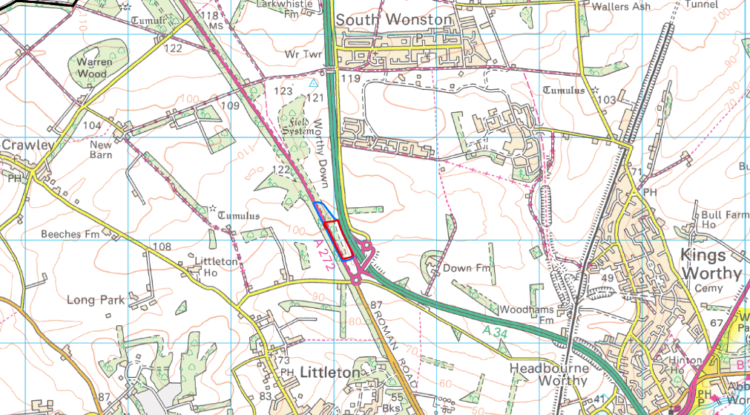
A site visit shows this to be land alongside the A34, with direct access onto the A272 (Andover road) to the very nearby Three Maids Hill roundabout leading to roads leading in all directions, including the A34. The character of the area is farmland to the north of Winchester, though dominated by a major intersection of roads with the noise of the A34 very prominent. The proposed site will abut a recently approved plan to locate a solid waste crushing and recycling facility. To the North of the site is a small area of woodland and on the other side of that, the soon to be commissioned 25MW solar farm.
The Biodigester/Anaerobic digester (AD) and its feedstock: The Planning and Design statement makes clear that the operator intends to produce energy, in the form of a gas rather than electricity, which allows it to fulfil a somewhat different and potentially complementary function to other technologies. The proposed AD facility would produce biomethane which is planned to be used directly to heat homes and fuel vehicles.
Acorn Bioenergy plans to use 83,000 tonnes of rotational arable break crops and straw/manures to generate low-carbon biomethane through a fermentation process using tried and tested technology developed and used extensively in other parts of Europe. The resources used by the AD process include crops (mainly maize, rye and grass and mixed cut grassland) grown by farms in the surrounding area which could include haulage from distances up to 15km (circa 10 miles). The applicant identifies it would also use chicken litter and farmyard manures for 50 to 55% of the feedstock, sourced from farms in the local area and up to 60 km from the site for cereal straw and poultry manures.
The anaerobic digestion plant uses these components of organic matter to produce methane, carbon dioxide together with solid and liquid fertiliser which would be spread on farmland, to assist the growth of other crops. All the methane gas and carbon dioxide is planned to be captured and transported to be sold as the commercial output.
WinACC recognise that farmers require break crops in their cropping plans in order to break the cycle of pests, diseases and weed infestation of typical arable cereal crops e.g. barley and wheat. Farmers value break crops which are also ‘restorative’ which particularly includes legumes that have nodules in their roots containing nitrogen-fixing bacteria (Rhizobium). Another valuable restorative break crop is grassland, especially three year grass leys, particularly if planted with legumes such as white clover which fix nitrate and the grassland also increases the carbon content of soils. Grass is especially useful in improving soil stability on sloping fields which have been under cultivation for cereal crops for long periods and where the organic content of soils has diminished.
Acorn Bioenergy intend using restorative crops as part of the feedstock for their operations. However, in order to increase the energy in the feedstock, they will also be using forage rye and forage maize. Neither of these break crops is particularly restorative, though both provide a useful break for arable farmers around Winchester.
Our misgivings about the possibilities of large acreages of forage maize grown locally have been discussed with Acorn. We have been assured that whilst not evident in the detail of their submission, Acorn bioenergy have said that while they intend a larger component of maize than either rye or grass and grass mixtures, they will not be exceeding half the grown crop component with maize. We welcome this assurance, though it is not something provided as part of the submission and could be varied enormously given seasonal characteristics.
Our concerns about maize are primarily with the higher potential for soil and nutrient run-off into watercourses. Chalk stream and chalk river habitat is very sensitive to this type of run-off which adversely affects the biological health of these important national and international assets. We have been assured by Acorn Bioenergy that their producers will be contracted to follow the Sustainable Agricultural Practice listed in the WinACC Response above in order to minimise adverse effects of maize growing
Acorn bioenergy have assured us that it is their commercial interests to diversify their selection and volumes of crop type because of seasonality changes due to climate change. A late, cold season or very dry conditions at the germination stage for the relatively late sown maize can result in very low yields whereas rye or grass will already be growing actively at that time.
Transport: The planning submission comprises a Transport Plan which details the numbers of vehicle movements expected per week, commensurate with seasonal factors, especially harvesting. Having spoken with Acorn Bioenergy, we understand that most farm vehicle traffic associated with the bio digestion plant will be active to the north and east of Winchester. However, we are aware that the site of the 60,000t Sparsholt College biodigester, located only 5.6km away, was approved by WCC Planning committee and construction commenced but never completed and commissioned. This plant could be completed and commissioned at any time and would similarly be serviced by traffic from farms within a potentially overlapping circa 15 km radius of farms. We have quizzed Acorn Bioenergy regarding the availability of feedstocks for two plants which are closely located and have been assured there is plenty of capacity, though have not verified that independently.
The biomethane intended to be produced by the applicant is planned to be used as an alternative fuel to power HGV vehicles. These include transport operations supplying straw and poultry manure to the plant and also transporting biomethane to the gas injection point at Portsdown Hill, near Portsmouth, where it would be injected into the gas grid to create renewable heat. Biomethane powered HGVs are also planned to transport CO2 captured by the bio-digestion process for use in the food industry.
We applaud the use of locally produced biomethane being used for transport operations, which will deliver a substantial reduction of equivalent carbon emissions compared to diesel-fuelled HGVs. However, we are disappointed that the majority of vehicles used to transport crop material to the plant are tractors with trailers largely powered by fossil fuels. We have made representation to Acorn Bioenergy, on this point and suggested that they consider using biomethane powered HGV Lorries for the delivery of fresh cut crop feedstock from satellite locations on farms in the circa 15km range, rather than having diesel powered tractors and trailers doing those journeys. This suggestion has been welcomed by Acorn Bioenergy who commented on their belief of the certainty of the mg of CO2 they are allowed to emit per megajoule of energy being reduced over time and their need to engage with and foster best practice in order to reduce the carbon impact of their operation. They commented that there are commercially available HGV bulk carriers which are capable of using Biomethane, as per the vehicles which will be ordered for their own gas delivery fleet and that they are still in the process of engaging with growers and will build their understanding of what is possible as these relationships develop.
We have also discussed with Acorn Bioenergy, the opportunity to use the available biomethane as a replacement fuel to diesel, for local farm tractors in the area, and especially those supplying feedstock to the AD plant. Acorn have acknowledged the point and appear willing and keen to discuss this with local farmers. They inform us that as farmers make decisions to replace their machinery in future, the option of biomethane fuelled tractors is more available to them. They commented that the first commercially available Biomethane Tractor only become commercially available for order in Europe in 2021 (the New Holland T6: https://agriculture.newholland.com/eu/en-uk/equipment/products/agricultural-tractors/t6-methane-power ) and that amongst the farming community, they say that New Holland currently have a declining market share. Acorn also commented that there are significant delays to ordering new vehicles in the current climate, and that for the specific biomethane powered model above, there will be a need to ensure maintenance is available to service those orders. They comment that the investment required will be significant, though they will need to engage with their contractors to discuss this.
Benefits to Climate Change and relevance of Anaerobic Digestion AD in Winchester district.
The proposed development is stated by the applicant as providing enough green gas to meet the heating demand of 7,650 UK households (based on 14.1 MWh/y per household).
The application contends that in comparison with standard UK grid emissions, the 9,753,325 Nm³ biomethane produced annually by the AD facility would have an equivalent saving of 31,000 tonnes of CO2e each year, equivalent to taking 20,900 cars off the road.
The UK government clearly recognises the value of biomethane gas through its Green Gas Subsidy Scheme (GGSS subsidy). GGSS support is payable to participants in the form of quarterly periodic support payments. These are calculated using the applicable tariff and the volume of ‘eligible biomethane’ injected. GGSS_Guidance_v11_June_221654085323267.pdf (ofgem.gov.uk) Once registered, scheme participants are eligible to receive periodic support payments each quarter, based on the volume of eligible biomethane they inject into the gas grid, subject to any adjustments which can be seen shown on Page 62, Paras 7.1-7.20. of the link above.
We are aware that applying for and receiving ‘sign-off’ of the GGSS is very challenging and that investors require ‘sign-off’ prior to pledging their investment, even though the current price of gas might allow a biomethane gas plant operator to do so without the GGSS subsidy. We believe there is comfort in the endorsement of the GGSS process, that operators who are approved have had their plans closely scrutinised.
The applicant will also need to ensure compliance with the requirements of the RTFO ( Renewable Transport Fuel Obligation (RTFO) guidance: 2021 – GOV.UK (www.gov.uk) ) by conducting a full life cycle analysis of all the crops they produce to ensure that any carbon emissions from the production of crops for energy provides a genuine and auditable reduction on CO2 when compared to the use of fossil fuels. This will include specific calculations of the emissions linked the use of artificial chemicals and artificial fertilisers on the crops. The maximum amount of CO2 emitted per millijoule of energy will be reduce steadily over time by Ofgem to encourage improvements in performance.
Unlike other forms of renewable energy, AD facilities produce consistent and fairly predictable quantities of biogas irrespective of weather conditions and daylight. The UK is expected to be partially dependent on gas, for many years and that the Russian invasion of Ukraine has bought into sharp focus how reliant Europe and the UK is on imported stocks of gas.
Since 2016 The Committee on Climate Change (CCC) has been recommending increasing the proportion of green gas in the grid which would include biomethane and green hydrogen. This recommendation was overshadowed in April 2021 when the UK government adopted the 6th Carbon Budget, to further its net-zero 2050 target. In relation to energy generation and supply, the budget focussed on full decarbonisation of the electricity grid by 2035, and whilst the role of green gas continues to feature, it largely focuses on hydrogen. However, it will be many years until the fossil gas supply network ceases to feature in the economy of energy supply to existing homes and businesses, which makes any move to reduce the carbon footprint of the gas supply, useful and supports the relevance of biomethane gas as a component of this.
We are fortunate that the Winchester District Local Plan anticipates the decarbonisation agenda. Policy CP12 states: “The Local Planning Authority is supportive of the generation of renewable and decentralised energy in the District.” This Policy is reinforced in the City Council’s Carbon Neutrality Action Plan which includes the following*, where mention of AD is highlighted (by us) *“Building or investing in large scale renewable generation project(s), e.g. solar farms, heat pumps, solar-battery car ports, anaerobic digester, wind farm” in committing Winchester City Council to an accelerated target for net-zero, by 2030.
We note that the applicant has a further application for another biodigester at Cow Down Farm near Andover as well as operating other AD plants.