
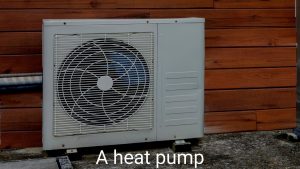
There’s been a lot of buzz lately about heat pumps as a replacement for gas boilers heating our homes. Heat pumps haven’t really had a good press in some quarters up until recently, with images of entire gardens being dug up and great big metal boxes attached to the outside walls of homes. The heat pumps that are available today are vastly different from those of even 10 years ago. However heat pumps were invented in the 19th century and have been used successfully for decades in continental Europe.
A few questions often arise in conversations about heat pumps.
Are heat pumps noisy?
Very few people would fit a noisy heat pump in their home through choice. The good news is that the heat pumps of today are about as noisy as a kitchen fridge. Given they’re often tucked away outside then you would be lucky to hear one at all. Plus in the summer, when you’re more likely to be using your garden, the heat pump is rarely running because you won’t need your central heating to be on.
Will the radiators need to be changed?
Heat pumps can and do work with existing radiators. Obviously it will depend on the specific radiators and the pipework and the amount of insulation your home already has, but there may be no need to change much at all. Bigger radiators may be needed if you have older, smaller ones. Heat pumps are more efficient with underfloor heating but it’s not necessary to install it (but good to know if your property already has underfloor heating).
Do heat pumps provide enough warmth in winter?
The answer is yes. Ground source heat pumps are excellent at maintaining a constant temperature, as the ground, under the surface, maintains a very constant temperature all year round. Whilst air source heat pumps have to work a little harder during the colder months, they keep producing heat until the outside temperature is approximately -20 degrees Celsius. Much like your fridge still keeps food cool even on the hottest summer day, so your home will keep you warm even on the coldest winter day.
Aren’t heat pumps large and take up a lot of space?
Well, no, not anymore. Regular size air source heat pumps take up about half the volume of one large wheelie bin, with a larger one taking the volume of almost one wheelie bin. They do need good airflow, so some space is needed all around them. They usually sit on the ground next to a wall. Some heat pumps can also be situated further away from the house, such as behind a shed or garage, so long as insulated pipework connecting them to the house can be laid.
They are too expensive
The cost of heat pumps has fallen in the past few years, and is set to fall further as demand increases. This is where the Winchester Area SuperHomes team can help. As well as providing trained retrofit advisors to visit your home and give you expert advice on heat pumps and any other changes that may be possible such as increased insulation, the team also have excellent knowledge of all the grants and subsidies available at the moment, and even details of those set to start in April 2022.
The good news is that heat pumps are around three times as efficient as a gas boiler, and therefore at the moment create about one third of the emissions. Although gas is currently three times cheaper than electricity, this means running costs are currently about the same.
There’s never been a better time to switch your heating to a heat pump. They are quiet, efficient and increasingly affordable, they’ll reduce your heating costs and you’ll be doing your bit for nature and the planet as well.
To contact Winchester Area SuperHomes email wash@winacc.org.uk or call Stu Mills, Project Manager on 07599 823 859 or search online for Winchester SuperHomes.