
Bus services in Hampshire are struggling to attract passengers after covid.
Hampshire is behind similar transport authorities in the average number of bus journeys per person (see below under “Evidence that Hampshire bus use is lower than it could be”).
There needs to be a fundamental rethink of buses in Hampshire. Routes, timetables and connections (between bus services and with rail services) need review.
This new report from our Transport and Planning Action Group shows how this could be done.
WinACC invites Hampshire to spend the new extra bus grant to make fundamental changes. The new mayoral authority offers an opportunity for fresh thinking.
An easy way to find more bus passengers
Trains in Hampshire carry 24% more passengers than buses (ORR and DfT data). So without good interchange arrangements, bus companies are ignoring their biggest potential source of passengers.
The next Bus Services Improvement Plan should focus on intermodal connectivity between buses and trains because good bus/rail interchange arrangements will:
- improve passengers’ experience.
- increase the number of bus passengers
- make more bus services more viable
- increase the range of public transport journey opportunities for passengers at relatively little cost.
What would improve connections between buses and trains?
- Better bus service signage, maps, and information at interchanges
- Redesigning of bus routes to increase bus services at interchanges
- Adjustment of timetables to enable bus services to connect with trains, and run earlier and later to meet the needs of passengers starting and ending relatively long journeys
- Guaranteeing connections
- Displaying electronic real-time information about trains on buses, and about buses on trains
- Improving bus parking and passenger waiting infrastructure at stations
- Redirecting traffic flow to ease bus access to/from interchanges
- Developing zonal and through ticketing
2026 will be a good year to influence how Hampshire train timetables could be reshaped to benefit bus services because the Secretary of State for Transport has announced that in Autumn 2026 South Western Railway will rewrite all its timetables.
Government support
The government is likely to fund transport integration schemes.
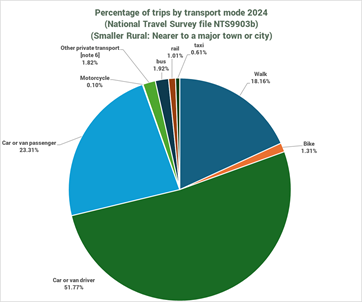
The National Travel Survey has a category of authority called “Smaller Rural: Nearer to a major town or city” which reflects closely transport behaviours in Hampshire. The number of journeys each person makes on buses is very close to that in Hampshire. It suggests that buses cater for only 1.92% of journeys. This compares with 75% of journeys made in vans and cars. A plan to improve connections between buses and trains could make a big contribution to redressing this imbalance.
Evidence that Hampshire bus use is lower than it could be
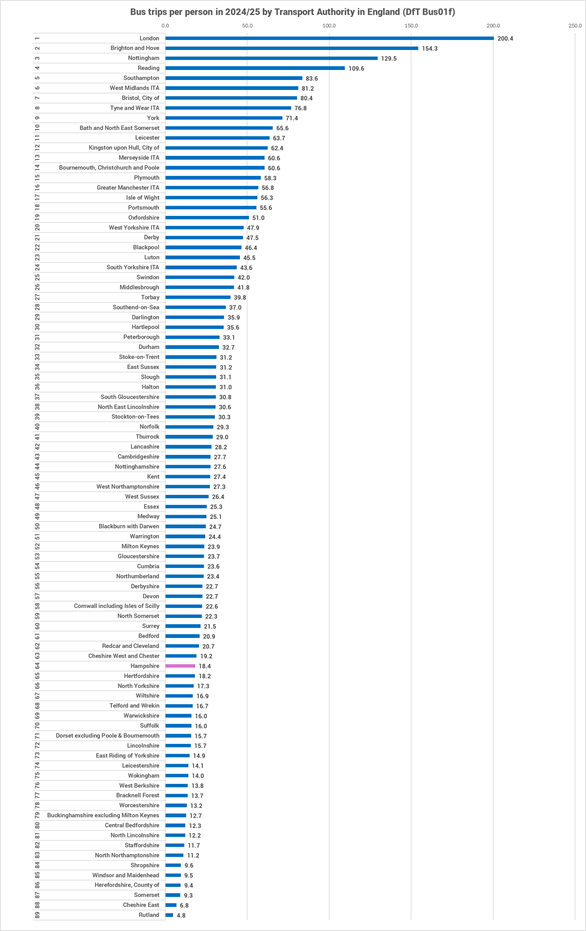
Department for Transport figures show that Hampshire came 64th out of 89 authorities in the league table of bus trips per person in 2024/2025.
Good transport authorities have increased bus journeys since 2010 and even since covid. Hampshire shows an overall reduction.
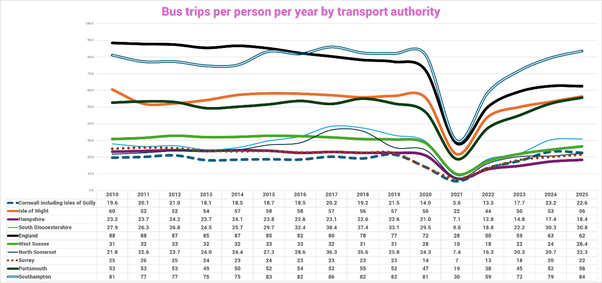
Hampshire County Council argues that this is because population density is low (in other words, because homes are spread out across rural areas in much of Hampshire). But Hampshire does worse than many authorities with lower population densities.
Hampshire would have 22.7 journeys per person per year if it was at the average for the other authorities in the chart. The trend (dotted blue) shows that Hampshire is underperforming, by about 5 journeys per person per year.