
The developers submitted a revised planning application and additional papers in February 2026.
WinACC’s Transport and Planning Action Group remains concerned about the proposals, especially the increased traffic and related greenhouse gas emissions.
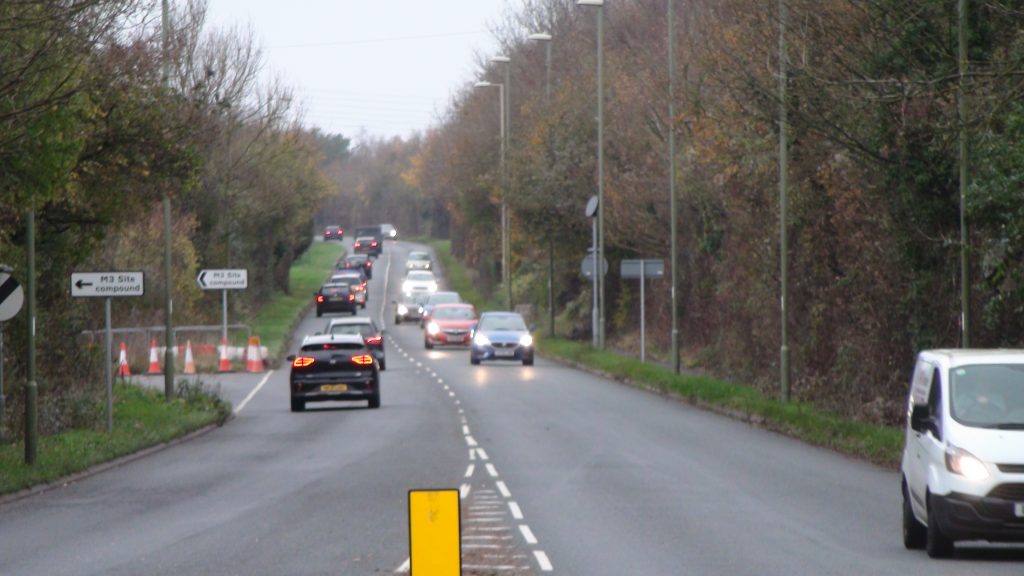
See the Group’s full response, objecting to the revised planning application. These are the main points we make:
Where aspects of this application are ‘reserved’, there will be an opportunity to discuss them in more detail as the application proceeds. This does not apply to access, and if this outline application is approved there will be no such further opportunity.
The proposals on access are still relatively unformed, even taking into account the additional material submitted in 2026, and it would be premature at this stage for Winchester City Council to approve the access proposals.
The parts of the application that discuss transport do not quantify or attempt to minimise the extent to which the development will increase transport greenhouse gas (GHG) emissions in Winchester District. The application includes emissions calculations related to the construction it proposes, and similar calculations on the additional transport emissions it will cause are equally necessary. This is despite long passages in the application referring to legislation and policy on emissions. It feels to us that the proposers have not thought carefully enough about the damage that their proposal will do for the climate, especially through the growth in traffic it will bring about. The proposal still needs to do more to demonstrate to Winchester City Council (WCC) that their proposals will not do irretrievable damage to the Carbon Neutrality Action Plan (CNAP) and jeopardise what it aims to achieve.
The traffic modelling suggests this development will increase transport emissions to such an extent it will undermine the CNAP. The application:
- includes only the most perfunctory emissions modelling (despite readily available guidance),
- does not set out clearly the climate implications of the additional GHG emissions from transport this development will cause, and
- makes no proposals robust enough to reduce transport emissions to a level compatible with the CNAP
- contains only the vaguest proposals on modal share
In summary
- Despite detailed references to policies on reducing GHGs at national and local level, the application and addenda fail to address the scale of transport GHG emissions it will cause. The reference to CP10 is meaningless without more practical proposals that address more usefully the growing urgency of climate policies. Many key policies are overlooked and their implications ignored.
- WCC must reduce all emissions sharply to achieve net zero by 2030 and transport emissions form just over half of these.
- Compared with the 2022 baseline used by the applicant, the modelling suggests traffic volumes will increase by between 17% to 37% on roads around the development by 2039. Despite their claims, the applicant does not attempt to show how the increase due to the development itself can be limited to help achieve the WCC net zero target by 2030, or meet the Hampshire County Council’s Local Transport Plan 4 (LTP4) target of reducing car use by 10%, and they do not mention how they will achieve the government’s Carbon Budget and Growth Delivery Plan (CBGDP) target of reducing 2024 emissions by 20% by 2037.
- No serious attempt has been made to quantify the annual extent of transport emissions associated with this development. They are clearly on a scale of increase that will undermine the CNAP. Using government conversion factors we calculate that the modelled increase in traffic of 4542 trips will produce 4.55 KtCO2e extra emissions annually. To achieve net zero emissions by 2030 there will have to be overall cumulative annual reductions of 79 KtCO2e in Winchester District transport emissions each year until 2030. This is not happening now. There is clearly no headroom to accommodate an increase in transport emissions on the scale caused by this proposal, and it will make the sharp reduction already necessary even more difficult.
- WCC made a submission to the M3 junction 9 inquiry that the increase in emissions associated with that project were working ‘in the opposite direction’ to achieving the CNAP target. Clearly the same comment will apply to this scheme, and WCC should not allow this scheme to ‘present further difficulties’ for the CNAP.
- The Sustainability Statement and the more recent Environmental Statement Addendum (February 2026) and its Appendix 4 Transport Assessment Addendummake a number of vague proposals that are relatively unformed and weak about mitigating the damage caused by increased transport emissions, but do not demonstrate satisfactorily (without any emissions reductions calculations) the extent to which these proposals will contribute to emissions reduction.
- The February 2026 Framework Travel Plan still has no targets for achieving modal transfer to increase the share of walking, cycling and public transport access, nor for increasing the share of BEVs. Mitigation proposals are vague and inadequate, costings are absent, offers of s106 funding are vague, the proposals for bus services are thin, and it is unclear whether the application suggests one or two cycle routes to central Winchester. Proposals do not have their own emissions reduction estimates or targets.
- The traffic modelling suggests there will be 4,542 daily journeys to and from the site. It appears there are plans for 1,050 parking spaces. It is difficult to reconcile these two figures. The proposals do not appear to be coherent or rigorous.
Full Report
Contents
- Introduction
- Conclusions
- Summary
- Detail
- Climate
- Policies not addressed
- No meaningful quantification of transport emissions
- Winchester City Council’s focus on limiting transport emissions
- Unchanged, unambitious mode share proposals
- Car share
- Mobility hub
- Car club
- Public transport
- Cycling
- Walking
- Contradictions between trip modelling and parking space provision
- The inadequate transport assessment addendum conclusion
Introduction
This objection incorporates the earlier objection by WinACC, but is updated to take account of the recent papers the developer has submitted in February 2026.
All aspects of this application, apart from those relating to access, are ‘reserved’ and there will be an opportunity to discuss them in more detail as the application proceeds. This does not apply to access, and if this outline application is approved there will be no such further opportunity. The proposals on access are still relatively unformed, even taking into account the additional material submitted in 2026, and it would be premature at this stage for Winchester City Council to approve the access proposals.
The parts of the application that discuss transport do not quantify or attempt to minimise the extent to which the development will increase transport greenhouse gas (GHG) emissions in Winchester District. The application includes emissions calculations related to the construction it proposes, and similar calculations on the additional transport emissions it will cause are equally necessary. This is despite long passages in the application referring to legislation and policy on emissions. It feels to us that the proposers have not thought carefully enough about the damage that their proposal will do for the climate, especially through the growth in traffic it will bring about. The proposal still needs to do more to demonstrate to Winchester City Council (WCC) that their proposals will not do irretrievable damage to the Carbon Neutrality Action Plan (CNAP) and jeopardise what it aims to achieve.
Conclusions
The traffic modelling suggests this development will increase transport emissions to such an extent it will undermine the CNAP. The specific out-oftown characteristics of this site are such that inevitably transport emissions will be disproportionately high in relation to the economic activity it will enable, and other sites would be more suitable with lower transport emissions. Since the application:
- includes only the most perfunctory emissions modelling (despite readily available guidance),
- does not set out clearly the climate implications of the additional GHG emissions from transport this development will cause, and
- makes no proposals robust enough to reduce transport emissions to a level compatible with the CNAP
- contains only the vaguest proposals on modal share
We urge WCC to reject this application. Any future submission should not be considered unless the issues we outline below are addressed fully.
If, despite the fundamental unsuitability of this application, Winchester City Council were to be minded to agree to outline planning permission, there would then be no way for the council to address the inadequacy of the access proposals. The worst impacts of the proposals could be softened slightly if the council were to impose something like the following conditions to prevent transport chaos.
The council would have to set conditions that the applicant plan, fund, and implement:
- reduction of emissions from transport access to the development, setting out targets for the rate of growth of zero carbon transport, and the rate of modal transfer to cycling, walking and public transport that will make carbon reduction possible, with full justification of any assumptions.
- compensatory offsetting schemes to balance car use per day of 5917 vehicles, such as funding a public transport interchange at Winchester Railway Station.
- bus services of sufficiently high quality to attract people from using cars to access the site that will provide integrated public transport routes to the site from a majority of the locations that the transport modelling assumed would be the source and destination of journeys to and from the site, where possible running at a turn-up-and-go frequency.
- cycling infrastructure sufficient to help reduce traffic volumes linking the potential of each proposed initiative with the scale of their potential for reducing car travel.
- quiet walking routes to the city centre, surrounding villages, the South Park & Ride, Shawford railway station and other key area within three miles of the development.
Summary
- Despite detailed references to policies on reducing GHGs at national and local level, the application and addenda fail to address the scale of transport GHG emissions it will cause. The reference to CP10 is meaningless without more practical proposals that address more usefully the growing urgency of climate policies. Many key policies are overlooked and their implications ignored.
- WCC must reduce all emissions sharply to achieve net zero by 2030 and transport emissions form just over half of these.
- Compared with the 2022 baseline used by the applicant, the modelling suggests traffic volumes will increase by between 17% to 37% on roads around the development by 2039. Despite their claims, the applicant does not attempt to show how the increase due to the development itself can be limited to help achieve the WCC net zero target by 2030, or meet the Hampshire County Council’s Local Transport Plan 4 (LTP4) target of reducing car use by 10%, and they do not mention how they will achieve the government’s Carbon Budget and Growth Delivery Plan (CBGDP) target of reducing 2024 emissions by 20% by 2037.
- No serious attempt has been made to quantify the annual extent of transport emissions associated with this development. They are clearly on a scale of increase that will undermine the CNAP. Using government conversion factors we calculate that the modelled increase in traffic of 4542 trips will produce 4.55 KtCO2e extra emissions annually. To achieve net zero emissions by 2030 there will have to be overall cumulative annual reductions of 79 KtCO2e in Winchester District transport emissions each year until 2030. This is not happening now. There is clearly no headroom to accommodate an increase in transport emissions on the scale caused by this proposal, and it will make the sharp reduction already necessary even more difficult.
- WCC made a submission to the M3 junction 9 inquiry that the increase in emissions associated with that project were working ‘in the opposite direction’ to achieving the CNAP target. Clearly the same comment will apply to this scheme, and WCC should not allow this scheme to ‘present further difficulties’ for the CNAP.
- The Sustainability Statement and the more recent Environmental Statement Addendum (February 2026) and its Appendix 4 Transport Assessment Addendummake a number of vague proposals that are relatively unformed and weak about mitigating the damage caused by increased transport emissions, but do not demonstrate satisfactorily (without any emissions reductions calculations) the extent to which these proposals will contribute to emissions reduction.
- The February 2026 Framework Travel Plan still has no targets for achieving modal transfer to increase the share of walking, cycling and public transport access, nor for increasing the share of BEVs. Mitigation proposals are vague and inadequate, costings are absent, offers of s106 funding are vague, the proposals for bus services are thin, and it is unclear whether the application suggests one or two cycle routes to central Winchester. Proposals do not have their own emissions reduction estimates or targets.
- The traffic modelling suggests there will be 4,542 daily journeys to and from the site. It appears there are plans for 1,050 parking spaces. It is difficult to reconcile these two figures. The proposals do not appear to be coherent or rigorous.
The application is not as specific or coherent as it must be about access since it is not a reserved matter, and these proposals will not therefore be revisited.
Detail
Climate
The original application, on the face of it, appeared to pay great attention to reducing the development’s contribution to global heating. The Environmental Statement Chapter E dutifully lists many national, Hampshire and Winchester policies on transport and climate.
The original Environmental Statement was right to reference Local Plan policy CP10 which includes the priority:

However, the Environmental Statement fails to address this policy in the context of the range of climate policies that have subsequently provided a more stringent focus for action. The ten-page summary of policies in section 2 reads like an introduction to comprehensive plans for practical ways this proposal will comply with these policies.
Unfortunately the Environmental Statement Addendum (16 February 2026) does little to improve matters.
- There is an update on policy with reference to the revised 2024 NPPF and the cosmetic inclusion of the words ‘vision-lead’ in appendix 4 on transport without any discernible change in focus or detail. There are still no serious sections setting out how the developers will ensure “the environmental impacts of traffic and transport infrastructure can be identified, assessed and taken into account – including appropriate opportunities for avoiding and mitigating any adverse effects, and for net environmental gains.” It is not enough simply to quote NPPF Para 104.
- Passing references have been added to HCC’s LTP 4 policy on reducing private cars by 10%, but no new practical proposals have been made to reduce in a way that is quantified the predicted increase in private cars caused by the development. The developers give no robust practical plan for ensuring the very significant changes in travel behaviour required in Vision A. “A 10% reduction (approx.) in car use (vehicle-kilometres) in Hampshire is required between 2019 and 2030 if we are to remain ontrack to deliver our climate change targets.” Simply referring to the policy is not sufficient.
- Astonishingly there is no reference to the government’s Carbon Budget and Growth Delivery Plan (CBGDP) despite its fundamental significance for the emissions reduction context of this application.
Section 9 deals with climate and claims that GHG calculations have been updated. Table 8 contains a reduced average length of car journeys to the site by 1 km (from 14 to 13km) and adjusted the carbon factor, but still does not include well-to-tank emissions. More importantly, there is still no attempt to place these emissions in the context of Winchester District transport emissions produced by DESNZ, and no attempt to allow for and quantify the significant changes that electrification of transport will bring over the next few years.
Policies not addressed
The applicant does not attempt to demonstrate how the application will comply with the policies that are referred to. There are not even timed targets for the applicant to tackle the scale of the transport CO2e the proposal. The key policies this application has overlooked or failed to address in sufficient practical detail are:
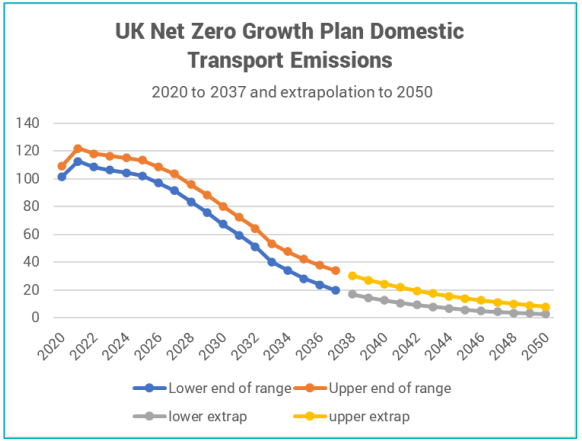
- The government’s March 2023 Net Zero Growth Plan (NZGP) that sets out indicative targets for domestic transport emissions for the dates referred to in this application (for 2039 values have been interpolated – government targets end at 2037 at 18% to 29% see Figure 1):
| NZGP 2027 emissions as % of 2022 | NZGP 2039 emissions as % of 2022 | |
| Lower end of range | 84% | 15% |
| Upper end of range | 88% | 24% |
This will be especially important because of the traffic growth the proposal anticipates will happen on the roads around the development:
| 2027 traffic as % of 2022 traffic | 2039 traffic as % 2022 traffic | |
| Lower end of range (Romsey Road) | 107% | 117% |
| Upper end of range (Badger Farm Road SE) | 128% | 137% |
To comply with the UK NZGP the applicant will need to demonstrate how the growth in traffic they predict will be accompanied by a sufficient cut in traffic emissions to achieve the emissions reductions the NZGP suggests.
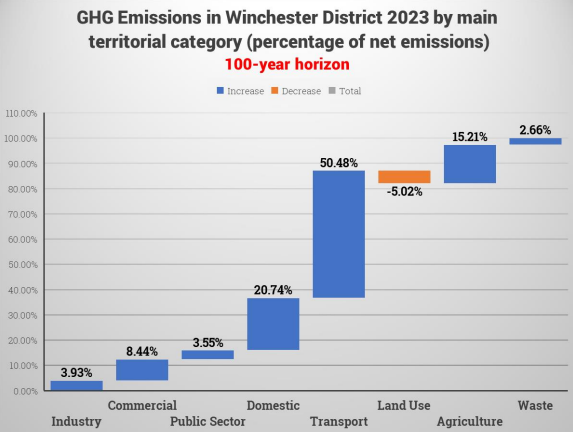
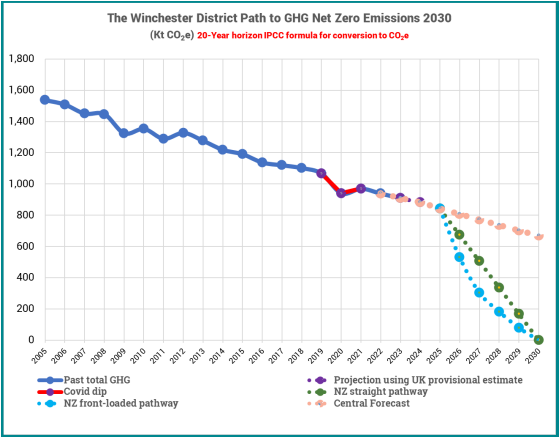
- Even more ambitious is Winchester City Council’s commitment in their Carbon Neutrality Action Plan (CNAP) to achieve net zero emissions by 2030, 50.48% of which were transport-related in 2021 (Figure 2); the City Council cannot afford to allow any scheme to cause an increase in transport (or any other) emissions, since overall they will need an annual reduction of at least 142 KtCO2e per year of Greenhouse Gases (GHGs) until 2030 – Figure 3. Transport emissions will need to reduce by 78.7 KtCO2e per year. To succeed the City Council will need all traffic to have zero emissions by 2030, or some form of offsetting. This development would make this ambition even more difficult.
- The initial application’s unamended appendix L2 Supplied Traffic Data assumes an underlying traffic increase between 2019 and 2027 will be about 10.5%, and between 2019 and 2039 it will be about 20.5%. This assumption continues to ignore the government’s NZGP and CBGDP, HCC’s LTP4, or WCC’s CNAP. All the traffic data needs to be recalculated in the light of these policies and better proposals developed to address what they are trying to achieve.
No Meaningful Quantification of Transport Emissions
In the current circumstances of dangerous levels of global heating, there is a need for an outline planning application like this to quantify all the emissions it will create and demonstrate the actions it will take to reduce them so that they are compatible with climate policies.
The applicant can have no justification for failing to submit data on the emissions caused by the additional traffic as “development user emissions.” The Department of Transport (DfT) publish extensive guidance and data tables for detailed calculations up to 2050, including guidance on how to allow for progressive electrification of road transport. These are readily available at:
- local-transport-quantifiable-carbon-guidance.pdf August 2025
- vehicle-emissions-carbon-tool-guidance.pdf Oct 2025
- technical_note_estimating_carbon_emissions_from_road_users.pdf Nov 2024 WSP
- tag-data-book-v2-02.xlsm Nov 2025
- tag-data-book-v2-03fc-dec-2025.xlsm with changes from May 2026
WCC cannot allow the additional transport emissions associated with this application and ideally any proposals will need to help reduce current emissions. It is clear that the outline application submitted demonstrates this will be far from the case with this scheme.
Since at this stage there is a focus on access, extensive detail should be given in the application on emissions relating to transport access. Winchester City Council must not approve this outline application until satisfactory proposals have been received for ensuring that the development will enable WCC to stay within the necessary emissions envelope.
The traffic modelling predicts by 2027 an increase in annual average daily traffic as a result of this proposal of 4542 journeys (3848 coming/going from the south east end of Badger Farm Road and 694 journeys coming/going from the north west end of Badger Farm Road) (Using data in ES Chapter E Transport p 38 Table E5.6 we subtracted do minimum (DM) in column 3 from do something (DS) in column 4 do see the developers’ estimate for the growth in traffic at sites 1a and 1b where traffic feeds into the proposed site). It is regrettable the applicants do not highlight this increase more clearly.
| Link Ref | Link Location Description | Two-way AADT 24 2027 DM (Vehicles) | Two-way AADT 24 2027 DS (Vehicles) | % Change in Link AADT |
| Site 1a | Badger Farm Road (between Meadow Way and Site Access) | 18289 | 18983 | 4% |
| Site 1b | Badger Farm Road (between Site Access and St Cross Road) | 18289 | 22137 | 21% |
The revised (17 February 2026) GHG user calculations (Appendix 21 Environmental Assessment Addendum Table 8 ) show a similar daily increase in trips, and confirm our calculation based on the table above. Dividing the annual trips in column 5 by 365 gives almost the same daily average trip increase, at 4,541.
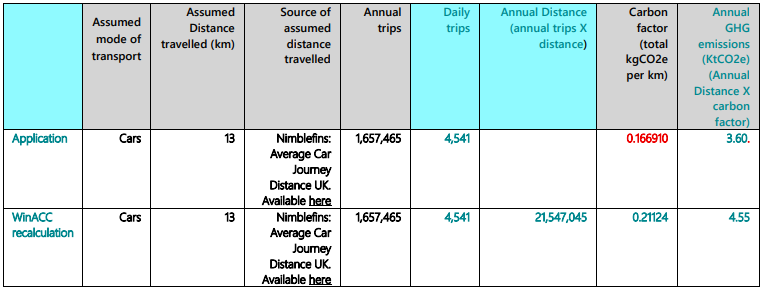
There are significant anomalies in this table; one we have removed and one we have marked in red. WinACC recalculations and additions are in turquoise. The anomalies are:
- The carbon factor given cannot be found in the government’s conversion factors published in 2025. The conversion factor given by the government for an average car using ‘unknown’ fuel is now 0.16725, or 0.21124, once the upstream well-to-tank emissions have been added in.
- The ‘GHG emissions’ in table 8 appear to be for the whole 60 years. This is of little use or meaning, especially since electrification of transport will reduce the data to nonsense. We have therefore substituted an annual emissions figure, so that the scale of the additional emissions can be compared to the most useful source of contextual data, the DESNZ data for each local authority which the application appears oblivious to.
- Using a more correct emissions factor for an ‘average car’ burning ‘unknown’ fuel (the most appropriate factor given in the government’s conversion factors for carbon reporting), accepting the proposal’s assumption that each trip will be an average length of 13 Km, we calculate that annual emissions from additional traffic will be 4.55 Kt CO2e. This is the equivalent of 1.17% of the 388 Kt greenhouse gas emissions from all transport in Winchester District in 2023.
We have mapped the increase in trips in 2027 as set out in the whole of table E5.6 in ES Chapter E Transport p 38:

In the early years up to 2030 it is likely almost all of these additional journeys will be fossil-fuel powered; registration of battery electric vehicles in the district is still very low, and the number of fossil fuel vehicles registered in the district continues to increase.
At a time when the district needs to achieve reductions in transport emissions of 78.7 KtCO2e each year this application will completely undermine the CNAP. Given the difficulty of achieving the 2030 net zero target for the current pattern of transport emissions, there is absolutely no justification for allowing this scheme to add further transport emissions. Similarly this increase in transport emissions will make it harder for Winchester to achieve the government’s CBGDP targets.
There are many brownfield sites closer to the centre of Winchester in need of investment that would have a fraction of the transport carbon footprint that this proposal will create, and that will not undermine the CNAP to such an extent.
In parallel to ES Chapter E Transport there is the February 2026 Transport Assessment Addendum Revised Framework Travel Plan (Appendix B) that totally ignores the need to set out emissions reduction targets. Section 6 is entitled Targets and Monitoring but it fails to go beyond the vaguest of aspirations. For example:
- To increase the number of people walking or cycling; and
- To increase the number of people using public transport.
There is no hint of how this will be achieved or scrutinised, and no timetable has been offered. The proposed monitoring is not ‘SMART’ even though it pompously tells us it is. The clue to its incoherence is that it fails to explain the ‘SMART’ acronym accurately. Somewhat lamely para 6.2.8 says no more than that targets will be monitored. Since access matters are not reserved, outline planning permission would remove from the council any opportunity of imposing conditions that will ensure effective action on ensuring action on increasing walking and cycling and reducing car traffic. If the council is minded to agree outline planning permission, it would need to impose the long list of conditions necessary to make this Framework Travel Plan effective.
As it stands the travel plan is simply not good enough. Conditions are needed to require that the applicant specify:
- when emissions will reduce,
- how in detail this will be achieved using the tables and guidance produced by DfT,
- costings and a commitment to fund the infrastructure and administration necessary,
- targets for the rate of growth of zero carbon transport, and the rate of modal transfer to cycling, walking and public transport that will make carbon reduction possible, with full justification of any assumptions.
Without these elements there is no competent travel plan and no meaningful framework for limiting emissions.
Winchester City Council’s focus on limiting transport emissions
In the summer of 2023, Winchester City Council argued strongly against the proposals to widen the A34 and M3 at M3 Junction 9. They made a submission to the Examining Authority that the increase in transport emissions that will result from the widening will threaten the CNAP targets. They argued strongly for quantification of emissions and careful emissions management. We believe that for the same reasons similar rigorous quantification of an increase in emissions is needed in this application. They submitted, amongst other things:

It would not be consistent with this submission for Winchester City Council to approve this outline application as currently submitted.
Unchanged, unambitious mode share proposals
The Transport Assessment Addendum is, confusingly, a reissue of the previous Sustainability Statement (Movement). The words have been changed, but not the content in any meaningful way. Para 3.1.7 has been worded to look as if it reflects the recent NPPF by talking about a vision-lead approach. It proposes a car driver mode share of 72.6% “from the outset.” However, this is precisely what was proposed, without the hype, in the previous Sustainability Statement (Movement) pp 28/9. As an aspiration it is of little value since it is no more than a reflection of the current mode share in areas like Hampshire, as measured by the National Travel Survey, and was given in the earlier document as the existing mode share in two wards south west of Winchester (carefully ignoring the better mode share of “Winchester 007”):
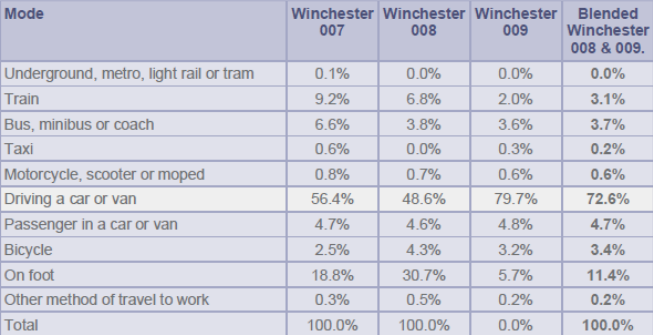
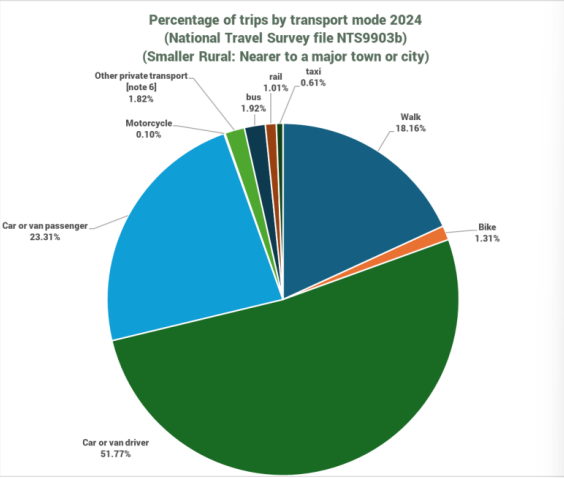
Para 3.1.8 proposes a “further mode shift” away from car use of 10 percent. This cannot be a “further mode shift” when there has not been an initial mode shift. It claims this proposal aligns with Hampshire and Winchester aspirations. It is difficult to accept this in the context of this new development. The applicants are not taking responsibility for the initial increase in traffic they will cause.
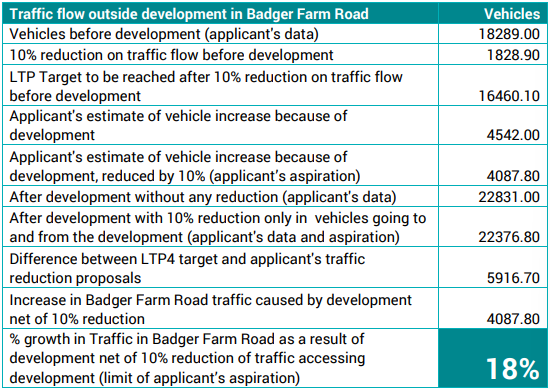
Hampshire CC’s LTP 4 was adopted in spring 2025 and proposed a ten percent cut in car use. Implicitly HCC have a target that traffic across the county will reduce by 10%; this would include Badger Farm Road at the time of the adoption. The applicant is wrong to claim that the proposal aligns with LTP4. Their car use reduction target should be seen in the context of the large traffic increase the development will initially cause and any subsequent decrease should be netted against that.
Even with their modest plan to reduce car use in relation to the development, the net effect of their proposals will be to increase car use on Badger Farm Road by 18%. The only way they could claim to be aligned to LTP4 would be to increase their car use reduction target considerably, and sponsor car use reduction schemes elsewhere to achieve the total reduction in car use per day of 5917 vehicles. A requirement to have a credible plan to achieve this reduction elsewhere should be a condition of any outline planning approval. The current plan is totally unconvincing. Only funding a public transport interchange at Winchester Railway Station, for example, could achieve the mode shift required, so this, or funding for an equivalent scheme, should be added to planning conditions.
None of this is of much value without specific mode share targets in the Framework Travel Plan (Appendix E2). In order to achieve net zero transport emissions by 2030 most access by then would have to be by walking, cycling, and BEV public transport. Any residual private transport would have to be by BEV with green electricity charging facilities, and a zero emissions transport zone on site.
Car share
Proposals for car share feel minimal, and have no targets or calculations that ensure a credible approach to how emissions will be reduced.
Mobility Hub
This is mentioned in the Transport Addendum para 3.3.3 and in the February 2026 Framework Travel Plan Table 4-2. More details are needed to give this any meaning, and some rationale is necessary but missing, on how this would reduce emissions and by how much. In that mobility hubs are normally used to facilitate transport interchange, and this location is a destination with little interchange, it is hard to know why this has been included. In political discourse this would be described as a “dead cat,” included as a distraction to divert us from the overall lack of productive ideas. As written, this does not go beyond a vague aesthetic aspiration, and is of no relevance.
Car club
Again no clear indication on how this will reduce emissions or reduce traffic congestion. We assume there will be embedded emissions saved through more intensive use of fewer cars. There is not even a reference to BEV car clubs.
Public Transport
References appear in the Framework Travel Plan especially in Table 7.5. The ambition has been increased slightly since the initial application, but it is not at all clear how the shuttle bus will interact with the Park & Ride buses, Winchester Town bus services and train connections. There is a need for an integrated public transport proposal that will ensure all journeys to/from the site will be sufficiently more attractive by public transport than by car to reduce car use by significant amounts.
Public transport provision seems to be a bit of a ‘mix and match.’ A more comprehensive and ambitious programme needs to be proposed to attract people out of their cars, and timed targets, and emissions reduction targets need to be included that are linked to mode transfer targets. Planning good public transport needs to go beyond planning where bus stops will go.
By now firm proposals and funding should be lined up but the plan still reads like jottings for a first draft. Winchester City Council should not grant outline outline planning permission without explicit planning conditions that the developer fund bus services that will provide integrated public transport routes to the site from a majority of the locations that the transport modelling assumed would be the source and destination of journeys to and from the site, where possible at a turnup-and-go frequency.
Cycling
Table 7.4 of the Framework Travel Plan lists a number of cycling initiatives, but the list is not coherent.
The plans for three new cycle routes are superficially impressive, but there is no formal commitment. As this is an ‘access’ item that is not reserved, any approval should include the following conditions requiring:
- A commitment to funding (references to ‘contributions’ are too desultory)
- Detailed plans
- Specific costings
- A construction timetable
- A clear statement of the roles of HCC and the developers
- Targets for cycle use
- A rationale for how cycling will help reduce traffic volumes linking the potential of each proposed initiative with the scale of their potential for reducing car travel.
All we have are aspirations and by now the application should be complete.
The planned routes between the site and Winchester need further work. They share the shortcomings of the LCWIP that they reach neither the railway station nor the city centre. Cyclists will be left hovering at the edge of the centre with no safe cyclable through route. This will limit the scale of the take-up by cyclists.
The references to LT 1/20 and other cycling infrastructure standards are too obviously not followed in the plans, especially the provision on Bushfield Roundabout.
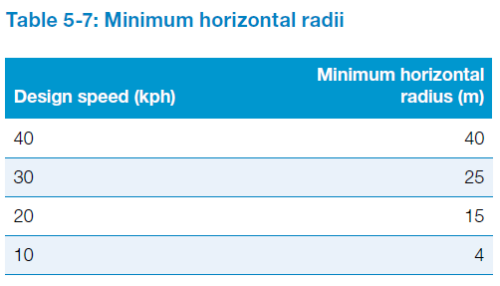
Of particular concern to us is the drawing of proposed pedestrian and cycling infrastructure at Bushfield Roundabout. It appears that the designers have not followed DfT LTN 1/20 despite claiming compliance. They seem to have overlooked the current design rules on horizontal radii:
They have ignored the examples in LTN 1/20 of roundabout design, such as:
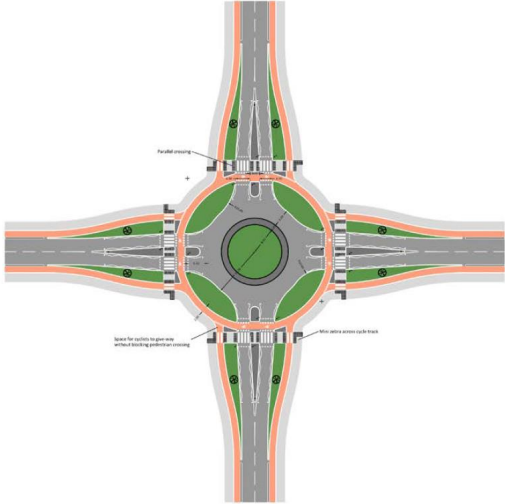
In particular they have ignored the recommendation in para 10.7.15 that ‘As with all crossings, there should be no stagger between the crossings for cyclists of the roundabout entry and exit.’
Overall the drawing is unlikely to produce infrastructure that will encourage more walking and cycling. Both pedestrians and cyclists want to travel directly to where they want to go, and generally refuse to be bullied by lazy engineers into crossing noisy intersections by navigating indirect routes with frequent right-angled kinks.
The whole design needs to be rethought and redesigned so it is truly in compliance with LTN 1/20.
Cycling seems to be promoted as a way of reducing traffic without a realistic appraisal of the potential for this.
Cycle routes to the city centre could only replace at a maximum 800 car journeys according to the modelling in our Figure 4. This would still leave over 3,000 new trips on the roads so the suggestion that these cycle route proposals will have any significant impact on vehicle access numbers or transport emissions is without foundation.
Walking
Table 7.3 of the Framework Travel Plan lists initiatives to encourage walking, but it is easy to see that they will have minimal impact. Many are innocuous such as active travel campaigns, walking maps, walking events, on-site security. Others are infrastructure proposals for the site: high-quality pedestrian surfaces, CCTV and Lighting, and staff changing facilities. The only off-site reference is to pedestrian crossings on “St Cross Rd x Badger Farm Roundabout” (this is unclear).
There is no mention, for example, of creating high quality quiet pedestrian access to the city centre, Shawford, Twyford, the River Itchen. Pedestrian access to Badger Farm will be helped by the cycle route proposed, but the implications for pedestrians are not explored. There are walking isochrone maps, but there is no analysis of what these mean about walking access, where walking access is good, and where it can be improved, and there are no proposals for improving walking routes. Without this there will be few people choosing to access the development by walking there.
If outline planning permission were to be granted it should include a condition that the applicant fund a comprehensive plan and construction programme of quiet walking routes to the city centre, surrounding villages, the South Park & Ride, Shawford railway station and other key area within three miles of the development.
Contradictions between trip modelling and parking space provision
There is a proposal for 1,050 parking spaces on the development. Our calculations suggest the floor area is unlikely to provide more than 850 spaces, and we would welcome a reduction in parking spaces. Even so, we are concerned that this may mean that even more space will be required for parking.
We do not understand how the 4,542 modelled daily journeys to and from the site will be accommodated in 1,050 parking spaces. If all modelled daily journeys stay all day it would seem that 2,271 spaces would need to be provided. It seems improbable that over half of daily visitors would stay for complementary short periods lasting less than half a day.
The graph in fig 5-2 on page 119 of the Transport Assessment, based recklessly on average daily demand, seems to assume that by 13:00 about 730 vehicles will have left the site and that about 530 vehicles will arrive after 13:00. It seems improbable that 56% of the vehicle-accessed stays on site will be for complementary halves of the day. On busy days the number of trips will be well above average. At peak times of the year there could be 6,000 trips requiring up to 3,000 spaces. This volume would defeat the modelling and produce parking chaos.
We believe that outline planning permission would be premature until the applicant can demonstrate that all the different parts of the application have logical inter-relationships, and that the disparate parts are compatible.
The Inadequate Transport Assessment Addendum Conclusion
The transport assessment addendum demonstrates very clearly how unconcerned the applicant is to reduce the traffic congestion the development will create, and how little thought has been put into ensuring that the traffic congestion will not materialise:
5.2.3. The new vision-led approach has not led to any change in the unambitious mode-share targets which are no more stringent than the current mode share without any interventions.
5.2.7 The proposals on student parking suggest a panicked recognition that there is a need to prevent parking chaos, but there are still no concrete proposals to manage the problem.
5.2.9 The four proposals for active travel routes are not on the scale necessary to encourage the level of active travel necessary to reduce car use so that the predicted congestion and emissions will not happen. Some details, such as the failure of cycle routes to reach the railway station and city centre reinforce this inadequacy.
5.2.10 Arranging for people to use buses feels an insignificant step to take, and a half-hearted response to the potentially catastrophic increase in traffic the development will cause.
We find the applicant’s support for active travel thin to non-existent, the list of improvements negligently short of the scale of what is required, and the Framework Travel Plan without rigour or substance. There is every possibility that these proposals will lead to traffic chaos and destroy WCC’s plans to reduce emissions by 2030.