
Blog series ’15 minute checks’.
We may all be finding ourselves spending more time than usual in our homes, and you might find yourself doing those projects around the house that you don’t ordinarily have time for.
In Winchester, our homes are a major source of the carbon emissions that contribute to the climate crisis as shown by our annual greenhouse gas emissions report. We’d like to share a series of quick ’15 minute checks’ that we can all take at home to help make our homes as energy efficient as possible, and therefore having the least impact on climate change.
These ’15 minute checks’ can be carried out by anyone living in a property, whether you are a renter, landlord or homeowner. These should also save you money, alongside making your home more energy efficient. If you have any comments or questions regarding any of these blogs please email us at contactus@winacc.org.uk and we’ll do our best to answer them.
Checking your roof insulation
Homes lose heat in all directions, up, down and sideways. In winter about a quarter of the heat loss can be upwards through the roof. The greater the temperature difference between the inside of the home and the outside the more heat is lost.
The reverse is true in summer. A well insulated roof can make top floor rooms much more comfortable to be in when it keeps out heat from the sun. So good roof insulation is important all the year round both for comfort and, in winter, to save energy and money.
A roof can be insulated by adding insulation between the joists on the floor of the attic or by fixing insulation between the rafters that hold up a pitched roof. The first case is more common and much easier for the DIY handyman to carry out and is described next.
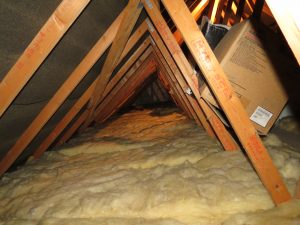
It is recommended that fibre glass sheets which are used for roof insulation and are laid between and over joists in the attic, should be 270 mm thick. You may think that you already have enough insulation and that it is in good condition, meaning it hasn’t been damaged by people walking over it or by items being stored on top of it. Perhaps now is a good time to make a trip into the loft to check it out!
If you decide to top up your insulation, or even to replace it all together with new fibre glass, then the task is not too difficult. First, estimate how much you will need. The sheets of fibre glass are often sold in several thicknesses all less than 270 mm. The optimum arrangement is to buy one set of rolls that match the height of the joists and then to buy a second set to get the total thickness up to 270 mm or more. This second set should be laid at right angles to the first set. Most large hardware stores sell rolls of fibre glass but try to ensure you chose a width that fits the distance between your joists.
Insulating the space between the rafters is more complicated and may require professional help but will be necessary if you want to turn the attic space into a room. In this case batts of solid insulation are inserted between the rafters.
Clearly this is not a job that can be completed during the present situation but you can add it to your To-do list for when life gets back to normal and you’ll know exactly what to buy.
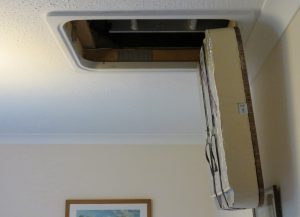
Finally, take a look at the loft hatch cover. If it is loose fitting heat will be lost through draughts so a way will have to be found to make it a tighter fit; maybe you can make a new hatch cover. The best hatches are also insulated with a layer of rigid insulation on the upper side.
Bob Whitmarsh
More information at https://lowcarbonhousehold.weebly.com/
All profits from sales of Bob’s book goes to WinACC.
These blogs are written in good faith and the author/WinACC cannot be responsible for the consequences of following the advice offered. If in doubt get professional advice