
Climate Litigation -a way to get governments and fossil fuel giants to act on Climate Change
Background
The UN Intergovernmental Panel on Climate Change’s AR6 report published this week (9/8/2021) presents a very strong case that governments and fossil fuel giants must very rapidly introduce measures to drastically reduce greenhouse gas emissions to prevent catastrophic damage to the planet. How can national governments and high carbon corporation be made to do this? The only way is for claimants to pursue court cases. As Roger Cox, the lead advocate in the successful Urgenda cases mentioned below put it, “Only the law can save us now”. Presenting the very thorough and well corroborated evidence presented in the AR6 report in court is very likely to increase the chance of success.
What is Climate Litigation?
Climate litigation can be defined as lawsuits brought before judicial, administrative or other investigatory bodies, in domestic or international courts to raise issues of law or fact regarding climate change science, climate change mitigation (avoiding and reducing greenhouse gas emissions) and climate adaptation (adapting to life as climates change).
Climate litigation has a huge potential for reducing emission and improving adaptation by challenging laws, and policies or actions of governments, fossil fuel giants or other polluting companies. It can challenge the adequacy of climate commitments and targets, implementation measures, or government action inconsistent with those commitments.
How rapidly is Climate Litigation growing?
It is generally recognised that Climate Litigation started in the United States in the late 1980s but has since gone global. The plot below shows the dramatic increase in the global number of cases in each year.
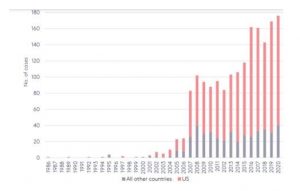
Fig 1 shows how the number of cases filed each year increased dramatically from 1 in 2000 to 176 in 2020. Figure reproduced with permission from “Global trends in climate change litigation: 2021 snapshot”. Grantham Research Institute on Climate Change and the Environment and Centre for Climate Change. 191 new cases were filed in the period from 1 May 2020 to 31 May 2021.
The number of cases of Climate Change aiming to protect Human Rights is growing while the number of cases brought against companies, or the financial sector is small but growing.
Who are the claimants in Climate Litigation?
The number of cases brought by nongovernmental organisations (NGO’s) and individuals has increased over the years. In 2020, 19 of the 42 cases were filed by NGOs, 7 by groups of individual claimants, and 6 jointly filed by NGOs and individuals.
Who are the defendants?
Outside the US most cases (76%) have been brought against governments. A small number of cases have been filed against fossil fuel companies.
What percentage of cases have been won by claimants?
A recent study of The Climate Change Laws of the World database ( https://climate-laws.org/ ) showed that 58% of all cases had judicial rulings ‘favourable’ to climate change action while 32% of cases had outcomes ‘unfavourable’ and 10% ‘neutral’ outcomes.
Are there any key cases we should know about?
In 2020, the NGO Urgenda Foundation and 900 Dutch citizens jointly sued the Dutch government for the inadequacy of their climate policies. The Hague court ordered the Dutch State to produce plans to reduce greenhouse gas emissions to 25% below 1990 levels by 2020, finding the government’s existing pledge of 17% insufficient to meet the state’s fair contribution toward the UN goal of keeping global temperature within 2° C of pre-industrial conditions https://climate-laws.org/geographies/netherlands/litigation_cases/urgenda-foundation-v-state-of-the-netherlands.
In July 2021 Friends of the Earth Netherlands and over 17,000 plaintiffs successfully sued Royal Dutch Shell for failure to provide adequate plans to cut the carbon emissions of the company’s suppliers and buyers by 45% by 2030 to stay in line with Paris climate agreement. The ruling may have wide implications for the fossil fuel industries and other polluting multinationals. https://friendsoftheearth.uk/climate/judge-forces-shell-drastically-reduce-co2-emissions. Shell intends to appeal the judgement.
Has WinACC been helped to develop Climate Litigation?
Yes. In May 2021 WinACC and the Foundation for Economic Sustainability jointly ran a two-day workshop in Winchester on Climate Litigation. Speakers included: a leading expert on sea level rise; a world expert on climate attribution; a representative from the US NGO Our Childrens’ Trust who were planning a climate case; the leading attorney for the Urgenda case; Green Peace International’s lawyer and several other lawyers and barristers. This was probably the first time in UK that leading climate scientists, legal experts and activists came together to discuss Climate Litigation. The workshop spawned a London-based group on Climate Litigation which has initiated several judicial reviews on Fracking and a case brought by 6 Portuguese young people against the governments of 33 countries for not doing enough to reduce emissions. See https://youth4climatejustice.org/ https://www.theguardian.com/environment/2021/may/07/the-young-people-taking-their-countries-to-court-over-climate-inaction
What can I do about Climate Litigation?
- Wise up on current Climate Litigation cases on the web. https://climate-laws.org/litigation_cases
- Join and organisation such as WinACC or Friends of the Earth that is actively pursuing Climate Litigation.
- Use social media to share what you have found out about Climate Litigation. Search Twitter for Climate Litigation e.g. The Climate Change Litigation Initiative (C2LI). Search Facebook e.g. Climate Litigation Discussion Group; Climate Action Litigation.
- Contribute money to a new case via crowd sourcing for example https://secure.avaaz.org/page/en/?gclid=Cj0KCQjwu7OIBhCsARIsALxCUaPuDr8tnx_N1q3TBYIhb_hs5A54UNGcy_a_QukqOxOQEDHY17FfScEaAp8KEALw_wcB
David Knight 13.08.2021