
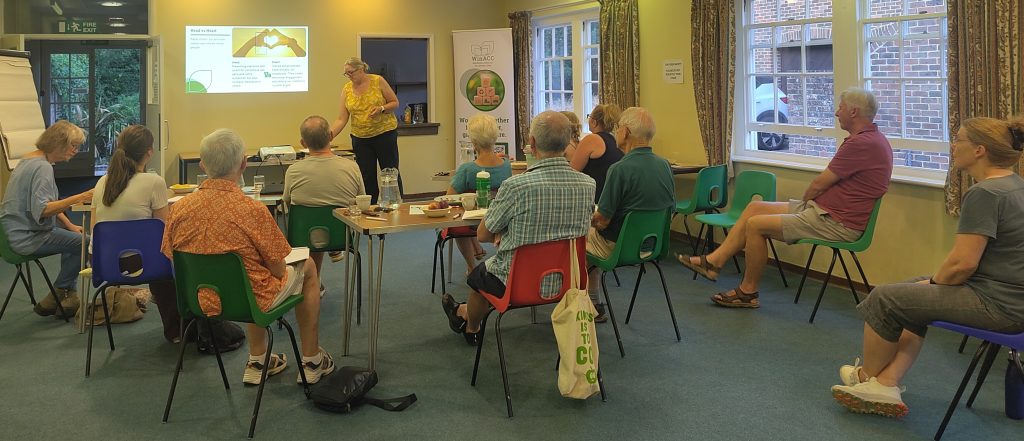
First for the evening we had an update from Stuart Mills, WinACC’s project manager on supporting the energy transition, including community-owned energy projects.
Stuart started with a My Home Made Better update – funding for this project and the home energy advice calls will be ending in October but Stu is looking at how these calls can continue beyond then. The project may restart in the future but depends on partners being successful with an application for funding.
Next, Stuart explained his current focus on supporting community energy and connecting communities to the energy system. Large-scale commercial solar farms are the quickest way for the district to decarbonise – but there can also be a big part to play for community-owned energy generation projects.
Great British Energy (GBE) was established as a publicly-owned company in 2025 to accelerate the UK’s transition to clean, secure, home-grown energy. It launched the Local Power Plan three months ago, which aims to expand local and community-owned renewable energy across the UK, providing up to £1 billion in funding.
This will be administered by the five regional Net Zero Hubs, which are agencies funded by the government and have a large part to play in the community energy transition. The GBE Partnership Fund will be accepting applications from community organisations that are in partnership with local authorities. The South West Net Zero Hub is funding WinACC and The Environment Centre (tEC) to develop the Hampshire and Solent Community Energy Network.
The newly established network has its next in-person event on the 9 September from 12-3pm at Solent University – this will include informal and structured networking opportunities and WeCAN groups are welcome to attend. Details of the event can be found here.
WeCAN groups can support initiatives like this by communicating about the potential for community energy, mapping what is available locally to identify possible sites – talking to landowners and persuading them to get involved.
The rest of the session was led by Kay Mitchell, Communications Manager for WinACC. The presentation and subsequent exercises focused on effectively communicating local climate action to people and inspiring them to get involved. It’s often assumed that if people just knew the facts they’d act – but research on climate communication tells a different story.
If the facts clash with someone’s identity or values then it can increase resistance. If you reduce the instinct to counter argue, then you see an increase in participation.
Members of WeCAN groups worked on telling the ‘story’ of themselves, how they got involved in climate action, and how their local groups started up – focusing on what values they have in common, and how those values might relate to those they want to engage and encourage to take part.
You can see the slides of the presentation and exercises here in a google drive or here as a PDF.