
According to a New Scientist article published on 24 March 2020, wildfires could become a big threat in the UK due to climate change.
In 2020, wildfires spread across large areas of Australia, Brazil, the USA as well as the UK and during the April 2020 Easter Bank Holiday Hampshire fire fighters tackled 1 fire every hour!
During this early stage of the global Covid-19 pandemic, there were shortages of many supplies including compost. This is when WinACC’s Scientific and Technical Advisory Panel (STAP) identified, through an investigation, that peat compost was being sold by suppliers in Hampshire and that some of the peat was sourced from Scotland and Northern Ireland. Peatlands are vulnerable to wildfires; many are also nationally and internally protected habitats. It was therefore a surprise for STAP to learn that peat extraction was still ongoing in the UK and being sold despite the government planned voluntary phase out on the use of peat for amateur’s compost by 2020.
Why should you care about peat?
Peatlands are the most important terrestrial ecosystem with respect to carbon storage and climate regulation.
Peat soils are carbon rich and contain a minimum of 20% carbon. Globally peaty soils cover only ~2.8 % land area yet store up to half of the world’s soil carbon. A healthy peatland can store large volumes of carbon and water, and a dry damaged peatland can neither accumulate peat nor capture carbon. It takes thousands of years for 1m of peat to form under very specific wet conditions. Peatland systems therefore cannot replace what is lost or extracted during our or our children’s lifetimes.
Peat is therefore a finite non-renewable resource.
We need to protect and restore peatland because the benefits peatlands provide as carbon reservoirs in the UK go beyond any single region. Unfortunately, ~70% of UK peatlands are classed as degraded (due to atmospheric pollution and mismanagement), and consequently are emitting an estimated ~18.5 million tonnes of CO2/year, this is over 22 times the total emissions of Winchester district and almost three times the emissions from the whole of Hampshire in 2018.
Why do I personally care about peat?
My name is Dr Suzane Michelle Qassim, and I’m an environmental scientist working in environmental quality and ecotoxicology. Living through a pandemic and a climate emergency today, I reflect on my experience as an environmental scientist, and the natural capital and important service that nature based solutions provide, such as peatland, including:
- climate change mitigation (as carbon storage)
- climate adaptation (in terms of resilience to flooding and drought)
- biodiversity locally and globally (eg for migratory birds)
- health and wellbeing through the enjoyment that natural landscapes bring to us all.
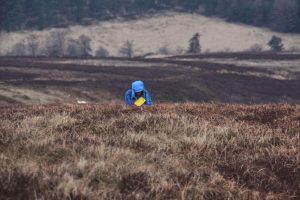
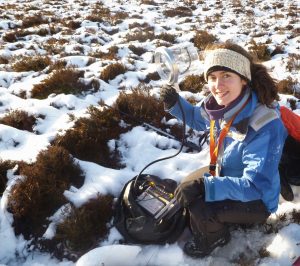
During my time undertaking research at Durham University, I spent four years researching peatland carbon fluxes and water quality. I had the privilege of visiting some of the most beautiful and remote areas, of the Peak District National Park, not accessible to the public.
One of my studies involved trekking monthly 5km up the Derbyshire Pennine Way, and ascending up 127m to the summit of Bleaklow Plateau. Carrying an Infra-Red Gas Analyser, a spare battery and water samples and sampling tools, I would walk through difficult to reach, scarred, bare land that was scorched on Easter Bank Holiday, 18 April 2003, five years previously, by a human caused wildfire which extended over seven square kilometres (equivalent to ~ 1308 football pitches).

The fire de-vegetated the site burning through the top layer of peat, leaving behind a dysfunctional system. The land was now dry, unable to effectively capture carbon or repair itself without help and resource.
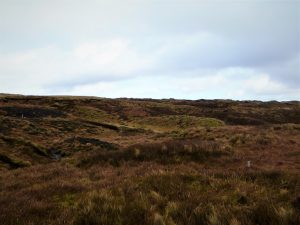
My research was intended to help assess the success of different measures used to restore the Bleaklow bare landscape. A five year £5.5million restoration project was required and involved helicopters, volunteers and many years to spread heather mulch and seeds, and install netting to stabilise the soil. Additionally gullies were blocked to raise the water table. These efforts were intended to keep the peat wet, protect the land from further erosion, and reduce the rate of peat decomposition and loss of carbon as CO2 to the atmosphere, as well as promote vegetation growth and peat accumulation.
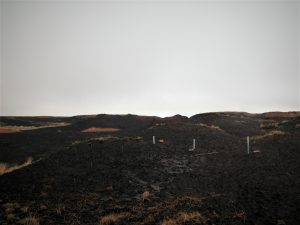
The weather conditions were often harsh, cold, windy, wet and foggy. Sitting at the top of the summit alone, clutching onto a hot drink from my thermos, there were moments where the mist would clear and I would listen out for a curlew singing, or search for a rare glimpse of a majestic endangered hen harrier. These are the moments when I felt most connected to nature, and understood the value it brought to mine and others wellbeing. On a clear day, I could look down the valley at the city of Manchester, full of people from diverse communities all who depended on this upland for the water stored in the peat, and for the potential carbon and flood water storage capacity that this landscape had in the past and could have in the future.
It will take a lot of effort and time for bare and degraded peatlands to be restored, but it is possible, and it is up to us all to take responsible actions to protect these habitats and prevent wildfires in the UK and abroad.
Here is what you can do as an individual to protect peatlands and contribute towards WinACCs 3 key Peatland Nature Based Solution objectives:
- Protect and enhance existing peatland
Fully functional, healthy peatlands are the most space efficient long-term carbon store and sink in our planet’s biosphere. The deposition of nitrogen and sulphur based pollutants form the atmosphere are key obstacles to improving the status of peatland. You can take action by:
- Tackling sources of atmospheric sulphur – linked to industrial emissions, and burning of fossil fuels. You can help by for example, driving less and not burning coal.
- Tackling sources of ammonia and nitrates in the environment linked to agriculture. By cutting down on meat, poultry, dairy and eggs (sources of ammonia – linked to slurry and manure) and opting for foods which tend to use less nitrogen inputs, eg organic foods. You could even grow your own herbs and vegetables at home.
Following these links to learn more about how to grow your own vegetables at home sustainably through Incredible Edible Winchester.
2. Use more sustainable alternatives to peat
Peat soil erosion is occurring at a faster rate than accumulation, so we must stop peat extraction in the UK and abroad by us all reducing the demand for peat and no using peat as a compost or fuel. Based on STAPs investigation in 2020 we know that peat is still being sold in Hampshire. You can take now by:
- Making your own compost at home.
- Purchasing sustainable compost based on coir, wood and green compost, or spent mushroom compost. Remember … if the compost bag doesn’t say “peat-free” then it most likely isn’t.
- Don’t use peat as fuel. WinACC does not support peat or wood burning, however should you have a wood burner we recommends you find a sustainable wood fuel provider on gov.uk, or considering improving your homes energy efficiency and using renewable energy solutions.
3. Improving resilience of peatlands to wildfire
Degraded peatland are vulnerable to fire and due to the climate emergency we are facing, there is increased risk of wildfires. During the summer, peat is especially dry and flammable and the fire smoulders unseen under the surface, making it difficult to put out. A 2020 Natural England report found that the most common causes of wildfire were camp fires (49%) and BBQs (10%). We must stop this cycle, and we can all help by:
- Only using designated areas for BBQs.
- Not smoking, having open flames or bonfires, or portable BBQs on any nature reserves and peatland.
Blog written by Dr Suzane Michelle Qassim, WinACC Science and Technology Advisory Panel member.