
What is the Local Plan?
The Local Plan is a document produced by Winchester City Council to address local housing need, the economy, environmental considerations including the climate emergency, community infrastructure as well as strategic infrastructure needs. The document is produced by Winchester City Council in its role as the local planning authority, to set out what development may be allowed up to 2038. It does not cover the whole of the district because the South Downs National Park Authority has responsibility for planning matters in a large part of the council’s area (around 40% of the district) and they have made their own plan.
The government planning a revised version of the National Planning Policy Framework ( NPPF). At the same time it has introduced a new methodology to calculate housing need. For Winchester this will result in an increase from the existing target of 676 dwellings per annum to a revised target of 1099 dwellings per annum. However the government has provided transitional arrangements which will allow local plans which are at an advanced stage to submit to the planning inspectorate and be assessed under the existing NPPF a provided they are submitted within one month of the new version being published. To take advantage of this opportunity and avoid having to re write the plan Winchester City Council has brought forward the Regulation 19 Consultation.
The website for responding to Winchester City Council is here. Deadline for responses is 13 October.

What is Regulation 19?
The Regulation 19 Plan represents the Local Plan as the council intends to submit to the Planning Inspectorate for their consideration.
It is the last stage of developing the plan before submitting the draft Local Plan to the Inspector appointed by the Secretary of State to hold an independent examination of the Plan. By bringing forward the date of submission of the plan, Winchester City Council hopes to take advantage of transitional arrangements in the National Planning Policy Framework (NPFF) and have their plan assessed against the existing version of the NPPF and existing housing numbers.
The representations made at Regulation 18 consultation have been taken into consideration in preparing this final version. This means that the Regulation 19 consultation comments will only be accepted on the soundness of the plan.
Why is Winchester Action on the Climate Crisis (WinACC) responding to the regulation 19 consultation?
We are living in unprecedented times. We are pleased that Winchester City Council has declared a climate emergency and support them in ensuring that Winchester district treads as lightly on the planet as it can. We know that we need to build more homes and infrastructure for our growing population. We respond to these plans to make sure they will create as little impact on our environment as possible, and where possible improve the environment so that we contribute as little as possible to climate change.
How to respond to the plan
This is a technical consultation therefore responses need to address the issues of “soundness” as set out in the NPPF. The Inspector will not be interested in making the Plan “better”, but just in establishing that it meets the soundness tests.
If arguing that the plan, or a policy in the plan is not sound, the response needs to say why, and what needs to be changed to ensure that the plan is sound.
Interpreting the soundness tests:
- Positively prepared – this relates mainly to strategic planning across authority boundaries and the need to meet the duty to cooperate.
- Justified – policies need to be supported by up to date and robust evidence to demonstrate need. Also the sustainability appraisal (now part of the Integrated Impact Assessment) should be used to demonstrate that the proposed strategy is appropriate and that reasonable alternatives have been considered;
- Effective – the plan should be deliverable over the plan period, so if there are uncertainties (such as highway issues at Bushfield), the policy may not be sound if it can’t be demonstrated that these issues can be resolved.
- Consistent with national policy – this is self explanatory and if a policy conflicts with national policy it cannot be sound.
How to respond – links to the consultation
The responses to the consultation are being collected online.
Click here to submit your response
The WinACC response to the consultation
Overall, WinACC supports the proposed new Local Plan. WinACC is submitting responses on various aspects of the Local Plan, including standards for housing and building, transport, energy supply and nature, with suggested improvements.
We welcome the proposed stronger standards for new buildings, in particular. Our comment is “WinACC strongly supports the Policy CN3 introduction of LETI standards. We commend the Council for setting standards which are more ambitious than the Future Homes Standard.”
We support CN5 on Renewable and Low Carbon Energy Schemes except that Criterion (v) of CN5 is not effective as it does not provide a clear measure for assessing the visual impact of development proposals for the generation of renewable and low carbon energy. “Significant impact” is too broad. It relies on subjective judgement and would allow policy challenge from a very low bar of assessment. It would allow personal aesthetic judgement to block appropriate and viable renewable and low carbon schemes from coming forward. Instead, we say that criterion (v) should require proposals to demonstrate that “there is no measurable harm to the landscape character or visual amenity of nationally designated landscapes, to be demonstrated by undertaking a Landscape Visual Appraisal or a Landscape Visual Impact Assessment.”
We support CN6 on Micro Generation Schemes.
We are concerned that under CN7 on Energy Storage, criterion (iv) of policy SP1 will discourage the provision of large scale installations. It makes the policy unduly restrictive and conflicts with the objectives of the Council’s Climate Emergency declaration. Our suggested wording is “Criterion (iv). Proposals for large scale installations should be accompanied by evidence to demonstrate that any noise impact from cooling plans has been acceptably mitigated.”
We argue that CN8 on Embodied Carbon does not fully align with NPPF Chapter 2, Paragraph 8(c) and Chapter 14, Paragraphs 157-158. The policy as currently written prioritises data collection on embodied carbon without need to meet a lower embodied carbon target, which is crucial given the significance of
embodied carbon in overall carbon emissions from construction projects. Embodied carbon often accounts for 20-50% of a building’s total lifecycle carbon emissions. Reducing these emissions is vital to achieving the District and UK’s net-zero goals. While national embodied carbon standards are still evolving, local authorities have the responsibility to adopt robust frameworks, such as the RICS Whole Life Carbon Assessment or UK Green Building Council (UKGBC) guidelines, to measure and set targets for reducing embodied carbon. We suggest new wordings:
Embodied Carbon Targets: “Major residential and non-residential developments must calculate and demonstrate how they will achieve low embodied carbon outcomes using the RICS Whole Life Carbon Assessment for the Built Environment.”
Integration with Carbon Reporting: “The agreed embodied carbon targets must be included in the Energy and Carbon Statement required by Policy CN1 and should detail the proposed embodied carbon reduction measures.”
See below for WinACC’s draft responses on nature, and then transport.
Nature aspects of the Reg 19 draft of the Local Plan Winchester Action on the Climate Crisis 2024
Reg19 Plan as a whole is unsound as there is a lack of consistency with National Planning Policy Framework (NPPF). With the suggested amendments this can be addressed.
Strategic Policy NE1 – Protecting and Enhancing Biodiversity and the Natural Environment in the District
Policy NE1 is not consistent with Chapter 15, Paragraph 180 as does not adequately address the increasing environmental and climate challenges with optimal solutions or harm avoidance measures. It fails to integrate an Ecosystems Services approach, which is essential for fully understanding and avoiding harm to the economic, social, and environmental benefits of biodiversity, natural capital, sustainable land management and communities.
Rationale
Ecosystem functions include the physicochemical and biological processes that occur within natural ecosystems to maintain terrestrial life. Ecosystem services are the set of ecosystem functions that are directly linked to benefit human well-being. Ecological networks are representations of the interactions that occur between species withing a community. Generating no harm to Ecological networks and Ecosystem services is essential for human well-being, nature and the mitigating climate change.
Without the adoption of an Ecosystem Services approach, it is impossible to comprehensively assess and mitigate the long-term effects of development(s) on biodiversity, the natural environment and communities. This plan fails to address how developments will ensure holistic resilience in response to future climatic pressures and biodiversity loss, thus neglecting to fully uphold NPPF objectives.
The Winchester District overlap with the South Downs National Park (SDNP) heightens the need for a cohesive approach between nature conservation (protection and restoration) and climate mitigation/adaptation measures across both authority regions which can be achieved with adoption of Ecosystem Services.
Recommendation
To rectify this, the Reg19 Plan should incorporate a similar approach to SDNP by introducing a new clause.
Suggested Amendment to Policy NE1:
– Add Sub-paragraph (vi): “All planning applications must include a statement demonstrating how the development impacts both positively and negatively on Ecosystem Services.”
Policy NE6 – Flooding, Flood Risk, and the Water Environment
Policy NE6 is unsound due to its inconsistency with NPPF Chapter 14, Paragraphs 167 and 168, regarding managing flood risk and addressing future climate and nature challenges. The policy does not provide adequate safeguards for managing current and future flood risks, particularly in light of the increasingly unpredictable environmental conditions exacerbated by climate change including inadequate resilient water management infrastructure.
Winchester District is already prone to frequent flooding, worsened by ineffective waste and surface water infrastructure and rising groundwater levels. Flooding is a growing risk to communities, nature and infrastructure that needs robust measures.
Relying solely on statutory consultees for flood risk assessment is insufficient with an understandable inclination to be over optimistic with the assessments due to lagging government regulation and shortage of solution funding.
The policy’s lack of mandatory requirements for Sustainable Urban Drainage Systems (SuDS) for developments smaller than 10 properties neglects important flood risk mitigation strategies amongst other options to reduce increasing hydraulic load to water management systems and the environment is not sustainable.
Recommendation
The policy should require stronger protective, mitigation and adaptation measures to prevent infrastructure being overwhelmed with increasing water load in an already overstressed systems.
Suggested Amendments to Policy NE6:
Flood Risk: “The Local Planning Authority (LPA) will only permit developments that avoid flood risk to people and property and comply with the best available techniques to prevent excessive hydraulic load on local systems. This is for both current flood-prone and non-flood prone areas.
Requirements:
“SuDS or equivalent, rainwater, and greywater harvesting systems are mandatory for all new developments and significant retrofit projects.”
“Secondary and tertiary systems, such as reed beds, rain gardens or equivalent Nature-Based Solutions (NbS) are mandatory where there is high flood risk from treated or untreated wastewater to enter sensitive receptor sites e.g., SSSIs and water bodies. This applies for increasing rainfall, malfunctioning off grid treatment plants risks or poor infrastructure.
“Other measures for surface water protective measures must include networks of other suitable vegetated areas, green roofs, swales, ponds including natural aquifer blocks to eliminate water runoff risks”.
“Sustainable surface water management plans must be adopted to ensure regular maintenance and cleaning routines especially for SuDS receptors or equivalent. SuDS should be adopted by sewerage undertakers and/or highways to guarantee perpetual maintenance and optimal functioning.”
Policy CN8 – Embodied Carbon
Policy CN8 is unsound because it does not fully align with NPPF Chapter 2, Paragraph 8(c) and Chapter 14, Paragraphs 157-158. The policy as currently written prioritises data collection on embodied carbon without need to meet a lower embodied carbon target, which is crucial given the significance of embodied carbon in overall carbon emissions from construction projects.
Rationale
Embodied carbon often accounts for 20-50% of a building’s total lifecycle carbon emissions. Reducing these emissions is vital to achieving the District and UK’s net-zero goals. While national embodied carbon standards are still evolving, local authorities have the responsibility to adopt robust frameworks, such as the RICS Whole Life Carbon Assessment or UK Green Building Council (UKGBC) guidelines, to measure and set targets for reducing embodied carbon.
Recommendation
To ensure consistency with national climate targets and the City Council’s climate emergency declaration, Policy CN8 should mandate the use of established embodied carbon assessment methodologies with a realistic target for new developments and not just the collection of data.
Suggested Amendments to Policy CN8:
Embodied Carbon Targets: “Major residential and non-residential developments must calculate and demonstrate how they will achieve low embodied carbon outcomes using the RICS Whole Life Carbon Assessment for the Built Environment.”
Integration with Carbon Reporting: “The agreed embodied carbon targets must be included in the Energy and Carbon Statement required by Policy CN1 and should detail the proposed embodied carbon reduction measures.”
In summary
By implementing these changes, the plan will align more closely with national policy and better address the pressing challenges of the climate and nature crises and protecting communities, our economy with environmental sustainability.
Transport aspects of the Reg 19 draft of the Local Plan Winchester Action on the Climate Crisis 2024
Carbon Neutrality and Designing for Low Carbon Infrastructure: Policy CN1
Policy CN1 refers to the Winchester District Carbon Neutrality Action Plan (CNAP) and promotes its values and aims. However this section of the plan is not sound::
- in that it is not positively prepared (it does not explicitly state what the target of the plan is – net zero emissions by 2030 – and does not therefore set out a strategy)
- neither is it effective (it does not include emissions targets for development and does not therefore provide an effective framework for emissions reduction associated with development).
Strategic Policy CN1 is introduced by
“The plan will help to meet the targets in the council’s Climate Emergency Declaration and reduce the district’s carbon footprint by supporting the re-use and refurbishment of existing buildings where possible and ensuring that new development is designed in a way that adapts to challenges of climate change in a positive, comprehensive and integrated way.”
The policy fails to include the target: the council has declared an aim to reach net zero emissions by 2030. This will not be reached unless the council takes every possible step. Since in 2022 transport emission were very close to half the emissions in the district, the top priority must be to tackle transport emissions. The section of policy CN1 on transport says:
In order to mitigate against climate change, development proposals (excluding household extensions and changes of use) will need to demonstrate through the design process that:
iv. Sustainable travel modes of transport have been fully incorporated into the layout in a way that encourages people to use more sustainable forms of transport such as buses, cycles or walking and reduces car dependency;
v. Recharging points for sustainable modes of transport are incorporated early on in the design and build process (Policy T3) and they are provided in conveniently located positions within the development; in a timely way to benefit residents from the first occupation;
This leaves far too much open to interpretation, as such it is inconsistent with the plan’s commitment to the Carbon Neutrality Action Plan. The adoption of LETI energy standards in para 4.27 includes references to quantitative building standards and many specific standards are given. A similar approach is needed for sustainable transport, to tackle an even greater level of emissions.
Sustainable Transport and Active Travel Policies: T1 to T4
Policies T1 to T4 are not sound: they are not positively prepared; they fail to ensure delivery at a proportionate scale the carbon emissions reductions required by the Carbon Neutrality Action Plan referenced in policy CN1 and are accompanied by supporting paragraphs that contain serious errors.
Policy T1 relies too heavily on words that require subjective interpretation, and are not specific enough to establish compliance or drive change, for example “a genuine choice of sustainable and active modes” “development that reduces the number of trips made by private car” “maximising opportunities to walk” “safe, attractive, secure and convenient and secure ways that encourage all users.” These words should be replaced with words that would not depend so heavily on interpretation. “A genuine choice” could be more unambiguously expressed as “equal route lengths of pedestrian, cycling and private car infrastructure, giving equal access.” “Safe secure and convenient” would be more unambiguously expressed by referring to sections of LT 1/20 and Department for Transport infrastructure manuals, re-emphasising the need for compliance.
Policy T2 is the only T policy that refers to Travel Plans, It would be more effective to have a policy specifically about travel plans, since these should be at the heart of all aspects of how the developer will influence and encourage sustainabletravel behaviour, not just parking. The presentation of travel plans here does nothing to prevent the nominal inconclusive nature of most developer travel plans in the district so far.
Policy T3 asks that applicants “demonstrate through the design process the need for parking.” It is difficult to know how design will demonstrate the need for parking. Some indication of the criteria that should be used to assess this and the rationale that would be necessary would be more relevant and help deliver policy CN1.
Policy T4 appears too weak to achieve more than a nominal contribution to policy CN1. Sub policy i requires connection with “the nearest” public transport stop and seems to preclude connections with other public transport stops, even if they are more useful. More closely tailored site-specific requirements within site-specific policies would be more likely to achieve the aims of policy CN1. Local Plans elsewhere often provide outline plans of connections across the whole area for walking and cycling, and specify how each development will be expected to link in. This can often supplement any overall reference to an LCWIP
We welcome the aspirations of the Reg 19 draft to develop sustainable transport. They are in introductory passages, non-site-specific policies and site-specific policies. However, without the support of quantitative requirements, it is probable that developers will underestimate the scale of the innovation necessary, planning committees will become confused, and/or appeals will proliferate, and ultimately the local plan will fail to deliver the greenhouse gas reductions that the plan’s climate policies require.
Compliance with National Infrastructure Policies
on Transport
Together policies T1 TO T4 do not take sufficient advantage of the opportunities offered by the National Planning Policy Framework (NPPF) to deliver the targets in the district’s Carbon Neutrality Action Plan. In that the local plan has failed to make sufficient use of the NPPF to tackle the problem of excessive emissions it has identified, it is not consistent with national policy.
Even without the changes currently under consultation, the NPPF encourages detailed sustainable transport policies to reduce emissions, but also allows for them to be robustly quantitative if that is the only way of reducing transport emissions sufficiently, as it is in Winchester District. The Reg 19 draft lacks the detailed guidance necessary to apply these paragraphs in a way that will deliver the Carbon Neutrality plan targets.
The NPPF has a presumption in favour of sustainable development and has as an objective for sustainable development (Para 8) (our highlighting)
c) an environmental objective – to protect and enhance our natural, built and historic environment; including making effective use of land, improving biodiversity, using natural resources prudently, minimising waste and pollution, and mitigating and adapting to climate change, including moving to a low carbon economy.
Para 11 emphasises the need for a sustainable pattern of development:
- all plans should promote a sustainable pattern of development that seeks to: meet the development needs of their area; align growth and infrastructure; improve the environment; mitigate climate change (including by making effective use of land in urban areas) and adapt to its effects;
Para 16 presses for proposals that will deliver sustainability through infrastructure; plans should:
- be prepared with the objective of contributing to the achievement of sustainable development[1];
- be prepared positively, in a way that is aspirational but deliverable;
Para 28 encourages detailed policies on specific sites:
28. Non-strategic policies should be used by local planning authorities and communities to set out more detailed policies for specific areas, neighbourhoods or types of development. This can include allocating sites, the provision of infrastructure and community facilities at a local level, establishing design principles, conserving and enhancing the natural and historic environment and setting out other development management policies
Para 110 sets out the meaning of planning for sustainable transport; the planning policies should:
a) support an appropriate mix of uses across an area, and within larger scale sites, to minimise the number and length of journeys needed for employment, shopping, leisure, education and other activities;
b) be prepared with the active involvement of local highways authorities, other transport infrastructure providers and operators and neighbouring councils, so that strategies and investments for supporting sustainable transport and development patterns are aligned;
c) identify and protect, where there is robust evidence, sites and routes which could be critical in developing infrastructure to widen transport choice and realise opportunities for large scale development;
d) provide for attractive and well-designed walking and cycling networks with supporting facilities such as secure cycle parking (drawing on Local Cycling and Walking Infrastructure Plans);
Para 116 emphasises the need for cycling and walking routes and access to public transport, in particular:
Within this context, applications for development should:
- give priority first to pedestrian and cycle movements, both within the scheme and with neighbouring areas; and second – so far as possible – to facilitating access to high quality public transport, with layouts that maximise the catchment area for bus or other public transport services, and appropriate facilities that encourage public transport use;
- address the needs of people with disabilities and reduced mobility in relation to all modes of transport;
- create places that are safe, secure and attractive – which minimise the scope for conflicts between pedestrians, cyclists and vehicles, avoid unnecessary street clutter, and respond to local character and design standards;
Transport policy supporting statements
These supporting paragraphs repeatedly allude to ways of promoting low-carbon transport modes, but like the policies fail to quantify what must be done.
Para 6.1 sets out the aspiration
“There needs to be a step change away from continued reliance on private cars as a main travel solution and the use of sustainable and active means of travel must be prioritised and made more attractive options.”
This is a welcome emphasis, but the plan needs to quantify the scale of the step change away from private car use and specify clearly and in detail the infrastructure this this will require in future developments. The aspirations of the reg 19 draft are excellent, but the detailed requirements (the overall and site-specific policies) do not soundly support these aspirations.
The Winchester City Council Carbon Neutrality Action Plan aims to achieve net zero carbon emissions by 2030. Transport emissions in 2022 contributed 49.9% of greenhouse gas emissions in the district (All emissions data from DESNZ). The local plan refers to Hampshire County Council targets in their Local Transport Plan 4 and implies it shares the same targets.
However LTP4’s targets are too modest to achieve the emissions reduction target referred to in policy CN1.. The most explicit target is a 10% reduction in car use over an unspecified period of years. There is no reduction target for any other transport modes. Most Hampshire County council climate targets are by 2050 so we can assume only that the target for car reduction is also for 2050.
Between 2005 and 2022 emissions in Winchester District have reduced at an average of 2.78% per year. If this rate continues 2022 emissions will reduce by only 22.2% by 2030. At best a 10% reduction in car use by 2030 will increase total emissions reduction from 2022 to 2030 to only 27% if transport emissions are 50% of the total emissions. 73% of the 2022 emissions will still remain and the Carbon Neutrality Action Plan aims will be defeated. Electrification of road transport could assist a little, but it is clear that the Local Plan needs to be far more ambitious on all motor traffic reduction, and far more rigorous on the need for low-carbon transport infrastructure (public transport, cycling and walking infrastructure), if it is to be sound.
Similarly paras 6.2 and 6.3 add further detail on the nature of the challenge, but again fail to specify the scale of the infrastructure changes required to reach the council’s emissions reduction targets.
Para 6.2:
“The city council’s climate change targets for the district and objectives of the City of Winchester Movement Strategy, Air Quality Action Plan and Carbon Neutrality Plan will only be met by ensuring that we prioritise development towards sustainable transport modes of travel. These include safe and accessible means of transport with an overall low impact on the environment which includes walking, cycling, ultra-low and zero carbon emission vehicles, car sharing and public transport. This is because transport is one of the highest contributors towards the carbon footprint of the district and the private car is the least sustainable form of transport.”
Para 6.3:
“The biggest challenges in accommodating development will be in relation to ensuring the development generates as little new private car traffic movements as possible and providing the necessary infrastructure to accommodate more sustainable means of travel and ensure access to facilities and services.”
Para 6.7 contains errors: it refers to and relies on the Winchester Town LCWIP draft which has now been abandoned. It ignores the subsequent (May 2024) “District Focus” LCWIP consultation draft
The Hampshire County Council website currently (October 2024) says “It is expected that the final District Focus LCWIP document will to go to an executive members decision day later this year. Please read the draft LCWIP report. The “urban” City Focus LCWIP document is currently being developed and will be available for public consultation early next year.”
The District Focus LCWIP (i.e. the district outside Winchester Town) is strong on aspiration and tentative on proposals. It proposes a debate on four core walking zones.
It makes timid, unfunded, tentative proposals on 8 mostly disconnected “primary” cycle routes and identifies ‘secondary’ and ‘local’ cycle routes but is far from comprehensive.
Para 6.7 is entirely inaccurate. There are currently no LCWIP proposals for Winchester Town itself. The proposals the Reg 19 draft refers to have been withdrawn. Elsewhere there is little sign of progress. The failure to recognise the lack of agreed proposals for promoting active transport obscures the need for the local plan itself to set out specific active travel requirements in its policies and to specify for each development what would be adequate provision of active travel and public transport infrastructure.
Paragraph 6.11 contains too little detail or quantification to actively succeed in enabling sustainable transport and achieve the climate aims of the plan
The sections aimed at promoting facilities that will encourage active travel and public transport use are far too vague to have sufficient impact to achieve the council’s carbon targets. It is good to see sections in site-relevant policies setting out in principle an approach to active transport.
We would like to see policies that include measurable standards on active transport for new developments. We give examples of the type of quantification we believe necessary to make the plan sound:
- allocated sites to contain, at least, 0.12 linear miles of a) mobility scooter / cycling and b) walking infrastructure per hectare of the allocation. This standard is based on the scale of what would be needed in slightly upgraded mobility scooter / cycling and walking infrastructure at Badger Farm.
- primary (front door) access to all dwellings to be from a footpath/cycleway (like St James’s Terrace, Winchester) and that car access will be secondary at the rear of dwellings.
- Car parking limited to parking spaces and spaces limited to 1.2 spaces per dwelling.
- Sufficient infrastructure to enable direct cycle / mobility scooter / walking access from every dwelling to key local facilities and bus stops within 15 minutes’ walk (¾ mile)
- Development of key essential local facilities that do not already exist to reduce transport demand
- Requirements reflecting local circumstances referring to links with specific local bus stops, schools, and shops etc.
- Where active travel infrastructure is poor within a 2-mile radius of the site a contribution (CIL, s106?) to its overall improvement.
Paragraph 6.13 is misleading and unrealistic about cycling growth
It is true that the pandemic increased the volume of cycling but that increase has subsequently been more than reversed, especially with the massive increase in motor traffic. The plan will have to increase the steps it proposes to promote active transport to make the support for its aspirations sound.
Paragraph 6.14 proposals are unlikely to reduce car use or reduce emissions
The specific proposals offered are not positively prepared and are insufficient for meeting the carbon reduction targets of policy CN1:
Park and Ride: any additional car parking facilities can increase car use, and additional park and ride facilities are no exception to this. At best new proposals will be expensive and have a slow marginal effect on traffic volumes across the district without reduction in parking facilities in Winchester Town.
Hydrogen as a transport fuel will reduce emissions only if it is green hydrogen, and this is approximately four times the cost of battery-electric power using green electricity. Currently references to hydrogen as a transport fuel will merely encourage CO2 emissions from gas-based production. The reference here is inappropriate.
Other suggestions need to be added to meet the reg 19 draft’s aspirations such as comprehensive walking and cycling networks, extensive public transport facilities, developer contributions to new railway stations etc.
Site-specific Policies
These share the weakness of the strategic transport policies. They focus on the aspirations but do not specify the scale and nature of the infrastructure necessary if the Local Plan is to play a proportionate part in achieving the implicit aims of policy CN1. They are not positively prepared or effective and fail to make the local plan sound. Examples of this are:
Policy W2
on Sir John Moore Barracks requires that detailed proposals accord with the Development Plan and demonstrate how proposals will accord with the following:[…] viii. Include direct, safe and lit, active travel links as part of a strategy that minimises car journeys from the development. High quality facilities for walking, cycling and wheeling and public transport that is connected to the surrounding area/ PROW/cycle network in accordance with the Hampshire Movement and Place Framework and Healthy Streets approach.
However, too much is left to interpretation. More specific guidance is needed to ensure potential developers reduce transport emissions to the necessary extent.
Policy W5
Section v mentions some links, but there is insufficient specification for the standards to which they will be built. Neither the Winchester District LCWIP, nor the Winchester Movement Strategy have mentioned Bushfield Camp, so the reference here is of no value.
Policy W6
Sub-policy v is almost negated by the introduction that “proposals should seek to maximise opportunities” to create or improve pedestrian/cycle links. This is so tentative that even the least effectual inaction would be compliant. To be positively prepared the plan should simply require the delivery of these things. Even better it could specify the links that are needed. Similarly, a simple requirement for public transport connectivity would seem necessary, too.
Policy W8
Para 12.74 onwards and Policy W8 are inconsistent about a transport interchange at the railway station. The strategic value of this site to effect transport emissions reduction across the whole district will not be realised.
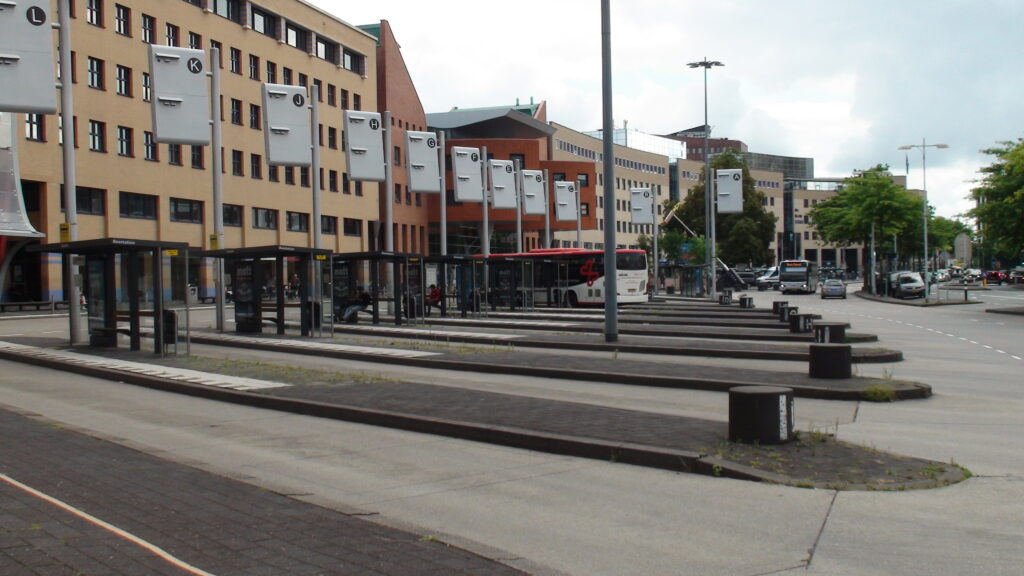
The essential element of the vision for the Station Approach Area in para 5.59b to co-locate the bus station at the railway station to create a transport interchange is not reflected in policy W8 and needs to be added. The September 2024 draft plan does not provide for this at sufficient scale. To provide an interchange capable of delivering Taktfahrplan interchange facilities on the Swiss model, the type of facilities capable of reducing car use at the necessary scale, will require far more land than the current plans have allocated. It will certainly not be possible to do this in a square shared with pedestrians in front of the station. The bus transport interchange at Amersfoort in the Netherlands, for example, indicates the scale of what would be required:
Policy W9
To support policy CN1, the plan would be positively prepared if it were to reserve parts of development sites for parts of through active travel corridors. Sub policy vii should include the requirement to create a cycling and walking route across the site from Welland Road to the Leisure Centre as the first stage in a through active travel route from Winnall to the Leisure Centre.
Policy W11 University of Winchester / Royal Hampshire County Hospital
Sub-policy iv is disappointingly vague. Here is an opportunity to build in pedestrian and cycling permeability across the site and to provide a route away from but parallel to Romsey Road to encourage modal shift and support policy CN1.
Policy SH2 North Whiteley
This policy is not sound in that it fails to follow the sustainable transport provisions of the NPPF or support Policy CN1 in any meaningful way. Sub policy iii mentions a public transport strategy, but fails to specify a railway station at North Whiteley. At the northern tip of the development, on a rail line with spare capacity, this is an opportunity to support policy CN1 that should not be missed. Policy iv is wrong to suggest that enlarging junction 9 of M27 will encourage modal shift. The accompanying Botley by-pass Policy SH6 will increase emissions even more and undermine policy CN1. A development as large as this should include extensive requirements for pedestrian and cycling internal networks, direct cycling and pedestrian connections to the north, and requirements for bus connections to Eastleigh and Bishop’s Waltham to supplement the current bus connection with Fareham.
Policies BW1,2,3,4
Together these policies will have a major impact on Bishop’s Waltham, and to be sound they should share general sustainable transport requirements to provide sustainable transport infrastructure across Bishop’s Waltham, especially cycle and pedestrian infrastructure, and public transport routes linking Bishop’s Waltham with Winchester, Botley, Station and Fareham more effectively.
Policy NA2 Sun Lane, New Alresford
Sub-policy v is worded in such a way that it conflicts with the tone of the rest of the document promoting sustainable transport. It says “access to the site should be primarily from the south by means of a new junction onto the A31” The word ‘car’ should be inserted at the beginning of the sentence. Following this, sub-paragraphs vi and vii are vague and non-specific. The policy needs far more detail about the types of cycling and walking networks required to make the policy compatible with the NPPF and policy CN1 and ensure the development is sustainable. It needs to say where the cycling and walking routes should go, how many of them there need to be, and how they will relate to bus services in Alresford. A requirement to support buses serving the development should also be included.