
Jo Crocker Executive Director
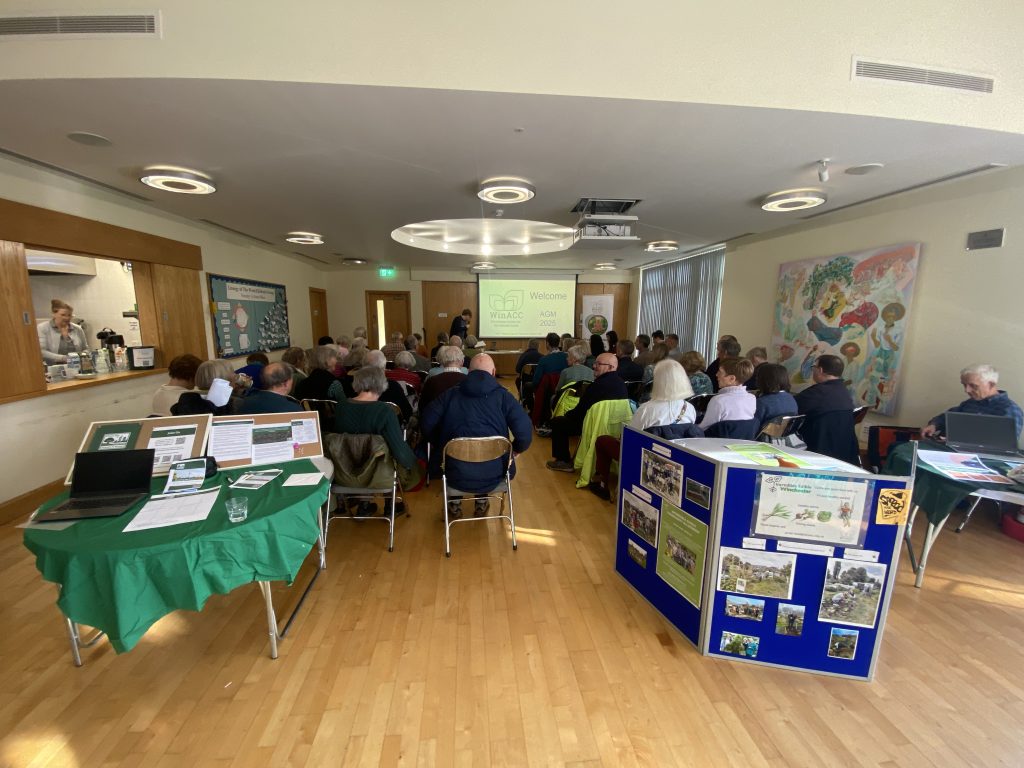
It is important to look to the future whilst understanding the context we are working in.
Internationally, in 2024, global temperatures reached a new record, exceeding 1.5°C above pre-industrial levels for the first time (Carbon brief analysis). This week COP 30 is happening in Brazil.
Nationally – The Climate Change committee report to parliament earlier this year says Government effort so far on preparedness and resilience, is inadequate – putting pressure on them for stronger leadership and policy.
Regionally, devolution creates opportunities to remove structural barriers to impact e.g. around transport, and Local Authority reorganisation will impact where and how we work.
Locally, we know that:
– Winchester has the highest per capita emissions in Hampshire 6.6 tonnes as opposed to 4.6tonnes
– Emission reduction is complex, involving multiple local entities
– Mis and dis-information distorts climate solution action
But we also know that:
– 64% of Winchester’s population supports net-zero, this is above the national average.
– 90% of Winchester’s population support renewable energy projects in the local area……..this is not a persuasion exercise…it’s about enabling action
Our new strategy equips us for the next 5 years: WinACC aims to urgently drive systemic change towards a net-zero carbon Winchester area with communities and decision makers
What do we mean by systemic change? Tackling the causes of complex problems, not just the surface issues. It’s about understanding how everything is connected – people, ideas, power, place, ecosystems, values, decisions. Instead of quick fixes, it’s about creating deep, lasting change. No one organisation can take this on. We’re all part of a system, and a system that needs to change. It is, I think, the work of our time. Collaboration is key.
Objective 1 Inspire and enable communities and organisations to care about climate change and act.
We know from our annual survey over recent years that the majority think systemic change will have most impact, that most think individual behaviour change is the easiest to do, and that taking collective climate action is felt by most to be the hardest.
So, we can be useful in supporting communities to take collective action. And the work through our WeCAN project (supported by WCC and SDNPA) – currently 17 groups in a learning network across the district – means 51 000 people living in the District have access to a local climate action group. That’s a bit more than ⅓ of the population.
We want to grow that to half the population of the district.
These groups are running repair cafes, doing future energy landscape workshops, running regular climate cafes, school bike buses, thermal imaging schemes… but more than this, learning from each other, supporting each other when it is hard, persisting, accessing funding, inspiring others in their communities, building resilience.
Objective 2: Share zero carbon solutions and expertise to enable local change.
We have channelled the learning and expertise built up through the Winchester Superhomes project to connect with others locally for My Home Made Better – our new Retrofit Advice hub with the Environment Centre, PeCAN and Energy Alton. Partnership enabled access to a scale of project we wouldn’t have managed on our own, covering Hampshire, Portsmouth and Southampton.
We know that the downward trend in Winchester District emissions correlates with decarbonisation of the grid. The energy transition will continue to provide ever more opportunities. WinACC plans to be a confident and resourced part of this – whether it is to do with reducing energy use, through retrofit, including historic buildings; energy infrastructure; or local renewable energy generation.
The largest contribution to emissions comes from transport. New opportunities will open up for work on transport as the new Mayoral Strategic Authority takes over from Hampshire County Council. As you’ve heard, we’re already leading the way in cross Hampshire and Solent preparation for communicating with Mayoral candidates and the new Strategic Mayor about how climate can be tackled through their work. This is crucial in setting the context within which all our other work will happen.
Objective 3 Connect people and partners to accelerate impact.
We’ve a foundation of partnership working – with 70 partnerships identified in our recent strategic review, local, regional and national. We will continue to build strong partnerships to accelerate the change we can bring about together.
A core thread of our work is about connecting local voice and collective action with leaders and policy making. In July at the climate coalition Mass lobby where more than 5000 constituents from across the UK met with their MPs, WinACC had a stall at the member organisations base in the QE2 centre – we were the only community based climate organisation there.. For 7 hours we had a constant stream of people from across the country interested in the work we do, how we do it and wanting to learn from us. Of particular interest was our work on large scale solar, and our community engagement through WeCAN. We’ve been asked to be on the panel of speakers at the climate coalition’s AGM next week to share this story – the event being themed “Building and Sustaining our Collective Power”
One commentary I read on COP30 detected a strategic shift – that climate delivery is increasingly inseparable from social infrastructure, accountability, and public trust. I believe that through WeCAN we are creating a social infrastructure for change, which connected to the expertise of our action groups and delivery of funded projects, means we are living out this realisation.
The next 5 years is crucial in terms of climate action. We need to build resilience and adapt to a warming world. What I heard time and time again from scientists, academics and political leaders at the Global Tipping conference in the summer was that ‘Every fraction of a degree matters when it comes to the effects of global temperature rise’. What we are doing, matters.
Being part of WinACC is more than just supporting an organisation – it is commitment to pulling together to face the climate crisis – when we are desperate to draw out and live out the transformation we know it requires of the way we live life. We’ve got our work cut out, not least in terms of funding the work we want to do, the work we know we could do, but I look forward with determination and hope, encouraged by the difference we’ve already made, convinced that WinACC has an important part to play, and empowered by the commitment and support of everyone here.
Jo Crocker
WinACC Executive Director