
‘Our running costs are £75 per month for a 5 bedroom house’
My name is Rob Veck, and I am a retired project manager by profession. At the beginning of 2008, I had finished a major project at my company, and decided to retire. One of the motivating factors was Richard Heinberg’s book “The Party’s Over” (a scary book relating energy to human population growth – what goes up…). I decided to undertake a new challenge to reduce the carbon emissions and energy footprint of our house as close to zero as possible.
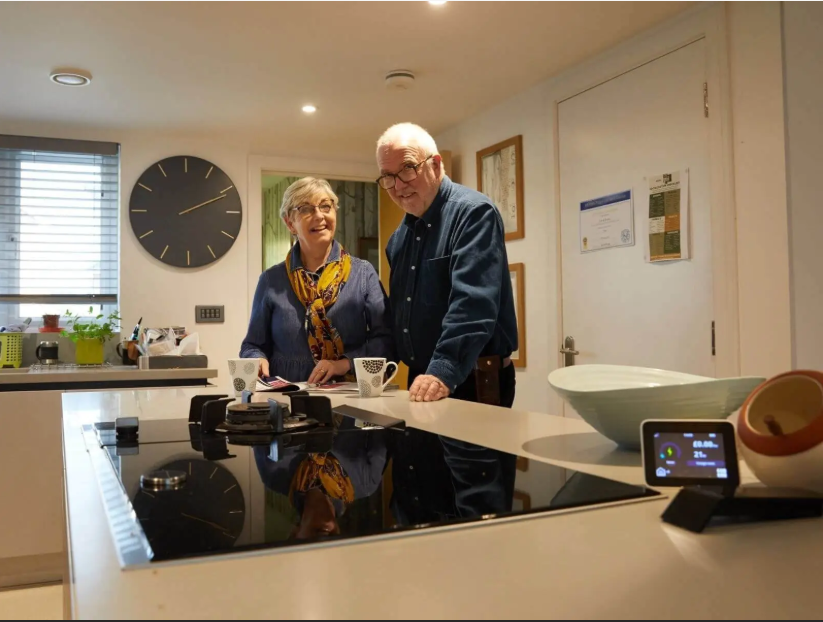
Rob with his wife Sue in their home
In 2018 we suffered a major leak from our water tank located on the second floor, which required the inside to be completely gutted, dried and rebuild. We suspect the leak was due to the solar hot water providing too much heat to the tank causing the cold water feed to come off.
The water tank is now on the ground floor.
Motivations:
Our original goal was to meey the Kyoto agreement to reduce emissions by 80% in 2050. However, this has now been replaced by a net zero goal which has been achieved for the house and the electricity supplied to the a PHEV car.
Measures:
- Loft Extension 1989.
- Refurbished kitchen 2000.
- Refurbished toilets and bathrooms + condensing boiler 2006.
- Ground floor extension 2009.
- New drive with rain water harvesting tank 2013.
- Kitchen upgraded to include under floor insulation 2013.
- Internal completely refurbished in 2018/2019.
Benefits:
We now have a comfortable house with running costs at £75 per month which covers our heating, charging the car, and power used by the house for appliances and heating. Low cost Octopus tariffs and solar power help achieve this low running cost, so a running cost of £150 to £200 gives a different figure if the tariff was on the standard capped rate. Our water usage is approx 700 litres per week for 2 people, and is approximately £20 per month depending upon weather conditions.
We took the attitude that the investment in out house was better than buying an annunity which is an entirely different approach to the “pay back”period. We think we have achieved that with the savings we make compared to the investmentwe have made. Hopefully our house is a positive legacy for the next owner.
Installed Measures:
- Ceiling insulation – Energain panels in 2 rooms to enhance thermal mass for loft extension.
- Air Sourse Heat Pump
- Homely AI management system to minimise running costs.
- Open Source Energy Monitor to check the system is running efficiently.
- 2 years of weekly data provde that AHP really do work efficienly.
- Available upon request.
- External wall insulation (Celotex) based on rain screen cladding with a U value of 0.14 W/m2K.
- External wall insulation on extension – 200mm celotex onto solid wall 212mm thick concrete blocks. Use of 10mm of Spacetherm (aerogel) on window edges and lintles. Rest of house: 110mm insulation (note: cavity wall insulation already in place)
- Floor insulation – 165mm Celotex under floor (except down stairs WC). Polystyrene panels for extension to achieve a U value of 0.10 W/m2K
- Loft insulation – 290mm Celotex on sloping roof and additional 150mm celotex on flat roof of dormer. Additional 200mm on dormer walls (with 100mm glass fiber insulation already in place).
- Low energy lighting – 80% of lights replaced with LED 1watt GU10 bulbs
- Mechanical Ventilation heat recovery – Villavent system
- 3.85kWp PV System; 22 BP 4175YT panels wire in 4 strings
- Solar hot water – Navitron SCM15-58/1800
- Triple glazing installed in dormer windows and extension. New front & back door from Green Building Store with a 0.8 U value
- Water saving devices – dual flush toilets, rain water harvesting
- (Contura Wood burning Stove – no longer used due to enviromental issues.)
- Recycled flooring & decking for back garden
- Halstead 3500 litre rainwater harvesting system supplying washing machine, 2 toilets and gardens
- Myenergi Charging point installed for electric vehicle. Electric vehicle in combination with a low carbon source of electricity.
- Smart home technology to monitor running costs and automatcally schedule appliances when free / low cost electricity available.
What Surprised us
‘Our running costs are £75 per month for a 5 bedroom house’
It continues to surprise us that people in general don’t believe you when you say you have running costs of £75 per month for a 5 bedroom home, and glaze over when you say you have achieved net zero on the house.
What didn’t meet our expectations
The experience level of the installers. Remedial work was required to improve the installation of the Air Source heat pumps only because I had educated myself online from experts in the field (eg Heat Geeks).
What we wished we had done differently
We had the opportunity to install underfloor heat through the house when it was refurbished after the flood, and have an air pressure test to find the leaks where drafts can appear.
What would I say to others
Decide what level of investment you want to make in your home. If you are planning to move, then use the pay back approach (number of years it will take to break even) PLUS the value it will add to your property when you come to sell it. Installation of Solar PV with a good battery system makes good sense (see YouTube “Gary Does Solar” who provides good independent advice).
If this is you “forever” home, then look at the cost of retirement annuties. Compare how much it would cost to buy one that covers you and your partner index linked with the return you can get by saving on your energy costs by investing in energy saving improvements. Remember, when you retire or work from home, you will be using more energy for heating and running the home.