
Itchen Abbas village hall solar photovoltaic and open-loop water source heat pump installations
Itchen Abbas Village Hall, on the outskirts of Winchester, has taken steps to become more sustainable by embarking on a series of energy saving and renewable energy microgeneration initiatives. In 2023 solar panels were installed on its roof, with the aim of reducing energy bills and contributing to environmental conservation.
The village hall, managed by volunteers, successfully raised over £10,000 through crowdfunding and received an additional £4,000 grant from Winchester City Council to fund the solar panel project.
By harnessing solar energy, the hall not only benefits the local community but also demonstrates a commitment to greener practices and a lower carbon footprint.

Solar Photovoltaic Installation
The village hall has saved over £500 in electricity since 1 April 2023 based on the reduced consumption over the first year, and also saved about £100 by heating water from solar over the summer. From next July onwards when they expect their electricity price to nearly double, they will save even more. Now that they can turned the gas off, they will save even more, given the gas price was set to treble. They do not expect to save much during the winter.
Next year they expect energy costs will be about £1,500 less than they might have been without the solar input, which is an 8.2% return paying off the capital over 20 years. Apart from the benefit of the reduced carbon footprint this will also reduce hire charges to the community for this facility.
Cost breakdown of solar installation
| Solar Panels | C2 Renewables | £ 22,980.00 | ||
| Structural Engineer | Challis | £ 450.00 | £ 23,430.00 | |
| LoCASE | £ 9,192.00 | |||
| Winchester City | Greener Futures Fund | £ 4,000.00 | ||
| Crowdfunder Local contributions | £ 5,859.74 | |||
| Direct contributions | £ 1,170.00 | |||
| Montessori | £ 700.00 | |||
| HMRC | Gift Aid | £ 1,669.00 | ||
| IAAVH | Own Resources | £ 839.26 | £ 23,430.00 | |
| Balance | £ – |
Open Loop Ground Source Heat Pump
Itchen Abbas Village Hall has further progressed its microgeneration journey by installing an open-loop water source heat pump in 2024. The locality is not new to water generated power. Avington used to have a coil in the lake, but it was expensive to run and was not economic.

This is an ‘open loop’ as opposed to closed loop water source heat pump. Closed-loop systems are more prevalent as they can be installed virtually anywhere. Open-loop on the other hand requires access to an adequate water supply or aquifer. The lack of understanding of open-loop systems and their potential is one of the barriers to the wider adoption of this technology in the domestic market.
Itchen Abbas Village Hall benefits from its proximity to the River Itchen and also from the fact the river is a chalk stream and ideally suited to this technology because it does not clog the system with silt. Visually there is virtually nothing to see, just a couple of manhole covers on the ground. The water comes in from the river at 11 degrees centigrade, always, all year round. This is why it is also good for growing the watercress!
A Borehole Record from the installer is sent to the Environment Agency. This is a one-off test basically saying 5.5 cubic metres (skip full an hour) an hour for 4 hours (at the 4 hour point it was at 5m depth). In this instance pumping depth recovered to 3.2m in 5 minutes from an initial 3.3m. This indicates that there is so much water they will never run out.
How the system works
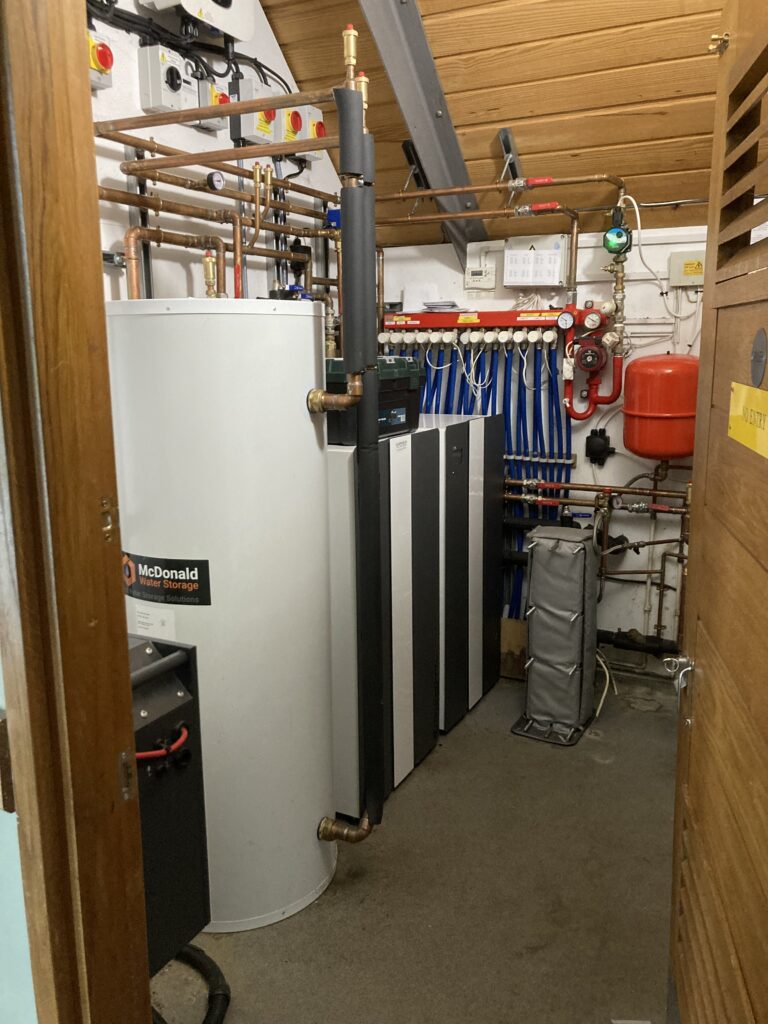
The water comes in at 11 degrees via the pipes which come into a plate exchanger (like a car) and transfers its heat to a glycol water mix in the pipe.
Then it goes into heat exchangers x2 – a bit like a fridge. Heat is extracted from the water with a gas and the temperature raises from 11 degrees to 46 degrees.
The water at 46 degrees then moves to a buffer tank (cylinder) a bit like a storage tank and from there goes to the blue water pipes, a pair (out/in) for each of the four zones in the hall, for the underfloor heating. The blue pipes have thermostats which go on/off at the required temperature and can also be regulated by a timer.
On the day of the visit the water from the underfloor pipes was coming back at 40 degrees and the heat exchangers were off because there was no need for them to operate. The hall was at 22 degrees, probably due to good solar gain.
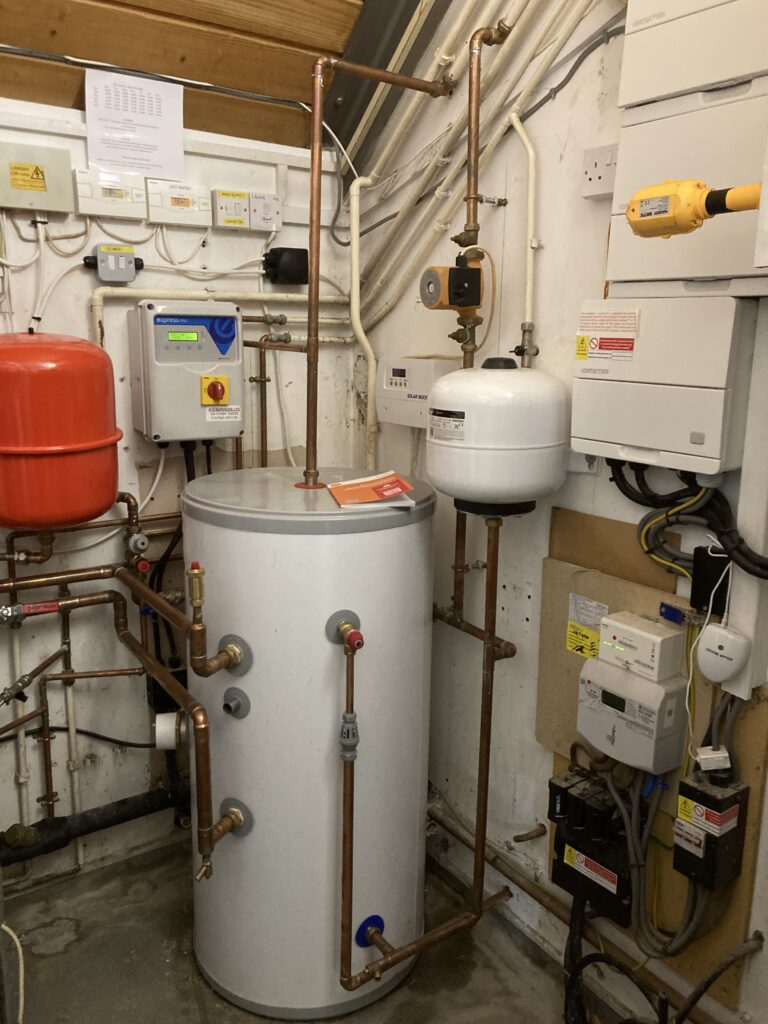
One of the heat exchangers supplies another storage tank (cylinder) for hot water usage in the hall. This one has to be kept at 60 degrees because of legionella (on a 7-day circulation).
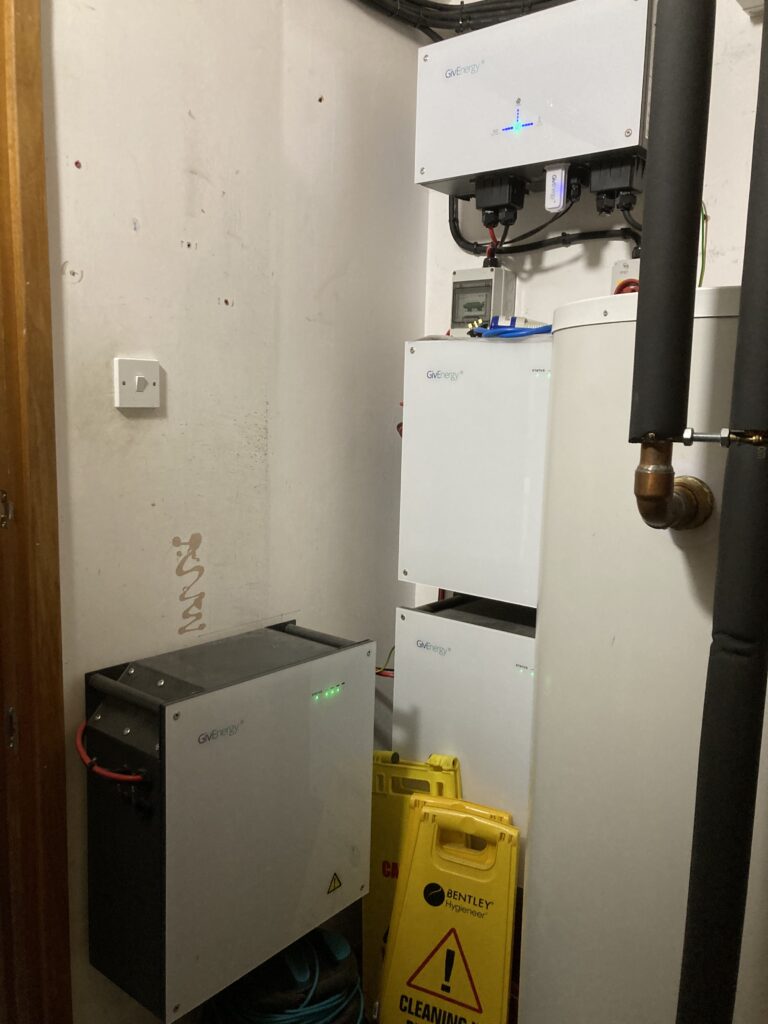
Solar power generated from the roof comes in via 2x inverters and from the inverters it goes to a hierarchy of options:
- It goes to the consumer unit first (like a house)
- Second it goes to the battery for storage – 3x 5kW batteries
- Once these are full, it goes to the immersion on the second tank
- And lastly, if the tank is hot enough, it goes to the grid
The sum effect is that the hall is self-sufficient in electricity and hot water in the summer. The situation in the winter is not yet known because the systems have not been in place long enough yet. In the summer they will switch off the water pump system and just use the solar system to heat the immersion heater.
Problems/issues
It has been very time consuming registering the system with British Gas.
The system has gone down a couple of times – drop in pressure. But HD Services (the borehole engineers) came fast to resolve the problem.
The pipes get pretty hot and the intention is to lag them to conserve heat. But the system is still bedding in and it is useful to observe things first.
Costings
The borehole cost £20K and altogether the system cost around £58,000 funded 50:50 by the UK Shared Prosperity Fund and HCC. The application process was supported by WinACC to get the grant funding. They did not get the Boiler Upgrade Scheme grant even though it seemed they would be eligible. But they did benefit from the change in VAT rules for charities (VAT at 0% from February 2024).
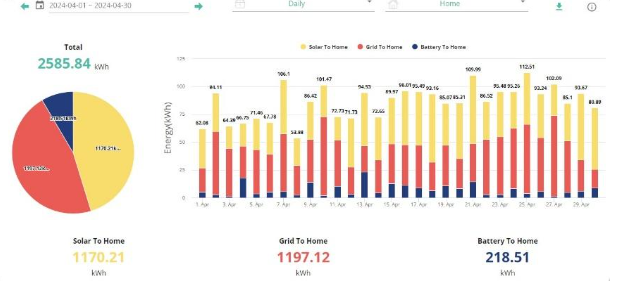
A cost comparison has been difficult because the meter is currently broken. But they consumed £700 cost equivalent for power in April 2024 (which they could deduce from their solar app) and only bought about half of that. Whereas in April 2023 they spend £645 on energy. Gas and electricity prices have fluctuated in the period as well because of the conflict in the Ukraine, so comparison is difficult because of that too.
Christopher Langford, the Chair of Itchen Abbas and Avington Village Hall said that in addition to the cost of the borehole work, “we paid £3,755 for a suitable hot water tank, £1995 to move the soakaway far from the borehole and £1255.57 on electrics – so a cost of £58,865.57. We have received an equal £28,000 from each of Hampshire County Council and the UK Shared Prosperity Fund meaning a net cost of £2,866. We did not pay VAT as a relief for energy saving equipment for charities came into force at the beginning of the year, and we missed out on a Boiler Upgrade Scheme grant of £7,500 because we had other government funding. We have further costs to go, integrating the heating controls into our booking system.”
Coefficient of performance (COP) is averaging 4.29
Still to do
- Pay to remove redundant gas boilers
- Do some lagging of pipes
- Aspiration to ‘manage’ the system using Hall Master which a booking system that could automatically control heating depending on user hire. This would potentially cut down energy usage even more.
They have already changed all lighting to LEDs, and insulated to 8” above the kitchen ceiling. But they leak around the doors and the double glazing is only 5mm (not 20mm). Secondary glazing would be beneficial but there is no plan for that at the moment.
Christopher says he has found the whole process very interesting, a voyage of discovery, and they are still learning! Obviously not everyone can have this system mainly because of real estate, but also capital cost, and there are proponents on both sides on the value of open versus closed loop systems (type Open Loop vs Close Loup GSHP into google.) He says they have been well supported by WCC & HCC and in return have promised to disseminate their experience, if anyone wants to know more.
Go Greener Faster in the Hampshire Chronicle
Winchester City Council awarded funding for the installation of solar panels on a village hall’s roof. The funding was provided from the council’s Greener Futures Fund via Crowdfunder which was open for applications earlier this year. The Itchen Abbas and Avington Village Hall applied for the funding for solar panels as part of its sustainability efforts and to reduce energy bills. The charity, managed by volunteers, raised more than £10,000 from both Crowdfunder and a grant of £4000 from Winchester City Council.
Cllr Kelsie Learney, Cabinet Member for Climate Emergency, said:
“The city council has made a commitment to go greener faster and we’re very pleased to be able to help support businesses and community organisations to not only lower their carbon footprint but save them money too. Itchen Abbas and Avington Village Hall’s solar panel project is an excellent example of how this funding can be used and we’re proud to have supported it.”
Christopher Langford, Chair of Itchen Abbas and Avington Village Hall, said:
“The Winchester City Council Greener Futures Fund operated through Crowdfunder has supported us to raise the money to put solar panels on the roof of our village hall this will help with future hire charges to benefit the local community.”
The council has other grant initiatives available for community organisations and businesses to become greener.
In addition to installing solar panels on its roof, Itchen Abbas Village Hall has taken other sustainable initiatives:
- Green Homes Fair: The Itchen Valley Parish Council hosted a “green homes fair” at Itchen Abbas and Avington Village Hall. This event aimed to encourage residents to reduce their domestic carbon emissions. Over 50 residents attended the fair to discuss sustainable energy and learn how to make their homes greener
- Community Engagement: Itchen Abbas Village Hall prides itself on being flexible, warm, and welcoming. Managed by volunteers, the hall actively engages with the local community to design events and make them truly special. By fostering community involvement, the hall contributes to a sense of shared responsibility for sustainability and environmental awareness
These initiatives demonstrate the village hall’s commitment to environmental conservation and community well-being.