
The Solar landscape- a response to the climate emergency
Climate Change is causing landscapes to change, and not in the way we want it to, though we have the power to make nature and the environment work together again.
As a community we can address the unfolding climate emergency, but we must look to embrace the change into a renewable landscape. It is no secret that effects of climate change are already being felt throughout the UK’s natural ecosystems. The increased pressure on the UK’s insects and birds to adapt makes these species most at risk of extinction. In order to combat this, it is essential to stop the pollution and degradation of our natural ecosystems. In addition, societies must look to put in place environmental protections both for today and tomorrow, whilst continuing to push for a full transition to green sources of energy.
Providing enough green energy to supply both households and businesses nationwide is a difficult challenge, but one that must be overcome together if we are to create a more sustainable landscape. There are positive signs to show that this is possible and change is underway. The UK is the first major global economy to pass a net-zero emissions demand into law. With a law requiring all greenhouse-gas emissions to be at net-zero by 2050. This is in addition to targets that aim for 100% clean energy by 2030. Despite ongoing concern over the future reliance on fossil fuels, the UK is heading firmly in the right direction in regard to its divestment from oil and gas. National greenhouse gas emissions from agriculture and land-use have been steadily falling since 1990 whilst renewable energy production exceeded 1 trillion Wh for the first time in 2023.

Source: dep. For business, energy and industrial strategy-gov.uk
The data from this graph shows greenhouse gas emissions have been mostly decreasing since 1990 from two major sources: agriculture (dark blue) and Land use/forestry (light blue). This is compared to all UK net emissions (Red).
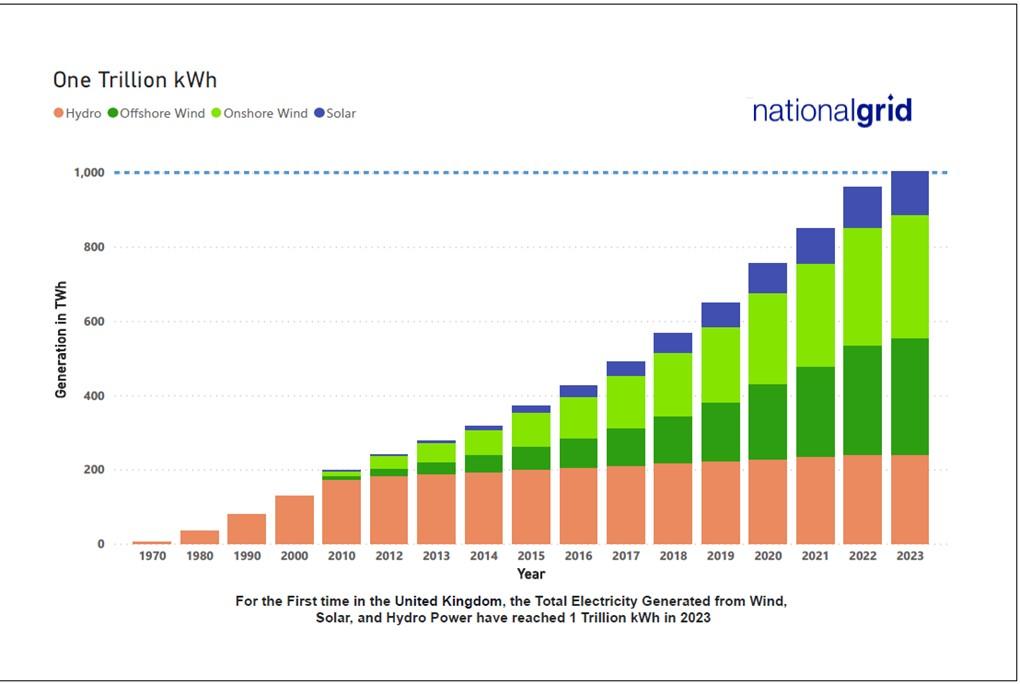
Source: National Grid statistics
The graphical representation of the data from the statistics of the National Grid shows how solar energy production (blue) has been steadily increasing since 2010. This alongside other sources of renewable energy such as wind (light and dark Green) as well as hydroelectricity (orange).
The statistics show, the generation of solar-powered energy has been on the rise since 2010 and now comprises a noticeable proportion of all renewable energy generated in the UK. Nationwide, solar energy production has the potential to power between 15-20 million homes (a total capacity of around 15-17 Gigawatts) (GW), however, the south of England has the most potential for solar energy production due to consistently higher luminescence (productive sunshine hours) throughout the year. Solar energy in the Winchester district has the potential to become a focal point in community led efforts that work towards achieving regional carbon-neutrality/net-zero emissions in the local area by 2030 with both current and future installations in place.
In 2019, Winchester City Council declared a `climate emergency`, pledging to directly address the climate crisis through divestment from fossil fuels whilst providing sufficient green energy to meet the target of becoming a fully sustainable local authority by 2024. This has prompted considerable interest from developers who are looking to install solar farms that would supply Winchester and the surrounding area. There are several new solar farm planning applications which have recently been approved and include South Lynch Farm in the parish of Hursley ( South Lynch, Winchester | Project | Innova) and land North and East of Denmead Farm, Edneys Lane, Denmead, Denmead Solar Farm | Enso Energy . If completed to specification, these installations would produce an output around 70 Megawatts (MW) into the local energy grid which would be sufficient to power over 16,300 homes. In addition to this, the farm would help remove over 15,000 tonnes of greenhouse gases per annum year, greatly helping to improve the drive to a more sustainable district. There are two further applications in the pipeline, with Titchfield Lane near Wickham https://conradenergy.co.uk/energy-generation/renewable-power/solar/titchfield-lane-solar-farm/ and another at Glebe Farm https://ethical-power.com/projects/glebe-solar-bess/ amounting to 10MW.
For more information on the planning process of the South Lynch solar farm and how the local community are involved with shaping the development, please see the previous WinACC posts on this topic. Relating to this piece however, efforts have been made to highlight the positive gains to wildlife and biodiversity the installation would help facilitate, and by ensuring that all steps have been taken to address public concerns over the perceived environmental and visual disruption that solar farms are frequently associated with. Numerous specialist environmental surveys have been conducted to provide positive answers to all the questions presented by feedback.
Positive community engagement will have to take centre stage if a new `solar landscape` is to emerge in the Winchester area and beyond. Whilst full divestment from fossil fuels is essential if we are to tackle the climate crisis, ensuring that concerns of local communities are comprehensively addressed when it comes to the providing alternative sources of energy is equally as important. Given ongoing concerns over future commitments to green energy promises coupled with growing threat of widespread species decline, community driven projects will play a huge role in creating a `greener landscape` where solar (and wind) farms are seen as an extension of the natural world.
Post written by Matthew Seenan, WinACC intern.