
This application has been withdrawn by the developer.
This summary was prepared to offer assistance for responses to this specific planning application. You’ll find more general comments in WinACC’s overview of Solar Farms.
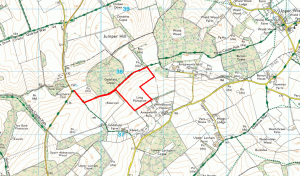
[/vc_column_text][vc_column_text css=”.vc_custom_1654346475442{margin-bottom: 0px !important;}”]You can view the site from the Three Castles Path which runs along its northwestern boundary. Access the Path from the bend in Spiers Lane on Bugmore Hill (map ref. SU595377) where there is limited off road parking. An interactive version of this map is available on the City Council planning platform.
About the Solar Farm
Capacity: 12 MW Land area: 22 hectares (55 acres)
Location: 2.5 miles north of Old Alresford, just south of Godsfield Copse and Three Castles Long Distance Path.
Impact: saving of 3,060 tonnes of CO2 per annum. Source: Barton Willmore Planning Statement. The output equates to over 1% of our District’s total demand for electricity.
Duration: 40 years, after which the site must be cleared unless further planning approval is secured.
About the Planning Application
Expiry Date for Comments: 17th February 2021
Winchester City Council Planning Ref: 20/02832/FUL
Parish: Old Alresford
Applicant: Anesco Ltd
Planning agent: Barton Willmore
Community Engagement
Prior to submitting the planning application, Anesco distributed a leaflet The Godsfield Solar Project to homes close to the site, inviting questions and feedback. It notes that “due to the restrictions from the Covid-19 pandemic, we are unable to host a public consultation event in person within the local village of Old Alresford.”
The leaflet also states: “We welcome community engagement with ongoing biodiversity monitoring and schools visits to the solar farm.”
The Old Alresford Parish Council opted to defer consultation until after the full planning application was submitted.
WinACC Response
This is WinACC’s response to the application. You can contact us at renewables@winacc.org.uk.
******
WinACC supports this application.
Our site visits verify the LVIA summary that its “bowl-like local landform restricts the visual envelope.” Reinforcement of existing boundary hedgerows will increase the seclusion from distant vantage points. We note that the site does not lie within any special landscape designations.
The 35 metre buffer between the Three Castles Path and the security fence is significantly greater than we’ve seen in other solar farms. A strip of this width establishes a real opportunity to mitigate the visual intrusion from the PROW through creative planting.
We agree with the conclusion of the LVIA that the residual effect on landscape character and visual amenity exists within a “very localised envelope.” And that it is not unacceptable within the terms of the Local Plan and National Planning Regulations.
Where assessment of visual and heritage concerns is finely balanced, we feel that the reversible nature of the solar farm should weigh in favour of its approval. Forty years is arguably negligible in relation to the temporal quality that establishes heritage and archaeological value. And forty years also synchronises with the intergenerational inequality that climate action seeks to address.
We understand the strength of feeling about the view from the Three Castles Path in the objections to the application, but consider these are outweighed by both the secluded location and extensive screening. More importantly, this development responds directly to the state of climate emergency declared by the UK government in May 2019, closely followed by legislation to achieve net-zero emissions by 2050.
This legislation compels rapid decarbonisation of the national grid. All current projections for achieving that goal envisage very significant expansion of onshore solar and wind energy. The City Council’s Carbon Neutrality Action Plan envisages “large-scale solar” development. Yet Winchester District’s contribution to large scale solar has stalled since 2017: solar energy generated within the District equates to only 9% of current electricity consumption (itself due to more than double by 2050). The contribution of wind generation is zero.
Winchester District must therefore do more to generate its own clean energy needs, especially where this outcome can be funded entirely by private finance. If the concept of an emergency, approved by Parliament, is to have any meaning, then we should seize this opportunity.
If less sensitive sites for a solar farm in our District were available, perhaps within more urban settings, energy investors would surely prioritise them. The reality is that sites of 20 hectares or more (the minimum to be financially viable), meeting all topographical conditions for a solar farm, close to a suitable grid connection, and free of planning restrictions, are very difficult to find.
WinACC also sympathises with those objections that express the value of familiar rural settings to personal well-being at a time of Covid-19. However, our work has encountered the inverse profile of this emotion, especially if younger age groups are considered.
A paper published in The Lancet in September 2020 warns: “the climate crisis could precipitate new psychological conditions and worsen existing mental illnesses among young people experiencing climate anxiety.” Climate anxiety is now a condition recognised as “a chronic fear of environmental doom.”
Where some perceive solar panels as destructive of the landscape, others are uplifted by witnessing decisive action on the climate crisis, amongst so much prevarication. The change in land use for this site from arable to grassland will calm anxiety about soil erosion. Doubling the current quantified biodiversity value of the field will deliver a rare win-win for climate and biodiversity.
Unfortunately, there is no vaccine for climate change. We hope that the long term interests of the younger generation, currently unlikely to engage in the minutiae of this application, will be taken into account in the planning decision.
******
Technical Assessments
These statements are copied, without amendment, from background papers and consultee comments that will be considered by the planning officers. The relevant document is identified in italics. These extracts have been drawn from hundreds of pages of reports and are not presented as a substitute for them.
Visual Impact
The Three Castles Path extends along the Site’s northern boundary. It forms part of a recognised Long Distance Path (LDP) between Windsor and Winchester. (Landscape and Visual Impact Assessment)
In summary, the Site is predominantly well contained by existing robust field boundary vegetation and a wider, strongly wooded landscape, which in combination with the bowl-like local landform restricts the visual envelope. The Site is not visible in the wider landscape to the west, north or east, with the exception of close range views from the Three Castles Path LDP both within and to the immediate east and west of the Site (Landscape and Visual Impact Assessment)
The presence of existing overhead power lines is apparent in these views (from the Three Castles path), with two lines crossing the Site and imparting a limited but perceptible influence of electrical infrastructure on the character of the Site (Landscape and Visual Impact Assessment)
The Proposed Development will alter the composition of predominantly rural open views (from the Path) of the wider agricultural landscape to one where the foreground is more strongly influenced by infrastructure, drawing focus away from the wider landscape and leading to a noticeable deterioration of the view. This deterioration is reversible and will not be perceived as a permanent feature within the landscape. (Landscape and Visual Impact Assessment)
A comprehensive series of mitigation measures has been developed to avoid or reduce adverse landscape and visual effects arising from the Proposed Development (Landscape and Visual Impact Assessment)
In order to reduce impacts from the footpath to the north of the Site, the solar arrays are to be set back by 40m from the northern site boundary, with a landscaping strip to help reduce the visual impact, whilst also ensuring that the open views to the wide area from the footpath are not lost. (Planning Statement)
The Proposed Development has a restricted height, with the panels no higher than approximately 2.5m above ground level, and fences no higher than 2m above ground level. Fencing proposed is akin to deer fences used to protect planting from browsing animals and is therefore not uncharacteristic in a rural environment. (Landscape and Visual Impact Assessment)
The design of the Proposed Development, including a substantial offset from the northern site boundary (between 35m and 50m to the proposed fence line and between 45m and 70m to the proposed panels) reduces the impact on views from the PRoW as the proposed fencing will not interrupt views to the wider landscape, and the proposed panels will be perceived at greater distance and further downhill on the less exposed slopes of the Site. (Landscape and Visual Impact Assessment)
(click on image below for full scale plan)
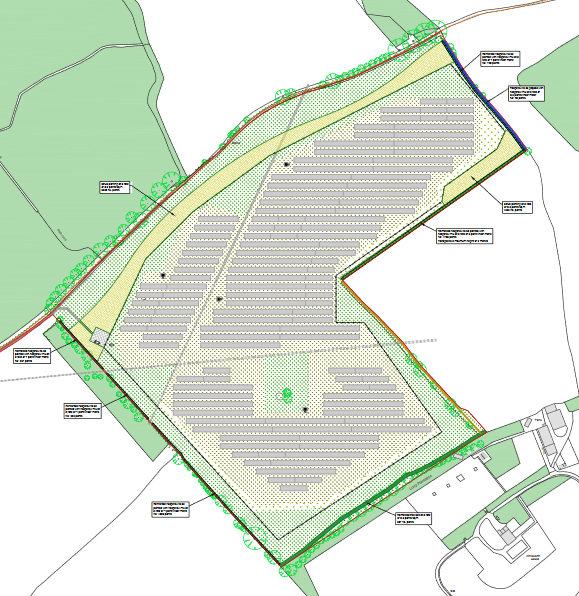
Whilst the Proposed Development would result in an adverse residual effect within a very localised envelope, its impact on the wider landscape and views is limited by the design of the Proposed development and the nature of landform and vegetation…….On this basis, the Site is considered to have the capacity to accommodate the Proposed Development without widespread and unacceptable effects on landscape character and visual amenity (Landscape and Visual Impact Assessment)
We therefore have concerns that the proposed solar farm would indeed affect the landscape character of the area even with mitigation suggested within the Landscape and Visual Impact Assessment (WCC Landscape)
Furthermore, the 40 year lifespan of the Proposed Development and the way in which it is constructed is such that it has a temporary character, and the existing baseline is readily reinstated on removal (Landscape and Visual Impact Assessment)
Agriculture
The site comprises shallow soils over chalk and deep loamy soils. The land is of subgrade 3a and 3b agricultural quality, limited by either droughtiness or stoniness. (Summary of Agricultural Quality of Land Report)
Biodiversity
No hedgerows or trees would be removed to facilitate access or accommodate the scheme.
The site at present is an agricultural field which is of relatively low ecological value. The solar farm actually offers opportunities for biodiversity enhancements.
A new circa 615 metre long native scrubby buffer (spaced at 0.5m centre, and comprising 6338 plants) shall be planted close to the northern Site boundary, with a further circa 300 metre long species-rich hedgerow being introduced along the south-eastern Site boundary.
Overall, the Site is assessed as having less than local importance for nesting birds……installation work will either take place outside of the main bird breeding season (which broadly extends between March and August inclusive) or immediately following a search for active nests by a qualified ecologist ….. The substantial amounts of proposed hedgerow and tree planting shall enhance the Site for a range of nesting and wintering passerine birds.
Gaps measuring 35cm high by 30cm wide will be created at the base of the perimeter fence adjacent to each sett and every 200-250 metres elsewhere along the boundary to allow access into the Site by badger. This will ensure that badgers, and other wildlife, are able to take advantage of the undisturbed foraging opportunities within the Site.
Following installation and taking into account all of the biodiversity enhancements described within the report, the Site is predicted to have a value of 133.19 biodiversity units, equating to a 136% net increase. In terms of linear habitats, 300 metres of new native species-rich hedgerow shall be planted, and 590 metres of existing hedgerow reinforced.This is a significant net increase.
Once the solar farm has been installed it shall be subject to annual monitoring by an appropriately experienced ecologist..….. Monitoring shall involve two visits a year; The results shall be presented in an annual monitoring report, which will be issued to the local planning authority.
(all quoted from the Ecological Impact Assessment)
Access
Access will be obtained by extending the existing access road off Spiers Lane. This route is designed to accommodate the type of vehicle expected to serve the Proposed Development. (Transport Assessment)
In order to provide access to the facility, a section of the Three Castles Path LDP approximately 560m long will require the installation of a loose crushed aggregate surface access track along the existing PRoW and agricultural track (Landscape and Visual Impact Assessment)
Inadequate information has been provided to enable the Local Planning Authority to fully consider the highway safety implications of this proposed development (HCC Highways Comments)
Heritage and Archaeology
Listed Heritage Assets (less than 500m from site)
- Godsfield Chapel – scheduled monument and grade I listed building
- Godsfield Farmhouse – grade II listed building.
- Barn 20m West of Godsfield Farmhouse – grade II listed building.
- Armsworth House – grade II listed building
- Armsworth Park House – grade II listed building
Proposed development would lead to small element of harm (lower end of less than substantial) to listed buildings of Godsfield Chapel, Farmhouse and Barn, Armsworth House and Armsworth Park House that would result from development within their setting. In reference to NPPF Paragraph 196 and Policy CP20 and DM28 of the Local Plan, this harm should be weighed in the planning balance. (Heritage Statement)
The key built heritage matter is the indirect impact of the proposed solar farm on the significance of the identified heritage assets, through change in part of their settings….. the setting of the group comprises a network of arable fields and scattered woodland, which amplifies an appreciation of the listed buildings / scheduled monument as a secluded and rural farmstead ensemble….. The development of the site as a solar farm would fundamentally alter the agrarian character of the site for the long-term, and impair the ability to appreciate its role. (WCC Historic Environment)
The construction of a solar farm here has the potential to impact the setting of a scheduled and Grade 1 listed chapel which has associations with the Knights Hospitallers. (Historic England)
The development proposals have not been accompanied by the clear & convincing justification for harm that is required by NPPF policy. Recommend refusal. (WCC Historic Environment)
The public benefits that will arise from this development are significant given that it will contribute to the national and local aim to achieve net zero……What has not been acknowledged by the historic environment officer is that any perceived harm of the development would be temporary as the solar farm will only be in operation for 40 years. (Agent response to WCC Historic Environment)
The evidence currently available would indicate that the known and potential archaeological remains identified for the Site would not be of a significance that would constrain or preclude its development (Historic Environment Desk-based Assessment)
Without further investigation the significance of buried heritage assets within the site cannot be ascertained. Intrusive archaeological investigation is required in order to provide sufficient information to confirm the significance of undesignated, but important buried heritage assets within the site and subsequently to assess the level of harm which would arise from the scheme. (WCC Archaeology)[/vc_column_text][/vc_column][/vc_row][vc_row][vc_column][vc_column_text css=”.vc_custom_1607951889958{margin-bottom: 0px !important;}”]
Join Us?
If you feel you can make a contribution to our solar farm campaign and other energy projects, please consider joining our Renewable Energy Action Group.
We especially welcome knowledge and skills as follows:
- Technical, commercial and local planning experience of renewable technologies at small/medium scale, especially solar
- GIS software skills relevant to local area energy planning
- Event delivery and marketing
- Current and ex-parish councillors or community leaders in a position to help WinACC reach local communities for engagement with energy projects
Meetings are held every other month in Winchester, or virtually, usually on Monday evenings. Contact renewables@winacc.org.uk.