
Introducing WinACC’s new 5 year strategy, as presented by Jo Crocker.
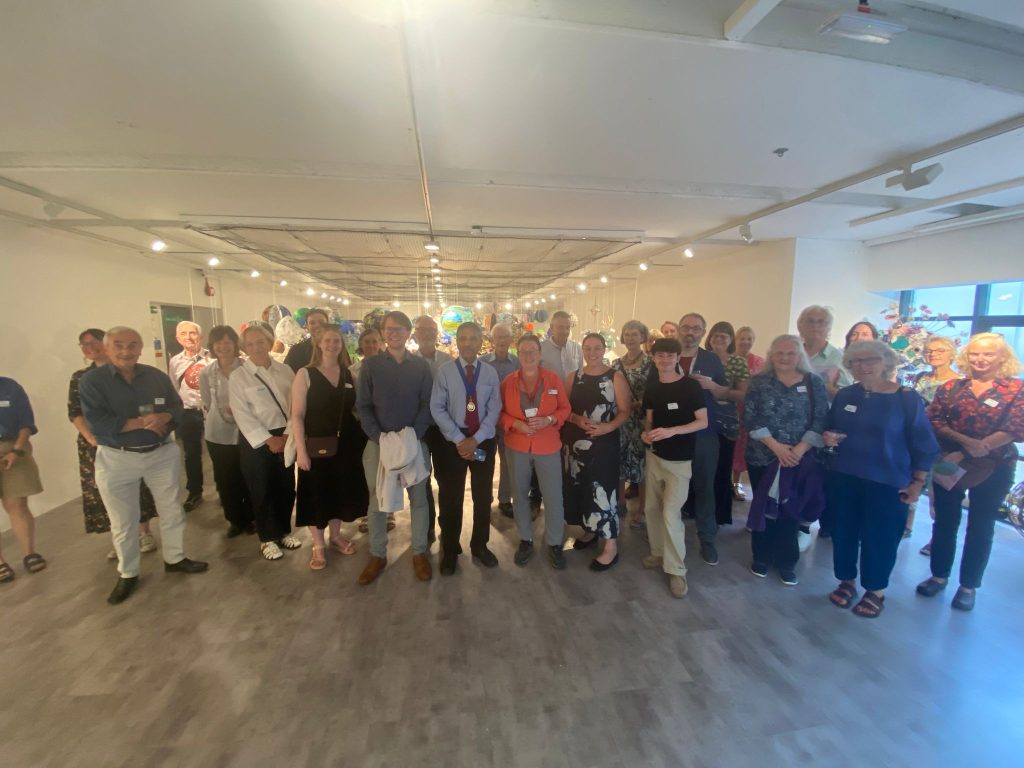
WinACC has carried out a strategic review and produced a new 5 year strategy which was officially launched in March. We were pleased to have an opportunity on 17 July to share the strategy with organisations we have or hope to work to lay out the bigger picture and purpose we are working towards.
Context
First, a snapshot of the context within which we are doing our work at different scales.
International: In 2024, global temperatures reached a new record, exceeding 1.5°C above pre-industrial levels for the first time … is rapidly approaching the lower end of the Paris Agreement’s long-term temperature goal (Carbon brief analysis) https://www.carbonbrief.org/state-of-the-climate-2024-will-be-first-year-above-1-5c-of-global-warming/
National: The Climate Change Committee report to parliament earlier this year says Government effort so far on preparedness and resilience, is inadequate – putting pressure on them for stronger leadership and policy. (Progress in adapting to climate change: 2025 report to Parliament)
Regional: Devolution creates opportunities to remove structural barriers to impact e.g. around transport.
Local: During the research for our strategic review we found out that:
– Winchester has the highest per capita emissions in Hampshire 6.6 tonnes as opposed to 4.6 tonnes
– Emission reduction is complex involving multiple local entities
– Mis and dis-information distorts climate solution action
– 68% emissions locally come from transport and domestic energy
– 64% of Winchester’s population supports net-zero, above national average
– 90% of Winchester’s population support renewable energy projects in the local area
(Local intelligence Hub –https://www.localintelligencehub.com/ )
These statistics suggest WinACC’s work is not a persuasion exercise, because there is a majority of support. It’s about enabling action.
Aim
WinACC aims to urgently drive systemic change towards a net-zero carbon Winchester area with communities and decision makers
What do we mean by systemic change? Tackling the causes of complex problems, not just the surface issues. It’s about understanding how everything is connected – people, ideas, power, place, ecosystems, values, decisions. Instead of quick fixes, it’s about creating deep, lasting change. No one organisation can take this on. We’re all part of a system, and systems that need to change. It is, I think, the work of our time. Collaboration is key.
Objective 1: Inspire and enable communities and organisations to care about climate change and act.
We know from our annual survey over recent years that the majority think systemic change will have most impact, that most think individual behaviour change is the easiest to do, and that taking collective climate action is felt by most to be the hardest. So, we can be useful in supporting communities to take collective action. And the work through our WeCAN project (supported by WCC and SDNPA)- currently 17 groups in a learning network across the district – means 51 000 people living in the District have access to a local climate action group. That’s a bit more than ⅓ of the population . We want to grow that to half the population of the district. These groups are running repair cafes, doing future energy landscape workshops, running regular climate cafes, school bike buses, thermal imaging schemes… but more than this, learning from each other, supporting each other when it is hard, persisting, accessing funding, inspiring others in their communities, building resilience
Objective 2. Share zero carbon solutions and expertise to enable local change.
We worked on the Winchester Area Superhomes project a few years ago. And have channeled that learning and built up expertise, connecting with others locally for My Home Made Better – our new Retrofit Advice hub with the Environment Centre, WinACC, PeCAN and Energy Alton. Partnership enabled access to a scale of project we wouldn’t have managed on our own. Covering Hampshire, Portsmouth and Southampton.
We want to build on this work and on this kind of model of work.
Objective 3 Connect people and partners to accelerate impact.
We’ve a foundation of partnership working – with 70 partnerships identified in our recent strategic review, local, regional and national. You here tonight represent many of them: WCC, SDNPA South Downs National Park Authority , the Mayor of Winchester, HCC Stakeholder Forum and Hampshire 2050 Partnership, Hampshire CAN, ESD – Energise South Downs, WSA uni of Southampton, PECAN Petersfield Climate Action, TeC The Environment Centre, Energy Alton, Alton Climate Action Network, City of Winchester Trust, Action Hampshire, Winchester Food Partnership, Cycle Winchester, The centre for sustainable Energy, the national Climate Coalition….the list goes on ……we will build strong partnerships to accelerate the change we can bring about together.
A core thread of our work is about connecting local voice and collective action with leaders and policy making. Last week at the climate coalition Mass lobby where more than 5000 constituents from across the UK met with their MPs, WinACC had a stall at the member organisations base in the QE2 centre – we were the only community based climate organisation there. For 7 hours we had a constant stream of people from across the country interested in the work we do, how we do it and wanting to learn from us. Of particular interest was our work on large scale solar, and our community engagement through WeCAN.
APPROACH
I was at the Global Tipping Points conference 2 weeks ago….. WinACC is part of the community of practice developing a toolkit for people around the world to access thinking about how we can understand positive tipping points and social change.
This framework will underpin our thinking and planning – to create enabling conditions for the kind of change we want. To notice feedback loops and seek to strengthen those that are reinforcing. To be mindful of potential triggers where a system can change into a new state, and become self reinforcing, and set new norms.
Conclusion
The next 5 years are crucial in terms of climate action. We need to be building resilience and adapting to a warming world. What I heard time and time again from scientists, academics and political leaders at the global tipping conference 2 weeks ago was that ‘Every fraction of a degree matters when it comes to the effects of global temperature rise’. What we are doing, matters.
Working with WinACC is more than just supporting us as an organisation – it is commitment to pulling together to face the climate crisis – desperate to draw out and live out the transformation we know it requires of the way we live life. We look forward to working with you.
Thank you again for coming tonight.