
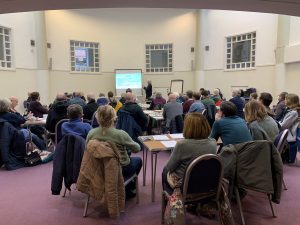
Almost 50 people came to WinACC’s public meeting on 27 November 2021 to hear about the coming consultation on the next steps on the Movement Strategy 2019 and to share ideas about how the Movement Strategy could reduce transport emissions in Winchester Town and across the district.
Update
Following this meeting, the consultation has been published. See WinACC’s first draft response.
Read more about what the consultation proposes, the context and background.
At the meeting
This summary of the context was available to participants.
Phil Gagg, Chair of WinACC Transport and Planning Action Group, set out the context in these slides.
Councillor Martin Tod spoke about the thinking behind the consultation and the proposed ten priority schemes. Martin is a Councillor for Winchester City Council, where he is the Councillor in the Cabinet who leads on transport issues. He is also a Hampshire County Councillor, where he is Opposition Spokesperson for Economy, Transport and Environment.
David Jowsey explained more about the consultation arrangements. It runs from 6 December to 11 February. Information and the questionnaire were subsequently published in section 3 ‘Have Your Say’ of Winchester Movement Strategy | Transport and roads | Hampshire County Council (hants.gov.uk) (David is the County Council lead officer for the Winchester Movement Strategy and a team leader in Integrated Transport at Hampshire County Council.)
Then group discussions identified the key issues, which are summarised below. Points in bold are those that at least one group shared as the most important.
Issues raised in the discussion groups
Overview
- Show the Movement Strategy does tackle climate change (acknowledging that isn’t the only tool).
- There are several overlapping workstreams. Who is sitting above, and looking across the lot? (See information about transport workstreams on the County Council website at https://www.hants.gov.uk/transport/strategies/transportstrategies)
- It’s about place as well as movement.
- Cars dominate. We need a change of attitude.
- We need behaviour to change. We can’t rely on technology – the Government is wrong.
- Focus on behaviour change, consequences of actions.
- To push the Movement Strategy forward depends on funding.
Public opinion/changing behaviour
- People tell politicians on the doorstep that they change, yet their voice isn’t heard.
- Tackling traffic shouldn’t be a party political issue.
- It’s essential to take people with you – which requires communication and explanation.
- Engagement should be simpler and clearer.
- Publicity, and explanations need to reach people before changes start, taking people by surprise.
- The way Hyde St. was handled engendered resistance.
- Show transport models and scenarios used; don’t be swayed by a few angry letters; test ideas.
- Be more imaginative about how to get the message out – e.g. use Next Door to explain the issues and what is being done.
- We need more stories, as well as facts and explanations.
- The Square closure is a good news story about actual change use as flagship example.
- One reason the Square succeeded was that the arrangements were changed many times to accommodate feedback from people affected. When making changes, treat the initial phase as a trial which can be stopped, and be prepared to adjust as you go along if experience shows that’s needed.
- If you are doing that, be honest about what people say about schemes. It’s not right to close them in the face of majority public opinion.
- Manners and etiquette evolved to influence behaviour in everyday life. Would it be possible to promulgate good movement and climate change manners so that bad manners become universally unpopular?
Data
- We need more and better data on the journeys people make and routes they take – and not only people in cars, but also walkers and cyclists and people using public transport.
- Good that HCC has detailed model of the city centre and so can look at the impact of car ark closures.
- Need to do the same for new housing developments that aren’t in the Local Plan e.g. Sir J Moore Barracks.
Planning
- When closing roads, take a joined-up approach looking at access, times of closures, and impact on neighbouring roads.
- We need to integrate different forms of transport.
- Take a holistic approach – look at impact on lives beyond actual travel e.g. delivery vans spoil pavements and create cost.
- Start with movement not vehicles – what are people’s needs for movement? Not everyone can walk or cycle.
- Prioritise people with different mobility needs – for example, mums, disabled people – including lower parking charges.
Parking
- Many parking spaces / too much traffic.
- If there are fewer parking spaces for cars in general, there can be more for people who actually need them such as people with mobility needs.
- Private car parking spaces need to be phased out, and alternative uses found.
- P&R is seen as easier, more convenient.
- South P&R is barely used on a Sunday.
- There is support for the North Park-and-Ride from people living in Kings Barton who feel that too many cars will drive though Kings Barton.
- Questions over north P&R: if bus routes aren’t good enough, need pedestrian routes into the city from Andover Road.
- More electric charging points will be needed at the P&Rs.
Alternatives to the car
- Make the “Golden Mile” from station to High St to Leisure Centre a priority as part of improving the public realm – – give emphasis to quality for pedestrians.
- Top of High St is important – historic site.
- If you remove car access you need viable alternatives e.g. buses.
- Do we need a bus station? Many cities have bus interchange at rail station.
- Bus prices vs car park prices – 80:20 rule – link to alternative transport modes for all users.
- To encourage shift from car to bus you need to address (1) price (2) reliability (3) ease of use.
- Using the car is always cheaper than the bus if you don’t include the cost of ownership. If you don’t own a car, it is cheaper to hire one when you need it and use public transport where you can.
- Extendibility – how to cover cost of bus improvements?
- Walking routes into the city ae poor: noisy, directly and overgrown.
- “predict and supply” leads to overall growth of traffic.
- Electric vehicles – issues of energy shortage, and pollution.
- Public realm design for pedestrians and cyclists.
Miscellaneous
- We need better walking routes, with more green spaces.
- And more trees.
- We need cross-radial connectivity – which might be helped if radial roads had 20 mph limits e.g. Andover Rd, Worthy Rd, Magdalen Hill, Southgate St.
- Needs for transport may be best met with taxis and buses in a range of sizes.
- We need a good bus interchange at Winchester railway station.
- Speed – especially by schools.
- Enforce speed limits.
- Motorway carbon speed limits.
- Kings Barton want a crossing over Andover Road.
- Oliver’s Battery junction needs attention.
- Cycle route from station to college and Leisure Centre.
- Trials e.g. contraflow along Jewry St for cycling.
- Loading bays – very sophisticated dropped bollards to bring on pavement.