
 One of the biggest obstacles to tackling traffic congestion in Winchester town is the belief that it will damage our economy.
This blog summarises what is known about the impact of car access on trade in town centres.
Ask most small shop-keepers, and they’ll say that they need people to be able to drive to their shop-door, park outside, and pop in.
So is it true?
Public policy must be based on facts not on emotions or assumptions. Something can seem obvious, yet be disproved by the facts.
The Winchester Movement Strategy doesn’t see a conflict between tackling congestion and supporting the economy of the town centre.
Summary – what the evidence shows
The research – by respectable institutions and academics – shows that helping people to do without their cars is good for the local economy. And the same findings are repeated again and again across the UK, across Europe, and over the last 25 years.
- Improving facilities for pedestrians is good for the local economy.
- Towns with the low car dependency are most likely to have vibrant shopping centres.
- Road closures do not damage trade. Traders tend to oppose traffic reduction measures when they are suggested, then support them once they are in place and the results are known.
- Restricting car parking isn’t linked to fewer visits to a town centre – as the reduction of Winchester’s Friarsgate parking shows.
This suggests very strongly that reduction in car access to Winchester City Centre will strengthen the vitality and economy of the town centre.
Improving facilities for pedestrians is good for the local economy.
Several studies in 2018 came to similar conclusions about the economic advantages of a shift from car to pedestrian access to town centres.
At a local level, a trial ban on motor vehicles in several Cheltenham streets took place in the second half of 2018. As the preliminary findings were released, the Cabinet member for development and safety Andrew McKinlay said “Overall, the data so far suggests that the trial road closure has not had a negative impact on visitors to the high street, actually the reverse!
Nationally, a report “The Pedestrian Pound”, updated and published in December 2018 by Living Streets Scotland, reviewed academic evidence to conclude. “Data on streets where the pedestrian experience has been improved shows footfall increasing 20-35 per cent. This bucks a 22 per cent decline in footfall across the UK between 2007-2017. ….For well-designed projects, sales can increase by 30 per cent or more when footfall is boosted.”
Around the same time, Transport for London (TfL) set up a virtual “hub” as an accessible source of evidence on research into this topic. Here’s a useful summary to look at.
TfL also funded two important reports, both published November 2018.
Street appeal: The value of street improvements , an academic study by University College London, concluded “more space for pedestrians and bicycles and less space (and slower speeds) for cars will open up the opportunity to deliver on the other factors that make for the highest quality street experience for all.”
The Summary says that improvements to the quality of the publically owned and managed areas of London’s mixed streets, such as high streets and town centres, return substantial benefits including:
- An uplift in office rental values equivalent to an ‘additional’ 4% per annum.
- A larger uplift in retail rental values equivalent to an ‘additional’ 7.5% per annum …
- A strongly related decline in retail vacancy leading to a sizable 17% per annum difference in vacancy rates between improved and unimproved street environments.
I was encouraged to read the second TfL publication of November 2018, Healthy Streets: a Business View by the University of Westminster. This gives results of a survey of the views of representatives of London Business Improvement Districts (BIDs). It shows that the London BIDS are now backing a reduction in car access because it is good for business.
Here are some key quotations from the findings:
- “…making it easier to walk and cycle is seen to boost the vitality of areas, increase footfall and help attract and retain staff.”
- “Over 85 per cent of responding BIDs said a good environment for walking, cycling, and spending time in is important for business performance.”
- “From a list of twelve plus user–defined options, the top three interventions to improve the street environment were improving public realm quality, reducing the amount of motor traffic, and improving pedestrian crossings.”
I believe that Winchester BID is thinking along the same lines.
Low car dependency links with economic vitality in towns
In October 2014, retail specialist Harper Dennis Hobbs published the first ever report that scored town centre retail incorporating a ‘vitality” score. Their report showed that retail centres that have implemented major traffic reduction policies generally performed better .
Winchester, without a traffic reduction scheme, was not achieving the same level of retail vitality as I would have expected taking into account the income levels of people who live here:
- Bath, with its large pedestrian zone, was ranked at 10 even though median income in Winchester was 19% higher.
- Oxford, whose centre is restricted almost entirely to public transport, did much better than Winchester and was ranked at 24, even though median income in Winchester was 14% higher.
York, whose traffic-free area is four times the size of Winchester’s, achieved the same vitality score as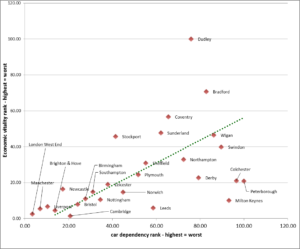 Winchester even though median income in Winchester was 25% higher than in York.
Around the same time as Harper Dennis Hobbs published its assessment of the economic vitality of 500 retail centres, the Campaign for Better Transport independently assessed the degree of car dependence of a number of town centres.
WinACC compared these two surveys. We found a very high correlation (98.7% chance of it being true) between low car dependency and high vitality in town centres. The towns with the lowest levels of car dependency were most likely to have the most vital shopping centres.
The impact of car park closures
“Research shows that there is NO relationship between how much parking you have and how successful your shopping centre is”. Not an assumption by me, but the findings of a European study.
The closure of Friarsgate Car Park in 2015 gave an opportunity to see if this was true for Winchester.
After the Friarsgate Car Park closure, and using figures from the Winchester BID (Business Improvement District), WinACC found that footfall in the High Street increased and footfall in the Square remained steady, initially with a marginal reduction at a lower rate than national trends, and then with an increase.
If you go to a big shopping centre, you usually have to park some distance from the shops. I started to wonder how this compared with the distance from Winchester car parks to the shops in the High St. How long does it take to walk from, for example, parking at Chesil multi-storey or Tower St to the Buttercross?
So we superimposed the Bluewater development onto Winchester at the same scale and discovered that we’d have to walk just as far to the shops there as here – and in much less attractive surroundings.
People with limited mobility, and others such as carers who need to park close to central Winchester, will benefit from restrictions on parking for private cars. They will have many more possibilities to park close to their destinations.
The findings are repeated across Europe
“Pedestrianisation and access restrictions can bring considerable benefits to towns and cities…Pedestrianising shopping streets tends to increase retail revenues and the value of property on those streets. “ This is one of the findings of The Economic Benefits of Sustainable Urban Mobility Measures Independent Review of Evidence: Summaries published by the European Platform on Sustainable Urban Mobility Plans in 2016 .
Here is an important lesson from the same summaries:
“The main barriers to implementation [of pedestrianisation] relate to local opposition, particularly from shop owners and motorists who perceive that road closures will increase congestion, journey times and/or journey distances. However there are very few examples of such measures being reversed or judged to have failed”.
Attitudes and assumptions about parking, too, mirror those in the UK.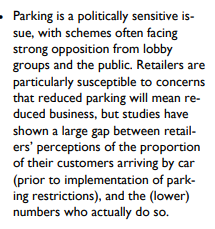
Here is another of their findings (see attached box):
The finding are repeated across the last 25 years
None of this is new. Back in 1992 (over 25 years ago – researchers in Leicester (Wiggins, 1993, Streets, Traffic and Trade, A Survey of Vacant Shop Sites in Leicester City Centre) found more vacancies in shops where traffic levels were high:
Chain stores, independent shops or coffee bars?
Some people say that discouraging cars in city centres leads to chain shops displacing independent local traders. They feel that people shopping in out-of-town supermarkets with car parks means that independents close down, moving to the internet or going bust. They are replaced by coffee-bars, restaurants and other venues for relaxation, consolidating a downward spiral in town centre shopping.
I couldn’t find any evidence for a link between car-free streets and chain shops. Yes, national chains will want to move to successful town centres. But this doesn’t mean that we want Winchester town centre to be less successful.
Some people complain when they see Winchester’s shops replaced by coffee bars and restaurants. Others argue that we must adapt – shopping is now a leisure activity, so town centres need more places for people to sit and chat – and that people who spend more time in town also spend more money there.
So what does this mean for climate change?
I have been puzzling about what changes of shopping behaviour mean from the perspective of climate change.
If we are buying less altogether, we aren’t responsible for so much greenhouse gas from manufacturing, so I’m inclined to welcome a shift from buying stuff to buying relaxation and chat. And it would be good if on-line buying means that goods are delivered in a more efficient way, with fewer transport-miles for each purchase.
And what does this mean for us?
The evidence from other places which I’ve summarised doesn’t support the idea that fewer cars in town damages trade. The Winchester Movement Strategy has a vision starting with “strong and sustainable economic growth for the city of Winchester “. Priority One in the strategy is “Reduce city centre traffic” . This strategy, approved by Winchester City Council on 25 March 2019, seems to have got it right – there isn’t a conflict.
So let’s base our views on evidence, and support the Movement Strategy to reduce city centre traffic blight.
Let’s leave our cars at home and come to the shops by bus, bicycle or on foot if we can. And if we live too far away or can’t carry shopping, let’s park outside the city centre in Park-and-Ride car parks. Or even the car parks close to the shops but outside the centre, such as Tower St and Chesil.
Let’s help Winchester show everyone how life can be better without the need to drive.
Chris Holloway