
The housing market has been in the doldrums for some while now, with low turnover limiting choice across much of the country for those looking to move home.
This stagnation is reflected in the statistics – in particular that we now move house much less frequently than we used to at the end of the twentieth century. In many areas, the only real option for buying a house seems to be a new-build on an estate on the outskirts of town.
Many older buyers prefer the space and character of period properties, being more likely to have the money to redecorate, remodel or even extend the property to meet their needs. For younger people however, and especially those just starting on the housing ladder, the appeal of a brand new home is often more beguiling. Just like a new car, you would hope it would be problem-free with low heating costs, as well as somewhere that you can make your mark without worrying about refurbishment or any of the other problems you might have to deal with in an older home.
In recent years, there seems to have been an increasing focus in the media on the standard of construction of new-builds. Earlier this month, two families I have been helping over the past two years featured on BBC News, in an item that highlighted the quality problems that the owners of new-build homes often have to deal with. Lyn Whiteman and Justin Revell bought detached homes a few doors from each other in the suburb of Costessey on the outskirts of Norwich a few years ago, but immediately identified a large number of outstanding issues with the quality of the home (known as “snags”). One of their concerns was around the quality of thermal insulation, and Lyn and Justin were referred on to me by a snagging company that they had contracted, to look into this in more detail.
An initial thermal imaging survey of the two homes early in 2017 revealed significant problems with insulation coverage in both, especially in the room-in-roof areas of these three-storey properties. The developer subsequently carried out some remedial work, however a number of significant problems remained, as evidenced by a second survey late in 2017. A second round of remedial work was more successful, although a third (and hopefully final!) survey of both properties last month showed that a few minor issues still remained.
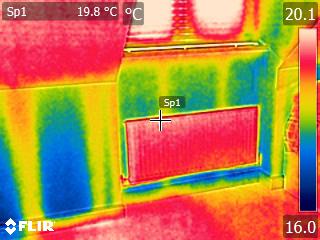
This case echoed a similar one that I was involved with near Reading back in 2015/16 on a new estate constructed by the same developer. One particularly aggrieved homeowner became fed up with what he felt was a lack of action to fix the problems he and his neighbours had encountered and took his concerns onto social media. Following widespread coverage in the national press, the homeowner (and yet another that I had helped) featured on an episode of Dispatches on Channel 4, along with the thermal imaging report I carried out for his property. As a result of this case, the developer became more proactive and asked me to carry out thermal imaging surveys on a further twenty-odd properties on that phase of the estate – many of which turned out to exhibit similarly significant problems with undue heat loss.
So what is going on here – why are so many new-build homes not up to scratch? It is important firstly to point out that problems are not limited to one particular developer. Inevitably I get to see some of the worst examples, however problems seem just as common with small builders as they are with some of the large developers. There are, however, significant variations between developers in my experience, with some clearly taking a more responsible approach to resolving issues than others.
Looking at the construction industry’s problems as a whole, some common themes emerge:
- Shortage of skills – it is increasingly hard for developers to find enough qualified tradespeople, resulting in those on site attempting to fill the gaps in areas in which they are not properly trained up, e.g. brickies moonlighting as chippies. The threat of Brexit has clearly not helped in this respect as skilled Eastern Europeans leave in droves.
- Lack of quality control – in the past, construction sites had a Clerk of Works, whose job it was to inspect the quality and workmanship on site. These days it is very unusual to find someone with this dedicated role and quality seems to have taken a back seat as a result.
- Shortfalls in building control – all building work has to be approved under local authority building control, although in many cases work can be ‘self-certified’ (a bit like marking your own homework perhaps). Perhaps understandably given their increasingly limited resources, LA Building Control officers seem most interested in ensuring gas and electrical safety rather than (say) the standard of thermal insulation; much building control work is also now outsourced to third parties, for whom it is in their commercial interest to “pass” as much work as possible to ensure a pipeline of future business…
- Tight timescales – properties are often built to meet quarterly targets, and if you are one of the lucky homeowners of a property “squeezed in” to meet the quota then you might have more than your fair share of snagging to do.
- Poor design – astoundingly, I often experience homes where insulation is simply designed to be in the wrong place, allowing cold air to enter and bypass it into voids directly surrounding rooms. These homes then end up being expensive and/or impossible to properly heat in winter, in spite of having a high EPC rating.
- Not built to recommended design – Justin Revell’s home was a case in point, where the cavity walls were retrofitted with blown insulation, leaving a cold uninsulated gap under the cavity tray at the base of the wall behind the skirting. A more appropriate solution would be to install solid insulation board in the cavity and behind the cavity tray to avoid this problem in the first place.
- What you don’t know won’t hurt you… – perhaps the most depressing issue I encounter. Many new homes and extensions have inaccessible roof voids – time after time I have seen how these voids are left either partially or completely uninsulated, presumably because the builder hopes that the homeowner will never find out that they haven’t bothered to complete the job up there. This seems to be more of an issue with independent builders, although a poor standard of loft insulation is prevalent throughout the industry.
Of course, not all new homes are a disaster area – in the area of thermal insulation it is often the more complex designs (e.g. dormer/room-in-roof) that fare worst, whereas the simple two-floors-and-a-loft-void layout has less to get wrong. It does seem, however, that quality has taken a nosedive in the last few years and this is reflected in a fall in the customer satisfaction ratings of some of the large developers.
It is encouraging that the government has now started looking into the issues – poor quality new-builds can result in years of upheaval and stress for homeowners whilst issues are put right. That we repeatedly find homebuyers in these situations is in itself clearly unacceptable, however we also need to work a lot harder to ensure our homes are designed and built to meet the challenge of tackling climate change without having to be upgraded all over again in a few years time.
– Andy Smale – WinACC Energy Consultant and Technical Director, Expert Energy