
Blog series ’15 minute checks’.
We may all be finding ourselves spending more time than usual in our homes, and you might find yourself doing those projects around the house that you don’t ordinarily have time for.
In Winchester, our homes are a major source of the carbon emissions that contribute to the climate crisis as shown by our annual greenhouse gas emissions report. We’d like to share a series of quick ’15 minute checks’ that we can all take at home to help make our homes as energy efficient as possible, and therefore having the least impact on climate change.
These ’15 minute checks’ can be carried out by anyone living in a property, whether you are a renter, landlord or homeowner. These should also save you money, alongside making your home more energy efficient. If you have any comments or questions regarding any of these blogs please email us at contactus@winacc.org.uk and we’ll do our best to answer them.
Checking fridges and freezers
These days almost everyone has a fridge or a fridge/freezer and most people also own a freezer. These appliances chunter away in the background working all day and night to keep our food at a safe temperature. Of course, in doing so they use electricity and therefore, unless you have an array of PV panels to make your own solar electricity, they are causing carbon dioxide emissions at some distant power station. So, running our fridges and freezers efficiently is important for the climate emergency as well as for saving us money.
There are two ways to check on the efficiency of fridges and freezers and both require only a few minutes of your time.
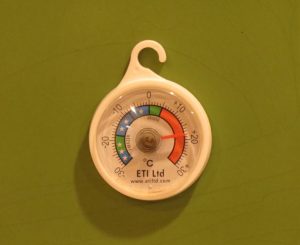
The first thing to check is whether the fridge and the freezer are running at the correct temperature. Clearly they mustn’t be set at too high a temperature because that could cause food to go off. On the other hand there is no point at setting the temperature lower than is required because this will mean that you will be wasting electricity. Ideally a fridge should be set between 3 and 5°C. Food stored in a freezer will last indefinitely if it is kept at around minus 18°C. But how do you measure the temperature, recognising that the settings on the appliances don’t provide any temperature information? The answer is to buy a small fridge/freezer thermometer for literally only a few pounds. This may pay for itself in no time at all. After adjusting the temperature control dial in the fridge or freezer allow 24 hours for the temperature to stabilise. You may have to repeat the adjustment until you hit the right temperature.
The other way to ensure that a fridge is running efficiently is to defrost it regularly. When you open the fridge door moist air enters from outside, it condenses on the colder internal walls of the fridge and may then freeze. If ice builds up inside the fridge it can interfere with the circulation of cold air and food may not remain as cold as required. In addition, the pump which circulates the cooling fluid inside the fridge will have to work for longer thereby using more electricity. Some fridges automatically defrost before ice can build up but defrosting can also be initiated manually by pushing the defrost button. Remember to keep an eye on the defrosting process and to re-start the fridge as soon as possible to minimise how much the food warms up.
Freezers are less of a problem, because the freezer door or lid is opened less often and your freezer may be located in a cooler, less humid part of the home, but even so freezers will need defrosting from time to time. The same advice applies as for fridges.
Bob Whitmarsh
More information at https://lowcarbonhousehold.weebly.com/
All profits from sales of Bob’s book goes to WinACC.
These blogs are written in good faith and the author/WinACC cannot be responsible for the consequences of following the advice offered. If in doubt get professional advice