
Guest blog by Paul Coverdale, WinACC Trustee and Chair of Winchester Action on Climate Change STAP (Science and Technology Advisory Panel) reflecting on recent events at Bournemouth Beach
For many last week, the temptation created by a combination of newly found freedoms brought about by the recent easing of lockdown restrictions and the hottest weather of the year proved too great to resist. Hundreds of thousands of people headed to the coast to cool down with some well reported consequences. The scenes on Thursday at Bournemouth Beach and the surrounding area showed a wilful disregard by some for the natural surroundings they chose to visit. There was an impact locally too, as anyone who had cause to travel past Winchester on the M3 will attest.
Setting aside the implications from the noticeable lack of social distancing, the pictures and headlines of the resulting mess are, on the face of it, shocking and they understandably provoked widespread indignation on social media. An adjunct to the story was the clean up operation commencing at dawn the following morning. An army of council workers and volunteers — even a BBC South today reporter — proceeded to gather some 33 tonnes of rubbish over the next few hours. And so as sure the waves receded on the next ebb tide, so those 33 (unsorted) tonnes headed off to landfill and the outrage receded too.
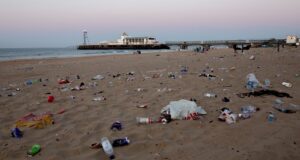
Bournemouth Beach early on Friday morning
The still dominant linear narrative of today’s throw away culture — produce to demand, consume, dispose — was neatly illuminated in a sweltering 24 hours. Yet the most outrageous aspect of the whole affair is that it is not a new problem, and yet we still treat the symptoms in the same way. Keep Britain Tidy has been going since 1957 and more than 60 years later we still can’t manage it. (Their latest campaign is entitled “Love Where You Live” — but somewhat ironically apparently not where you visit). More recent social phenomena such as plogging are a modern version of the same ethos that primarily draws attention to the problem of waste and littering in specific settings without addressing the root causes.
Therein lies the real problem. In amongst all the noise too little thought is given to the cycle that results in pictures like the one above. Scratch beneath the surface selfishness of a few people and the thicker layer of moral indignation, and you will start to uncover the systemic barriers to avoiding future repeats. It is convenient, easy even, to just focus on how we deal with waste and the social aspect of its removal from the public gaze. The common sight of high-vis jacketed volunteers going to pick up litter using non-recyclable bags neatly encapsulates how narrow our view can be. To prevent future repeats of mass littering — which happen daily on a smaller scale— we have to think hard about the whole system of how we consume perishable things, especially food and drink. Most of the detritus strewn across the sand was the packaging that goes with it and while big brands continue to make and market stuff for us to consume, aided and abetted by a powerful plastics industry lobby, the public will continue to buy it from them. Convenience is the other prime factor that creates a win-win outcome for all concerned. Food and drink manufacturers thrive because its so easy to sample their wares, to carry a drink in a plastic bottle or a sandwich in cellophane wrapping. That’s all they really care about. The packaging is the customer’s problem and often, as seen last week, it quickly becomes the state’s problem too. Fly-tipping is an even more egregious example.
But landfill is only the end of the journey for the disposable by-products of our consumptive habits. Throughout the packaging life cycle there are plenty of interventions that would be more effective: better recycling infrastructure to avoid scandals like this one also reported last week, clearer labelling, improved product design to create more sustainable alternatives, more effective legislation, and taxing the producers — not the public — to clean up the mess. All of these activities will be necessary to transition to a zero waste economy, but influencing what happens at the production end of the cycle is the most important. Waste can sometimes be viewed as less important than other climate related problems but each bottle, can or wrapper requires energy, water and other natural resources to make using processes that cause carbon emissions. Transportation of those goods to market causes yet more. According to one piece of research conducted last year, the growth of plastics production alone will see plastics related emissions taking up 13% of the total carbon budget set by the Paris Agreement by 2050.
So where do you fit in and what can you do?
Practice the mantra of Reduce, Reuse, Recycle and please take your rubbish home if you can’t*, are the usual, obvious, well-meaning solutions. Collecting a few bits and pieces while you are out walking the dog before binning them when you get home is helpful but is unlikely to prevent you from having to do it again in the future — and it all still ends up in landfill. To change the waste system requires us to challenge and question all parts of it. And the good news is that there are campaigns and organisations doing just that. One such is Plastic Patrol, founded in 2016 by activist and adventurer Lizzie Carr. Through an app, its users gather as much information about what they collect as they can which helps research into waste streams. Its aim is to eliminate single use plastic at source. So far more than 260,000 items of waste have been recorded in 82 countries. If you are in the habit of picking up litter when out and about then, if you can, sort what you have collected and then record it. Marine conservation charity Surfers Against Sewage has a Return To Offender campaign encouraging the public to name and shame polluting brands. Some research they conducted found that half of all waste food packaging was created by just 9 companies.
It suits the big disposable packaging producing brands for the media and public to focus on the litter louts and argue about whose fault it is. If last week’s scenes made you angry don’t fall into their trap. Download the Plastic Patrol app, and if you’re out litter picking make some noise about it and tell others what you’ve found.
*Please continue to do these things — just do them more often and in a smarter way.
Paul Coverdale
Photo credit from Friday morning, BCP Council, Twitter