
***Construction of this solar farm is now complete – read about it here ‘Solar saved our farm‘***
Application approved by the City Council planning committee
by majority 8-1 on 15th March, 2023
The original plans submitted in May 2021 have been revised to take account of comments and objections. Full details are set out in this Explanatory Letter from the planning agent. The deadline for comment has now passed.
WinACC submission to the City Council in response to the revised plans
Winchester Action on the Climate Crisis (WinACC) wishes to reaffirm its support for this planning application, for all of the reasons given in our response to the original plans, dated 5th July 2021. We’re also happy to see that plan revisions and upgraded reports have taken account of objections and suggestions.
In your assessment of the public benefit of the plans, in relation to their impact, we urge that you recalibrate the value of renewable energy, in light of events subsequent to the original application.
We hear different solutions to the energy crisis every day. The one consistent element is the need for an immediate and exponential increase in solar power. In particular, the new British Energy Security Strategy envisages that the contribution of solar must increase fivefold by 2035, consistent with the detail of the 6th Carbon Budget mentioned in our earlier response. Utility scale solar farms will be the major contributor to this goal.
Approval of these plans would take advantage of a rare opportunity for a decisive response to the climate and energy crises that lies within the power of the City Council to deliver.
The summary of the original plans on this page was prepared to assist understanding of the development.
WinACC’s response to the original planning application and our overview of Solar Farms
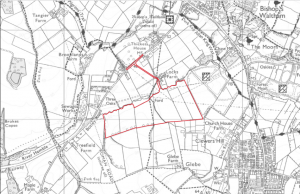
To access the site, start from the centre of Bishop’s Waltham. Walk half mile west along Botley Road and join the second Public Footpath signed on left (the first is for the Allan King Way). Walk diagonally across field to Locks Farm. Go through farmyard and the gate on the far side. Continue along farm track and take footbridge across stream. This is the centre of the site, which covers 5 fields to your left and right. A more detailed interactive version of this map is available on the City Council planning platform.
About the Solar Farm
Capacity: 18 MW Land area: 34 hectares (85 acres)
Support Structures: substation, switch gear, inverters, battery containers, mast (15m)
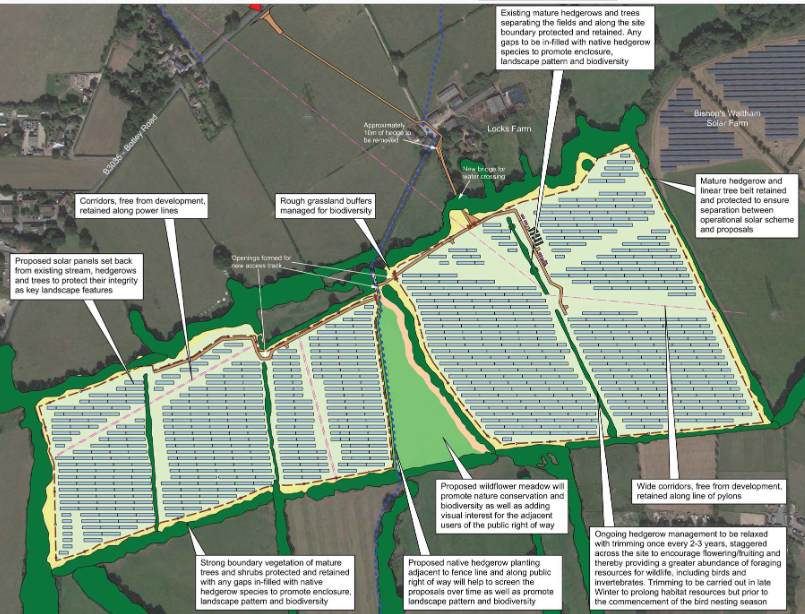
Layout and Access: Revised Plan
Impact: The output equates to almost 2% of our District’s total demand for electricity
Duration: 40 years, after which it will be dismantled and removed and the site reinstated to previous conditions.
About the Planning Application
Expiry Date for Comments: 7th July 2021
Winchester City Council Planning Ref: 21/01391/FUL
Location: 800m to the south of Bishop’s Waltham and 500m to the west of Waltham Chase
Parish: Bishop’s Waltham (and the site is adjacent to Shedfield parish)
Applicant: NextEnergy
Planning agent: Intelligent Alternatives
Community Engagement
extract from the Planning, Design and Access Statement:
NextEnergy have put in place a community benefit fund and have approached Bishop’s Waltham Parish Council to discuss how this could benefit the local community, and to discuss the application more generally. Nearby neighbours were approached and changes to the access arrangements have been made in response to their feedback.
There will also be local economic opportunities for construction and maintenance companies and NextEnergy welcomes the opportunity to discuss contract opportunities with local companies.
WinACC Response
This is WinACC’s final response to the original application. You can contact us at renewables@winacc.org.uk.
******
Winchester Action on Climate Change (WinACC) supports this application.
Our site visits found that the combination of contours and vegetation screen the site surprisingly well, whether approached along the footpath from Botley Road to the north or from Curdridge Lane to the south. The same verdict applied to different vantage points along those roads themselves.
For the short stretch where it crosses the site, the PROW will be protected either side by a newly planted hedgerow and wildflower meadow. In crossing the fields from Botley Road to Curdridge Lane, the evidence of wear underfoot suggests very low usage of this public footpath, even in midsummer.
The existing Bishops Waltham Solar Farm shares the same topography as the new proposals, being located in adjacent fields, immediately south of the same stream. Although smaller in scale, its impressive concealment from surrounding footpaths, roads and homes offers evidence that the new proposals can achieve similar results.
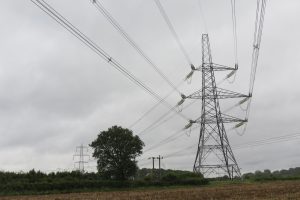
The site and its access road are overshadowed by high voltage overhead lines, in two separate configurations, with one of the larger pylons standing in the eastern section. This visual feature of the current landscape dominates what might otherwise have been described in terms of green fields. Any suggestion that glimpses of small sections of the new solar panels from key viewpoints will degrade the area’s landscape character seem somewhat naïve in this context. The National Grid’s current programme to replace pylons with tunnels in selected areas of the country indicates the low visual esteem for an industrial design dating from the 1920s.
We feel that the Biodiversity Management Plan is a strong feature of this application, especially in light of the City Council’s commitment to this topic, reflected in its Biodiversity Action Plan 2021. The infographic summary on page 8 of the Management Plan encompasses multiple interventions, ranging from kingfisher habitat to the minimum 5m wildflower margins throughout the site. These features, together with the underlying soil regeneration, over an area of 34 hectares, financed by the developer, can deliver a meaningful supplement to the WCC Action Plan.
We note that the Agriculture Land Classification Report grades the site “100% 3b”. This report also notes: “the installation is entirely temporary and reversible in nature and, in terms of land use, it will remain fundamentally agricultural in nature.”
This single renewable energy development would deliver output equating to almost 2% of our District’s total consumption of electricity. That represents a significant response to the climate emergency in our District, delivering a clear public benefit, funded by private finance.
It is noteworthy that our Distribution Network Operator, SSEN, announced in May 2021 that it will invest £2.9m in Bishops Waltham in reinforcing network infrastructure. The objective is to accommodate increased demand for electric vehicle charging and electrification of heat. The proposed solar farm development would align increased local demand with local generation.
In April 2021 the UK government adopted the 6th Carbon Budget, to further its net-zero 2050 target. This Budget commits the UK to full decarbonisation of the electricity grid by 2035, requiring rapid growth in solar pv capacity, on average 3GW per annum. In response, Solar Energy UK, the trade association representing all branches of the industry, has published projections showing that both rooftop and ground-based solar installations need to treble existing capacity by 2030.
We are fortunate that the Winchester District Local Plan anticipates the decarbonisation agenda. Policy CP12 states: “The Local Planning Authority is supportive of the generation of renewable and decentralised energy in the District.” This Policy is reinforced in the City Council’s Carbon Neutrality Action Plan which envisages “large-scale solar” development. Winchester City Council is committed to an accelerated target for net-zero, by 2030.
Nonetheless, suitable sites for large-scale solar are very difficult to find. The Planning Statement for this application includes an unusually thorough explanation of the constraints that must be overcome. It also details the obstacles that limit potential for rooftop and brownfield developments for this technology (Section 7 and Appendix A).
We feel unqualified to comment on planning technicalities that determine whether issues relating to the access road have been adequately addressed.
WinACC appeals to all parties involved to work towards a successful outcome to this application.Planning Application Documents
These extracts are copied, without amendment, from submissions and consultee comments that will be considered by the planning officers. The relevant document is identified in italics. The extracts offer quick reference to matters of potential importance; they have been drawn from hundreds of pages of reports and are not presented as a substitute for them.
Visual Impact
all extracts are from the Landscape and Visual Impact Assessment
Even from an open and elevated location within the National Park, the proposals will be nestled within the lower well-vegetated farmland, screened and enclosed by intervening mature vegetation.
…….The key point to note from the baseline cumulative assessment is that the (three existing) operational solar schemes (within 5km) appear to be well-absorbed and integrated and do not dominate the landscape or views, including when viewed from the nearby National Park.
…….The pylons crossing the eastern fields from the east to the north form prominent vertical elements (within the site).
Open views across the proposals will be possible as the public right of way crosses the site itself, with at worst, medium-high impacts and moderate adverse effects. However, the growth of the proposed hedgerow separating the proposals from the public right of way will reduce the influence, with only glimpsed views particularly during the winter possible over time.
In summary, the proposals:
- Adds a built element to the landscape
- Avoids and does not have a direct impact on any designated landscapes
- Is set within the regular landscape pattern within and contained by mature and well-vegetated field boundaries, which will be enhanced through in-fill and new hedgerow planting to the existing boundaries, where necessary
- Is set adjacent to an existing solar scheme and if perceived in combination will be viewed as an extension to the existing scheme, and
- Overall, will have minimal impacts on landscape relevant designations, landscape character and visual amenity receptors and their views
Agriculture
The soils noted on site were mainly clay or heavy silty clay loam over clay subsoils with very restricted drainage (Agricultural Land Classification Report)
…...the Site comprises of 100% 3b land, which means the land is considered moderate quality in practical farming terms, and is not Best and Most Versatile land (Planning, Design and Access Statement)
……. the installation is entirely temporary and reversible in nature and, in terms of land use, it will remain fundamentally agricultural in nature (Planning, Design and Access Statement)
Biodiversity
NextEnergy have a two-phase action plan in place across ten operational solar farms, which will be reflected in all new projects. This includes each site having a site-specific biodiversity management plan to implement a strategy for enhancing biodiversity, monitoring progress and testing ideas. (Planning, Design and Access Statement)
The reduction in management intensity of the site is expected to have multiple biodiversity benefits. First, the cessation of pesticide use will increase the potential for invertebrate populations to recover. Second, the intensive working of the soil will cease, leading to the development of mature grassland along field margins, which will benefit soil invertebrates. Third, the cessation of fertilizer use will encourage diversification of the botany across the site, especially grasses and herbs. In combination, the above will improve water and air quality and reduce carbon emissions……..With appropriate management, the scrub ecotone will provide long last benefits for a range of species and serve as a valuable transitionary habitat that has declined dramatically in the past 50 years……. The construction controls, habitat creation and habitat management activities presented in this report are in combination designed to generate a significant gain for biodiversity through the life of the solar farm. (Biodiversity Management Plan)
……measures for achieving biodiversity enhancements including:
- Hedgerow infilling and new areas of scrub;
- New areas of rough grassland, wild flower meadow, and wet flush;
- creation of a graduated scrub ecotone, planted between the existing riverine woodland the new wild flower meadow;
- Wet flush planting enhancement and creating a small pond; and
- Nest boxes and refugia for otters, hedgehogs and kingfishers, as well as compost heaps for nesting grass snakes and log piles for other small mammals.
……Hedgerows and trees will be retained and enhanced, creating new habitats and wildlife corridors linking the Site to the wider habitats.
……There will be at least 80cm between the bottom of the panels and the ground to facilitate sheep grazing in and around the panels (Planning, Design and Access Statement)
A wildflower meadow is to be created in the triangle located at the centre of site. The area is to be prepared according to good practice and sown with a native local species-rich grassland seed mix.
…….Rough grassland and wild flowers is to be sown along all field boundaries occupying 5m buffer zones. The seed mix is to contain fine and coarse native grasses, wild bird wild flowers and hedgerow and light shade wild flowers.
……A small pond is to be excavated within the wet flush in the run of the ephemeral stream. (Biodiversity Management Plan)

Access
all extracts are from Indicative Traffic Management Plan
To avoid traffic passing through Waltham Chase and Bishop’s Waltham, and to minimise disruption on smaller roads, it is proposed that vehicles will access the Site from the B3035 (travelling north from the A334) using a proposed new access point during construction, operation and decommissioning.
……..Furthermore, the decision to avoid using the existing access track between Locks Farm and the Site (the public footpath) will avoid conflict between construction traffic and walkers.
……..The vegetation and hedgerow along the proposed entrance to the Site will be trimmed and replanted at the back of the visibility splays, which are based on the speed survey results.
The access track will be restored to its former condition following the decommissioning of the Site.
The bridge is constructed such that the water level and river flow will not be impacted.
……vehicle movements associated with the operational period of the Proposals are anticipated to be approximately two per month (likely via van for maintenance)
The access point will be a crushed stone track, connected to the existing highway so there is a continuous, robust running surface of a suitable nature.
…….Waste generation is likely to be minimal, as many of the parts are brought to site pre-assembled. The contractor on site will comply with the relevant legislation, guidance and policy with regards to recycling
Heritage and Archaeology
all extracts are from Historic Environment: Desk-Based Assessment
Initial desk based studies in combination with a comprehensive site visit have concluded that no designated heritage asset or its setting is at risk of harm as a result of the proposed solar PV development at the Site, which is well screened by landscape features and topographic landform.
No harm is concluded in respect of designated heritage assets. The archaeological potential of the Site has been assessed as generally low to moderate.
The proposed solar PV development at the Site will have a limited impact on any buried archaeological remains if present. The proposed works involve very limited excavations to relatively shallow depths.
How to Comment on this Planning Application
- Go to the City Council’s Planning home page and Log In (Register first, if you haven’t already done so)
- Enter the Planning Reference Number (21/01391/FUL) in the search box.
- Click on Comments, and post your comment in the text box as directed
Join Us?
If you feel you can make a contribution to our solar farm campaign and other energy projects, please consider joining our Renewable Energy Action Group.
We especially welcome knowledge and skills as follows:
- Technical, commercial and local planning experience of renewable technologies at small/medium scale, especially solar
- GIS software skills relevant to local area energy planning
- Event delivery and marketing
- Current and ex-parish councillors or community leaders in a position to help WinACC reach local communities for engagement with energy projects
Meetings are held every other month in Winchester, or virtually, usually on Monday evenings. Contact renewables@winacc.org.uk.