
Written by Bob Whitmarsh, 1 July 2016
Updated 2025 by Brian Shorter
Contents
- Background
- Why is nuclear power still under consideration?
- Questions to be answered
- How practical is it in the long-term to rely on nuclear power stations?
- How will nuclear power contribute to the reduction of UK’s greenhouse gas emissions?
- What are the risks of nuclear power?
- Are there adequate, alternative, low carbon sources of electricity?
- Conclusions
- Footnotes
- References
Background
Can the UK provide for its future energy needs without recourse to nuclear power? 13.8% of UK’s electricity was produced by nuclear power in 20231.
In 2015 the UK relied on sixteen nuclear reactors on nine sites to supply 22% of its electricity demand.2 By June 2024 the UK had four twin advanced gas-cooled reactor (AGR) power stations, and Sizewell B, a single pressurised water reactor (PWR) power station. In December 2024, EDF, who manage all of the UK’s existing reactors, said that “Heysham 2 (Lancashire) and Torness (East Lothian) will keep producing zero-carbon electricity for an additional two years to March 2030 while Heysham 1 (Lancashire) and Hartlepool (Teesside) will produce power until March 2027, an extension of one year”3. Sizewell B is currently due to close in 20354.
In addition, construction of Hinkley Point C, partly funded by France and China, commenced in 2017. It comprises two PWRs, which “will be capable of generating 3,260 MW of secure, low-carbon electricity for 60 years”5. It has suffered delays and cost escalation, and is unlikely to be producing electricity before 20306, five years later than originally planned. Sizewell C, following the same design as Hinkley Point C, has been given the go ahead by government, subject to sufficient funding being available. By the end of 2024 full funding was still not available. Each of these, if producing for 80% of the time, is equivalent to about 7.5% of the total electricity produced in 2023; so potentially 15% together. However, total electricity demand is predicted to rise significantly as electric cars and heat pumps, in particular, become more common.
The previous government was keen to encourage private companies, and even other countries, to build new nuclear power stations to help fill the potential looming energy gap. The Manifesto of the new Labour government shows that it is in favour of nuclear power also7. In July 2024, the new DESNZ Secretary of State said that the government would “make Britain a clean energy superpower with zero carbon electricity by 2030”8. However, there is insufficient time for additional nuclear to play its part in that time frame. In September 2024, the government picked four companies to proceed to the next stage of negotiations for support to develop small modular nuclear reactors (SMRs) in the UK9. An SMR is a small nuclear reactor producing anything from 10 megawatts (MW) to 300 MW of power. By comparison, a medium sized solar farm may have a peak output of some 25 MW. They can be constructed mostly from “modules” made in a factory, which can “mass produce” elements of the reactor, thus bringing down cost. Most of the reactor can be transported from a factory to the site and assembled there far more quickly than the large one-off construction used for a traditional nuclear power station. An advantage they have over other power sources is that they need a much smaller area of land than for equivalent renewable energy installations. However, there are only two or three currently in operation in the world, in Russia and China10. It seems likely to be some time before their possible economies of scale bring down the cost of nuclear power in the UK.
Why is nuclear power still under consideration?
There are two major reasons.
Firstly, it can supply a reliable base load; valuable while most renewable energy sources suffer from intermittency problems (it’s not always sunny, nor windy).
Secondly, it is a fairly low carbon source of electricity; about which, more below.
Another reason, less well publicised, is that the huge spinning turbines of large nuclear power stations hold their speed in the face of small national fluctuations, providing stability of frequency to the grid and preventing equipment damage11. This is becoming increasingly important as most current renewable energy sources lack this spinning inertia.
However, several scenarios of the UK’s future energy supply suggest that nuclear energy is not a necessary part of the supply.12,13,14,15 So can the UK provide for its future needs without nuclear energy and, if so, should it do so?
Questions to be answered
To assess the UK’s future need for nuclear power the following questions need to be answered:
- How practical is it to rely on a new generation of nuclear power stations to meet an electricity demand which is likely to increase in the future as gas and oil usage reduces?
- How much would nuclear power contribute to the UK’s greenhouse gas emissions?
- What are the risks of continuing to depend on nuclear power?
- Are there adequate, alternative, non-greenhouse gas emitting, sources of electricity?
How practical is it in the long-term to rely on nuclear power stations?
Nuclear Fuel
A conventional one-gigawatt nuclear power station consumes approximately 200 tonnes of uranium a year, which must be extracted from ores which range between about 20% down to around 0.03% uranium for the best of the low-grade ores.16 ,17 Thus, nuclear power normally depends on access to a significant supply of sufficiently rich uranium ores; it is therefore not renewable because the Earth’s resources are finite. Although low-grade ores, in the form of granite for example, are widespread they are not rich enough to be exploited economically in today’s world.
A nuclear power station typically has a design life of 30 – 40 years18, but the actual life can often be extended. A vital part of the planning process is the availability, and cost, of fuel for that time period. Planners and funders must therefore make difficult decisions, as discussed below.
A big problem is that it is notoriously difficult to assess the quantity of reserves A of many minerals in the future; as more sources tend to be discovered, technology for refining improves, and the economics surrounding them change. For example, the International Copper Association says that “since 1950 there has always been, on average, 40 years of copper reserves and over 200 years of resources left”19. The World Nuclear Association20 estimates that “the world’s present measured resources of uranium (6.1 Mt) in the cost category less than three times present spot prices and used only in conventional reactors, are enough to last for about 90 years“. These estimates are based on current demand. If demand increases then supplies may run out sooner. However, they also state that this timeframe “represents a higher level of assured resources than is normal for most minerals”.
A Nuclear Energy Agency and International Atomic Energy Agency report of 202021 says that “Identified recoverable (uranium) resources, including reasonably assured resources and inferred resources, are sufficient for over 135 years…..” assuming 2019 rates of consumption. This time frame will clearly reduce as demand increases; and it takes no account of cost constraints.
Less optimistically, the US Geological Survey, with others, wrote in 201322 that “At 2010 rates of consumption, uranium resources identified in operating or developing mines would fuel the world nuclear fleet for about 30 years”
An added complication is that in 2022, over 40% of uranium was produced in Kazakhstan23, an unstable country, making availability (and hence prices) highly unpredictable.
Some argue that technology will find a way to use low-grade ores, almost irrespective of the cost involved, because of the huge capital investment already made in nuclear power stations. However, such arguments do not recognise the implications of the associated greenhouse gas emissions. Today, possibly 46% of the greenhouse gases emitted by a nuclear plant are from the extraction, processing and transport of uranium24. Some researchers have found that using poor ores containing less than 0.02% uranium oxide (U3O8) to produce fuel for nuclear reactors could lead to the emission of more greenhouse gases per unit of electricity generated than natural gas-fired plants! This is the so-called CO2 trap.25 How soon this will happen will depend on future global demand and on future discoveries and grades of uranium ores, but estimates suggest it will happen sometime in the second half of the 21st century.
Much more uranium exists in solution in the oceans (about 4,500 million tonnes).26 However no commercial technology currently exists to extract uranium from this source and it has been claimed that more energy is required to extract the uranium than can be generated by the fuel produced.27 Descriptions of the most recent advances in developing an ocean extraction method can be accessed at this reference.28 Here we consider only technologies that are mature and ready to be used.
Nuclear reactors currently have lifetimes of 30-40 years, although the lifetimes of some reactors have apparently been extended to 60 years. Building one more generation of nuclear power stations appears to be the limit using current estimates of ore supply (ie. resources), and will help to provide a solution to fill the energy gap until renewable technologies, smart grids,B energy storage and adequate interconnectivity are available on a large scale.
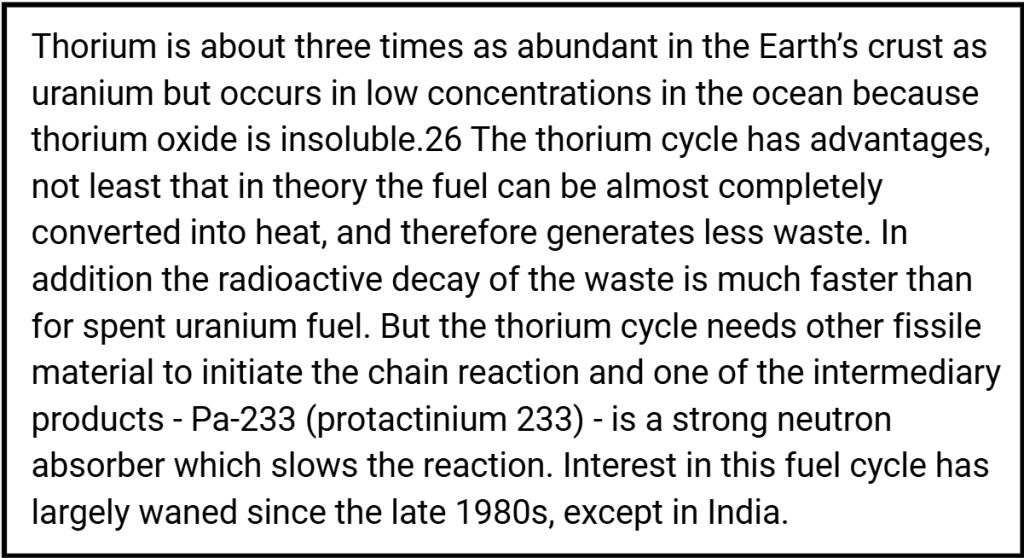
A thorium nuclear fuel cycle is also possible. This cycle is being tested in India but is no longer being investigated elsewhere. This appears to be a relatively immature technology not yet ready for deployment to mitigate climate change.
Planning and construction
However, the time required to actually build and commission a nuclear power station also needs to be considered. In Europe there are two examples of building the third generation European Pressurised Water Reactor (EPR). The Olkiluoto 3 reactor in Finland should have taken four years to build. It was started in 2005 and commenced operating in 2023.29 The construction of a second EPR reactor on that site was cancelled in 2015. Similarly, construction of the Flamanville reactor in France was started in December 2007, with a planned five-year construction period, and went into operation in late 2024.
If time for design and planning consent is included, then any decision taken today to build a nuclear power station in the UK is in danger of ending up with a reactor that is running out of fuel before the end of its life.
Fast breeder reactors use uranium sixty times more efficiently than pressurised water reactors (PWRs). They consume some of the waste plutonium and partly burnt uranium fuel from PWRs and produce yet more plutonium-239. The Russian BN-600 fast breeder reactor has operated since 1981 and a new version, the BN-800, has been in operation in Russia since 201430.
However, an international review of fast breeder reactors in 2010 concluded ‘After six decades and the expenditure of the equivalent of tens of billions of dollars, the promise of breeder reactors remains largely unfulfilled and efforts to commercialize them have been steadily cut back in most countries’ and ‘The breeder reactor dream is not dead but it has receded far into the future.’31 Currently, in Europe and the USA such reactors are still at the design stage.32
An important factor that needs to be considered in the rational planning of any energy source, including nuclear power, is the energy return on energy invested (EROI). This can be defined as the delivered energy divided by the total energy that has been invested to produce that energy. Thus, an energy source with an EROI less than 1 produces less energy than it consumes. It is probable that a nation’s principal power source must have an EROI in excess of 10 to maintain anything approaching the complexity of our present society.33
It appears that the EROI of nuclear power depends on numerous factors and is hard to calculate. It has been suggested that it is unlikely to exceed 10 or 11.34
For any energy source it is also necessary to consider the energy break even time, which is the time taken to ‘pay back’ the energy invested in developing a source with the cumulative energy supplied by that source. Energy break even time is important, because, without massive subsidies, investors are unlikely to be interested in financing schemes in which the energy payback time exceeds five years.
According to a detailed life-cycle analysis, pressurised water reactors (PWRs) have an energy payback-time of 6.5 years.35 As PWRs have a projected lifetime of no more than 40 years the maximum estimated EROI over this period can be estimated as (40)/6.5 = 6.15. However, it can be argued that this estimate is conservative in that it relies on results from an earlier generation of less efficient PWRs and takes no account of potential lifetime extensions.36 Against this it has been argued that the EROI for future nuclear power sources does not take into consideration the decline in net energy caused by a switch to progressively lower grades of uranium ore driven by the depletion of the best ores37. Further, it could be argued that even if the EROI could be increased to 10, this would not, as we have observed above, be enough for a principal energy source to support our society.38
Nuclear power in UK is expensive. At the end of 2023 the price for Hinkley Point C electricity was predicted to be £128.09 per MWh, when it starts producing; but this is likely to rise.39 Meanwhile, according to DESNZ40, the prices for projects to be commissioned in 2025 are likely to be:-
- CCGT (gas) £114 per MWh
- Offshore wind £44 per MWh
- Onshore wind £38 per MWh
- Large scale solar £41 per MWh
How will nuclear power contribute to the reduction of UK’s greenhouse gas emissions?
Nuclear energy is called ‘clean’ or ‘low carbon’ in the sense that the marginal greenhouse gas emissions from generating an additional kilowatt.hour of energy are close to zero.
However, such statements take no account of the emissions generated by building a nuclear power station, mining, processing and transporting ores and enriching the uranium-235 content, manufacturing fuel rods and, eventually, decommissioning the power station and safely disposing of the waste, particularly the high-level waste.
In recent years detailed life-cycle analyses of the production of energy by nuclear power stations have led to a range of estimates from 8 to 64 g CO2 per kWh.41 A report for EDF, who operate Torness station, in UK, calculate lifetime emissions of 16.5 g CO2 per kWh.42
These figures cover a large range, and demonstrate the difficulty of remotely accurate assessments.
For comparison, a 2014 life cycle analysis of offshore wind arrays came up with emissions of 18 to 31 g CO2 per kWh43; while a more recent one for solar photo voltaic systems calculated emissions as 14 to 73 g CO2 per kWh44. The range of all these figures demonstrates how difficult it is to compare them. But suffice to say that they are definitely significantly lower than those from coal or gas.
So nuclear power may not be the lowest carbon technology available today to help meet the 81% reduction in UK greenhouse gas emissions from 1990 levels by 2035, which was announced by the Prime Minister at COP 29. Although far less than coal or gas-fired power stations, even when such stations are fitted with carbon capture and storage (CCS), their emissions are not insubstantial and appear to be comparable with those from wind and solar photovoltaic.
A new generation of nuclear power stations could then provide a solution in supplying baseload electricity, at least until renewable technologies and the necessary accompanying grid solutions, including energy storage, are sufficiently well established.
What are the risks of nuclear power?
Nuclear power poses risks around accidents, terrorism and waste disposal. These risks are compounded as more nuclear power stations are built in more countries.45 Here risks are only considered qualitatively because there is so much uncertainty in estimating the risks quantitatively.
First, there is potential for lethal, widespread, extremely costly and long-lasting damage from any nuclear accident. In spite of a relatively safe record over the years, nuclear power stations will always be susceptible to human error and unexpected events, even with modern technology (Three Mile Island 1975, Chernobyl 1986, Thorp 2005 and Fukushima 2011 are examples of accidents). Having said this, designs have been refined over time, and more safety measures are now included. In particular, duplicate emergency cooling systems are now used; and “passive” emergency cooling systems are emerging, that require no external power to operate46.
Second, terrorists could acquire material from nuclear programmes to build a nuclear weapon or a ‘dirty’ bomb (one that contaminates a wide area around the site of a conventional explosion with radioactive material). Either scenario could lead to the death, immediate or delayed, and injury of a very large numbers of people. Terrorists may also directly attack a nuclear facility with unpredictable but probably dire consequences.
The third risk centres on high-level waste (HLW) produced from waste fuel and the decommissioning of power stations. What right do we have to leave this hazard for thousands of future generations? The UK already has about 1,500 m3 of high-level liquid waste at Sellafield47. A 1 GW reactor produces about 0.5 m3(5 tonnes) of solid HLW per year, so the annual increase in volume of HLW from a new generation of reactors is likely to be relatively small.48 However, in spite of extensive research over at least the last 30 years, no acceptable underground site in the UK has been identified where high level waste can either be safely stored or disposed of. Plutonium-239, found in irradiated fuel, has a half-life of 24,400 years and consequently will remain hazardous for around 250,000 years. It decays into uranium-235 with a half-life of 710,000 years.49 Although the hazard remains for millions of years, it is generated, in theory, by a relatively small volume (less than a 22 metre cube of high-level and spent fuel waste for the UK so far) yet it has to be broken up into safe, smaller volumes which have to be isolated from the biosphere for many thousands of years.
In summary, it is hard to fully and quantitatively assess the risks posed by nuclear power, particularly in comparison with other sources of energy. Many people, including voters, feel deeply uneasy at the prospect of an expanding nuclear power industry. Fear of radioactivity and distrust of the nuclear industry among the general population are just as likely to play a significant role in any political decision about nuclear power as the arguments presented here.50
Are there adequate, alternative, low carbon sources of electricity?
The answer to this question is undoubtedly a qualified ‘yes’, depending on how energy demand can be reduced, how energy can be used more efficiently in future, how it can be stored, and on whether renewable sources can be installed fast enough. The UK is investing strongly in renewables. In 2023 renewables, mainly wind, bioenergy and solar, delivered 46.4% of the UK’s electricity generation.51 It must be remembered, though, that electricity production comprises only around 15% of UK’s total energy consumption.
Renewable energy means that the energy source is infinite on a human timescale, free and largely derived from the Sun or the Moon’s rotation about the Earth. Renewable and well tested technologies in the form of onshore and offshore wind turbines, hydroelectricity, tidal barrages, and photovoltaic panels already exist. Some have operated for decades; some continue to be improved. New technologies in the form of wave and tidal current generators are being developed.
Although some embodied greenhouse gas emissions will be involved in the manufacture and construction of renewable energy equipment, the life-time emissions from such technologies per unit of energy produced are estimated to be lower than for fossil-fuel derived energy. Renewable energy also has the huge advantage that the ‘fuel’ is free and not susceptible to price fluctuations, nor imports.
However, nuclear power stations have one big advantage over renewable sources in that in principle they can deliver baseload electricity i.e. the supply that is required to satisfy a demand that exists around the clock. In the twelve months to mid-October 2024 the UK baseload was about 25 GW which is around 60% of the peak demand in the same period.52
But in 2023, as already mentioned, nuclear supplied only 13.8% of the demand for electricity, and the installed nuclear capacity is subject to planned power station closures. A national energy supply based predominantly on renewables might struggle, even with a smart grid, to supply the required baseload unless backed up by an efficient form of energy (electricity) storage and strong interconnectivity with other countries.
Finally, many advocate the use of nuclear fusion to generate electricity. Nuclear fusion aims to reproduce the fusion reactions that take place in the Sun. The International Thermonuclear Experimental Reactor (ITER) is being built over 10 years at Cadarache, France, where 35 nations are collaborating to create a fusion reactor. ITER plans to create the project’s First Plasma by 2035 and to reach full fusion power several years after that.53 ITER is seen as the bridge toward a first plant that will demonstrate the large-scale production of electrical power. This might be a feasible way to generate electricity in the second half of the 21st century but today, unfortunately, it remains a technology that is unproven at a useful scale.
Conclusions
The UK faces a looming energy gap, when demand will exceed ‘home grown’ supply, which presently is filled by imported energy. Existing nuclear reactors will mostly be phased out by 2030. Hinkley Point C should be producing electricity by 2030; and construction of Sizewell C has been approved by the government, subject to sufficient funding, which, as of December 2024, has not yet been committed. The government is showing interest in the unproven SMR technology. However, as described above, nuclear power is not renewable nor free of greenhouse gas emissions, nor cheap.
Two possible conclusions can be reached from the above discussion which are at opposite ends of a spectrum of views.
- A nuclear energy proponent will argue that one more generation of new nuclear power stations will help to fill the energy gap until renewable energy (or possibly nuclear fusion) is sufficiently developed to take over entirely. It will be particularly important as a supplier of base load, which most renewables can’t supply. It will be maintained on the assumption that new uranium reserves will be found, or fuels can be created using the fast breeder fuel cycle. The risks will be considered as worth taking and the argument will emphasise the increasing reliability, safety and security of nuclear power stations, while downplaying the high-level waste disposal problem.
- A nuclear energy sceptic will argue that the long time required to plan and construct a new generation of nuclear power stations (some fifteen to twenty years) will be too late to fill the energy gap. In addition, such power stations may come on stream in the UK only as global supplies of uranium fuel start to dry up and/or their exploitation generates more greenhouse gas than gas-fired power stations (the carbon dioxide trap). The argument will be that it seems inescapable that efforts and financial resources would be better spent on expanding existing, well tried, renewable energy technologies, the lifetimes of which will not be constrained by any depletion of their ‘fuel’. Lastly, nuclear power carries the risk of serious accidents, will potentially bequeath hazardous waste to thousands of future generations and is open to terrorist attack.
Perhaps, because of the need to decarbonise the grid quickly, the long time required to complete a new nuclear power station, together with the perceived risks, will count against further nuclear energy. Whatever decision is taken, there is an urgent need for a low carbon source of base load power within the next five years.
Read this as a PDF here.
Footnotes
A A mineral resource is a concentration of minerals that have been identified and measured with reasonable certainty but have not yet been proven to be economically viable for extraction; while a reserve is a portion of a mineral resource that has been demonstrated to be economically and legally extractable.
B‘A smart grid is an electrical grid that uses computers and other technology to gather and act on information, such as information about the behaviours of suppliers and consumers, in an automated fashion, to improve the efficiency, reliability, economics and sustainability of the production and distribution of electricity.’ From http://en.wikipedia.org/wiki/Smart_grid.
References
1 UK ENERGY IN BRIEF 2024, Department for Energy Security and Net Zero
2 Anon (IMechE). “ENGINEERING THE UK ELECTRICITY GAP.” London: Institution of Mechanical Engineers, 2016.
4 https://www.edfenergy.com/energy/power-stations/sizewell-b
5 https://www.edfenergy.com/energy/education/visitor-centres/hinkley-point-visitor-centre
6 https://www.world-nuclear-news.org/Articles/EDF-announces-Hinkley-Point-C-delay-and-big-rise-i
7 https://labour.org.uk/wp-content/uploads/2024/06/Labour-Party-manifesto-2024.pdf
8 https://www.gov.uk/government/news/energy-secretary-ed-miliband-sets-out-his-priorities-for-the department
9 https://www.ft.com/content/c99e4517-7e03-4acc-83f9-fd580004b9e2
10 https://www.oecd-nea.org/jcms/pl_90816/the-nea-small-modular-reactor-dashboard-second-edition
11 https://www.nuclear-power.com/what-is-the-role-of-nuclear-power-in-grid-stability/
12 MacKay, D. J. C. (2008). Sustainable energy – without the hot air. Cambridge, UIT although in the last days of his life (he died in April 2016) he remained convinced that nuclear power would continue to be essential; http://www.theguardian.com/environment/2016/may/03/idea-of-renewables-powering-uk-is-an-appalling delusion-david-mackay
13 Kemp, M. and J. Wexler (2010). ZERO CARBON BRITAIN 2030 A NEW ENERGY STRATEGY: The second report of the Zero Carbon Britain project. Machynlleth, CAT: pp.384.
14 Helweg-Larsen, T. and J. Bull (2007). Zero carbon Britain. Machynlleth, Public Interest Research Centre, Centre for Alternative Energy: 105 pp.
15 Anon. (2012). Electricity System: Assessment of Future Challenges – Summary. London, DECC: pp.12. 16 http://www.after-oil.co.uk/nuclear.htm
17 http://www.world-nuclear.org/information-library/nuclear-fuel-cycle/uranium-resources/supply-of uranium.aspx
18 https://www.iaea.org/newscenter/news/extending-operational-life-span-nuclear-plants
19 https://internationalcopper.org/sustainable-copper/about-copper/cu-demand-long-term-availability/
20 https://world-nuclear.org/information-library/nuclear-fuel-cycle/uranium-resources/supply-of-uranium
21 https://www.oecd-nea.org/upload/docs/application/pdf/2020-12/7555_uranium_- _resources_production_and_demand_2020__web.pdf
22 https://www.usgs.gov/publications/critical-analysis-world-uranium-resources
23 https://www.nasdaq.com/articles/top-10-uranium-producing-countries-updated-2024
24 https://pubs.acs.org/doi/10.1021/acs.est.3c03190
25 Fig. G.18 in http://www.stormsmith.nl/
26 MacKay, D. J. C. (2008). Sustainable energy – without the hot air. Cambridge, UIT.
27 Fleming, D. (2007). The lean guide to nuclear energy: A life-cycle in trouble. London, The Lean Economy Connection, p.27.
28http://phys.org/news/2016-04-advances-uranium-seawater-special-issue.html
29http://www.theecologist.org/News/news_analysis/2859924/finland_cancels_olkiluoto_4_nuclear_reactor_is _the_epr_finished.html
30 https://wna.origindigital.co/information-library/current-and-future-generation/fast-neutron-reactors
31 Cochran, T. B., H. A. Feiveson, et al. (2010). Fast Breeder Reactor Programs: History and Status, International Panel on Fissile Materials: pp.128.
32 https://www.neimagazine.com/advanced-reactorsfusion/time-for-a-new-focus-on-fast-reactors 10380132/?cf-view
33 Charles A. S. Hall and Kent A. Klitgaard (2012) Energy and the Wealth of Nations: Understanding the Biophysical Economy , Springer
34 http://georgewashington2.blogspot.co.uk/2011/04/us-wastes-more-energy-than-it-uses.html and Hall, Charles and Bobby Powers.“The Energy Return of Nuclear Power.” State University of New York. April 22, 2008.
35 Lenzen, M. (2008). “Life cycle energy and greenhouse gas emissions of nuclear energy: A review.” Energy Conversion and Management 49: 2178-2199.
36 Pers. Comm. Alexandre Poisson, McGill University, April, 2012.
37 http://www.stormsmith.nl/publications/secureenergy.pdf
38 For comparison, in 2006 onshore US wind turbines had an EROI of around 20 (www.eoearth.org/article/Energy_return_on_investment_(EROI)_for_wind_energy) and in 2009 PV systems had an EROI of about 6.6 (www.eoearth.org/article/Energy_return_on_investment_(EROI)_for_photovoltaic_energy).
39 renewable-energy-industry.com/news/world/article-6502-new-hinkley-point-c-nuclear-power-plant electricity-costs-over-15-cents-per-kilowatt-hour-at-launch#:~:text=Due%20to%20the%20price%20increases%20in%20the%20UK%2C,the%20International%20Eco nomic%20Forum%20for%20Renewable%20Energies%20%28IWR%29
40 Department for Energy Security and Net Zero, Electricity Generation Costs 2023
41 https://www.sciencedirect.com/science/article/abs/pii/S0306261921002555
42 Life Cycle Assessment of electricity from Torness nuclear power plant development EDF, May 2022 43 GHG emissions and energy performance of offshore wind power. Hanne Lerche Raadal et al, June 2014 44 Environmental impacts of solar photovoltaic systems: A critical review of recent progress and future outlook. Muhammad Tawalbeh et al, March 2021
45 http://www.pppl.gov/pub_report/2011/PPPL-4617.pdf
46 https://theconversation.com/nuclear-power-is-set-to-get-a-lot-safer-and-cheaper-heres-why 62207?utm_medium=email&utm_campaign=Latest%20from%20The%20Conversation%20for%20April%2012% 202017%20-
47 https://www.gov.uk/government/publications/uk-radioactive-waste-and-material-inventory-2022/uk radioactive-waste-inventory-2022
48 http://openlearn.open.ac.uk/mod/oucontent/view.php?id=398840§ion=4.4
49 http://www.nirs.org/factsheets/hlwfcst.htm
50 Attention is drawn to government decisions in Belgium, Germany, Japan, Scotland and Switzerland to close or phase out nuclear power plants after the Fukushima accident in 2011.
51Digest of UK Energy Statistics Annual data for UK,2023, DESNEZ, UK
52 http://www.gridwatch.templar.co.uk/index.php
53 https://www.world-nuclear-news.org/articles/europe-completes-manufacture-of-iter-vessel-sector