
This question about nuclear power is often asked. So we thought that there should be information on the Winchester Action on the Climate Crisis (WinACC) website to help people understand the issue better.
The decision that the government must make (or delay) to build more nuclear power stations is not as straightforward as some related ones, such as building solar farms or encouraging electric cars.
The full WinACC report on nuclear power is available to read as a word document here.
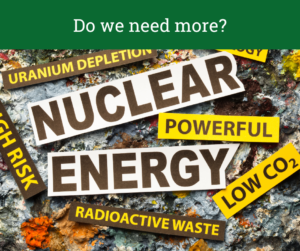
Why even consider nuclear power?
It is a low emission source, meaning that it releases fewer polluting greenhouse gases into the atmosphere than energy from coal, oil or gas.
Importantly, it can also supply a reliable base load. The base load is the minimum energy generally used in the country, which therefore should be produced at a constant rate, all the time. Most renewable energy systems are intermittent, and are not so good, at present, in guaranteeing this base load. It’s not always sunny, nor windy!
Once constructed, a nuclear power station is likely to have a life of some 60 years; far longer than is the case for wind turbines or solar PV equipment.
How practical are new nuclear power stations?
Producing nuclear power depends on access to a significant supply of sufficiently rich uranium ores. It is therefore not renewable. Our online research into current uranium resources suggests that it is far from certain that there will be sufficient uranium available for the whole life of a new power station.
The construction time is long for nuclear power stations. Two recent stations, similar to Hinkley Point C (being constructed in the UK at present), have taken seventeen years (in France) and eighteen years (in Finland) to construct. The planning process, particularly in the UK, is likely to add years to that figure.
Nuclear power in the UK is expensive. The current predicted price for electricity from Hinkley Point C is approximately three times that from wind and solar.
Risks of nuclear power
There are risks from accidents, terrorism and the difficulty of storing/disposing of high level nuclear waste.
There have been a comparatively small number of nuclear power station accidents in the world, but some have been very serious. Designs have improved, and more safety measures are now included.
There are a number of scenarios that could involve terrorism, the likelihood of occurrence being difficult to quantify without more detailed knowledge of designs and security systems.
In the UK no final solution to the disposal of high-level nuclear waste has been decided. There is now some 1,500 cubic metres of such waste stored at Sellafield. It will remain hazardous for hundreds of thousands of years. In spite of extensive research over at least the last 30 years, no acceptable underground site in the UK has been identified. A permanent solution must be found, because of the high level of very long term potential danger from the waste.
All the above issues must be taken account of by the politicians involved in decision making.
Are there alternatives to nuclear power?
A qualified “yes”; but this depends on us using less electricity and installing sufficient renewable energy infrastructure, including wind farms, solar farms and transmission lines. However, the intermittency of most renewable sources is a serious problem, because the grid requires a baseload of some 60% of peak demand.
Realistically, therefore, an avoidance of nuclear power also requires large scale “battery” storage, which is not yet available; or, of course, the use of gas power further into the future than is desirable. The use of hydrogen in some way is also an option.
Conclusions
The UK faces a looming energy gap, when demand for energy will exceed ‘home grown’ supply, which is likely to be increasingly filled by imported energy.
Existing nuclear reactors will mostly be phased out by about 2030. A significant amount of the base load supply needs replacing. This cannot be achieved using nuclear power in the required timescale; but in the longer term nuclear power could supply some of the baseload.
So, after reading the above, and ideally the full report, one might come to one of these conclusions, or somewhere in between.
- That nuclear power will help to fill the energy gap until renewable energy (or possibly some other source) is sufficiently developed to take over entirely, and, importantly, to supply some of the required base load. Also, that there are sufficient sources of uranium fuel. The risks of nuclear power will be considered as worth taking, together with improved safety and security of nuclear power stations, while downplaying the high-level waste disposal problem.
- That the long time required to plan and construct a new nuclear power station will be too late to fill the energy gap. Nuclear power carries the risk of serious accidents, will potentially bequeath hazardous waste to thousands of future generations, and is open to terrorist attack. In addition, such power stations may come on stream as global supplies of uranium fuel start to dry up and/or their exploitation generates more greenhouse gas than gas-fired power stations. Efforts and financial resources would be better spent on expanding and improving renewable energy technologies (particularly electricity storage), whose “fuel” will last forever.
Brian Shorter, WinACC Science and Technology Advisory Panel (STAP) member