
When the new UK government came in many people expected a resurgence in investment in renewable energy. This has indeed happened, but alongside an announcement of a large investment in Carbon Capture and Storage (CCS) prompting 24 scientists to write a letter to the government asking for the investment to be reconsidered.
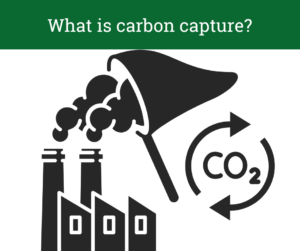
What is CCS and what is being proposed?
The idea of CCS is to reduce greenhouse gas emissions by capturing the carbon dioxide (CO2 ) produced in industrial processes – such as when natural gas is either burned to produce electricity or is used to create hydrogen. The captured CO2 is stored in a suitable geological formation, often by pumping down an old natural gas well. Hydrogen (a carbon-free fuel) produced from natural gas is called ‘blue hydrogen’; in contrast to ‘green hydrogen’ which is produced from water using renewable electricity. DeSmog’s article, and WinACC’s CCS explainer and hydrogen explainer, provide more information on CCS.
The initial £3.9 billion investments announced are for construction of a new gas power station with CCS and blue hydrogen production at sites in Teesside and Merseyside. Funding the commitment made by the previous government a total of £21.7 billion has been committed to support these projects over the next 25 years. This will include hydrogen pipelines and a large hydrogen storage facility.
To put these investments in context the Government’s Green Prosperity Plan including CCS is now expected to be funded with around £15 billion annually (at least initially) after it was reduced from £28 billion, and a total £2 billion will subsidise the first round of green hydrogen production at 11 sites over the next 15 years.
How did people react?
Many, including the CCS industry, welcome this investment. Some experts including Professor Myles Allen contend that continued large scale use of fossil fuels is inevitable so it will be impossible to meet our net zero goal without CCS. Since very little has been done to develop CCS in the UK so far, they think it is essential to start investing now. A group of them have written their own letter responding to many of the scientists’ points.
Oil and gas companies such as BP actively promote use of CCS which provides a path to continue using fossil fuels with fewer emissions, but they want subsidies before they will invest themselves because CCS increases their costs. It is concerning, however, that many of these companies appear to be reducing their commitment to net zero in other areas which could have reduced our reliance on fossil fuels.
Local officials including the mayor of Teesside and the government including the chancellor also welcome these investments, stressing the jobs that will be created.
On the other hand, many environmentalists, as expressed in the scientists’ letter, question how well CCS will perform, and think there are more effective ways to spend this money. The letter from 24 scientists referred to above, suggests much of this funding should instead be used to create a more flexible electricity grid, with more storage, alongside demand reduction measures such as insulation of buildings and low emissions heating systems.
Will CCS deliver a reduction in greenhouse gases being released?
Proponents anticipate that CCS will capture 95% of emissions from industrial processes. Continuing to use fossil fuels with CCS for electricity generation potentially addresses two significant problems – the intermittency of renewables and covering winter peaks in heating demand. Some ‘hard to decarbonise’ industries such as steel making, cement and fertilizer production could also use blue hydrogen instead of natural gas. The components of CCS have all been tested, albeit mainly by injecting the captured CO2 into oil wells to increase oil production in a process called Enhanced Oil Recovery (EOR).
As laid out by the scientists who wrote to the government – CCS does not come for free. Significant energy, material resources and infrastructure are needed, and far from all greenhouse gas emissions are eliminated. Capturing CO2 requires large installations, extra energy and uses specialized chemicals. Transporting and storing the CO2 involves energy for compression, new pipelines, undersea storage and monitoring infrastructure.
The energy for these additional processes must ultimately come from using more gas. For electricity generation, using CCS will increase gas use by 13%-44%, and for blue hydrogen around 25% more gas is needed compared with simply using natural gas directly. The additional costs mean that CCS will be subsidized – for example in the UK blue hydrogen production will be subsidized for at least 15 years, creating a perverse incentive for more fossil fuel extraction.
The overall (uncaptured) greenhouse gas emissions after using CCS are still likely to be significant. Producing and transporting natural gas before it is used leads to leaks of some methane – a much more powerful greenhouse gas than CO2. Also the potential of captured CO2 to leak from pipes or storage is unknown.
National regulations for CCS recognize there will still be significant CO2 emissions when it is employed. The UK standards for blue hydrogen production still allow for significant emissions. The UK low carbon hydrogen standard allows for (uncaptured) emissions from hydrogen production of up to 2.4 kg CO2(e) per kg hydrogen. This is still about 35% of the emissions from burning the (energy) equivalent amount of natural gas without using CCS. The equivalent EU figure is even higher at around 46%.
Despite bullish industry claims worldwide, CCS installations have been relatively few – mainly directed towards EOR (see above) – and have had limited success as documented in DeSmog’s analysis. Consequently, predictions of performance for the proposed developments are largely paper estimates informed by research projects. The Teesside development seems based in part on the ambitious and widely praised H21 project in Leeds aiming to start a conversion of the UK gas grid to hydrogen. This project looks to have drastically scaled back to looking at hydrogen safety without apparently ever supplying any homes.
All these factors suggest CCS will be expensive with past cost overruns having contributed to the cancellation of several projects, although some CCS experts contend the cost will ultimately be a fraction of a penny per kilowatt hour.
A final issue for CCS in the UK is that gas from the North Sea is dwindling and the main alternative currently is largely imported liquefied natural gas (LNG). However, LNG takes more energy to produce, mainly due to the liquefying step, so has higher emissions. Even expert CCS advocates recognise this puts it beyond use for making blue hydrogen compliant with the government standard.
What now?
The issue of CCS is far from clear-cut. However, the discussion above suggests to us that carbon reduction efforts, as listed above, should be prioritised over CCS investment as these will save more emissions in the short term, and do not suffer from the same level of uncertainty as CCS.
This is especially true at a time when we can barely afford existing gas imports and deploying CCS will increase those imports. The government should also consider refocussing CCS efforts for now onto areas which are smaller-scale and more likely to see a nearer-term benefit rather than building large scale CCS infrastructure.
Robin Speed with input from Bob Whitmarsh and Brian Shorter – January 2025.