Accelerating Solar Developments in Hampshire in review
WinACC Solar Conference 2026
What we heard, what we learned and how you can get involved after our first conference on large-scale solar in Hampshire.
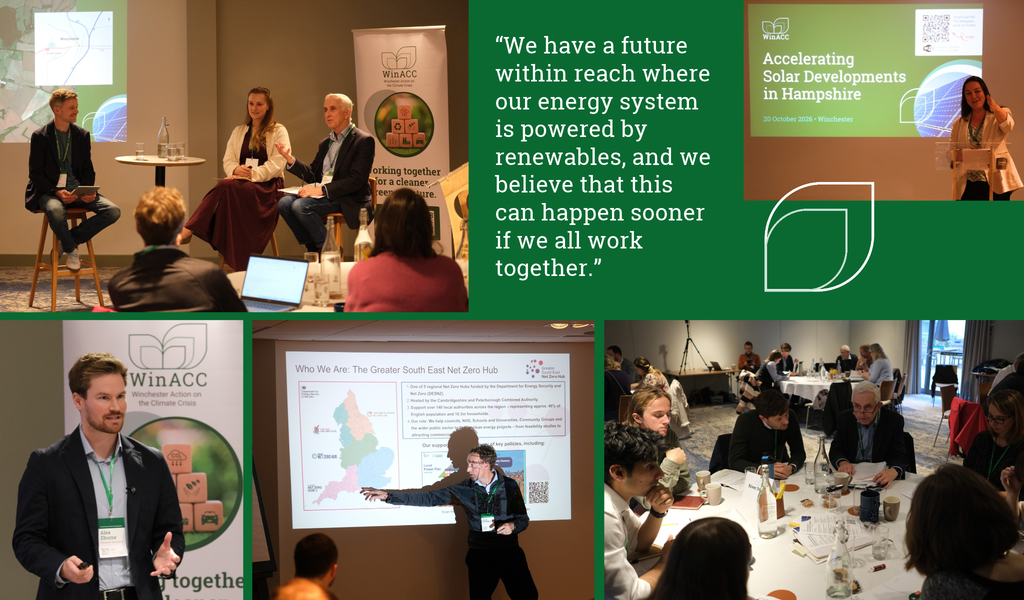
On 20 October 2026, Winchester Action on the Climate Crisis (WinACC) brought solar developers, planning officers, councillors, grid specialists, policymakers and community representatives together for Accelerating Solar Developments in Hampshire. The day looked at how solar farms in our area can get from planning to grid connection more smoothly, with communities involved much earlier in the process.
Why WinACC ran this event
Cutting emissions across Winchester district means changing how we generate and use energy, and local solar is central to that. Today, 23.8% of the electricity used in our district comes from local renewable installations, and 99.7% of that is solar. Most of it comes from solar farms. Rooftop panels on homes and businesses make up a much smaller share, even though the district has installed them faster than most of the country.
Winchester City Council’s Local Area Energy Plan, published in October 2026, shows we’ll need far more of both. Rooftop solar can’t meet the district’s needs alone, so new solar farms will play a big part in building a cleaner energy system.
Getting them built is the hard part. The Government’s Solar Roadmap (June 2025) names planning capacity and grid connections as the main barriers to delivery. It also sees local communities as key partners in getting schemes built.
WinACC exists to help Winchester district reach net-zero carbon, and we believe change happens fastest when communities and decision makers work together. This event put that belief into practice. It brought local voices into the room where our energy future is being shaped, and it looked at ways to get more clean energy built across the district.
Our Renewable Energy Action Group (REAG) has spent 6 years working with developers and communities on solar farm schemes in the district. In that time, we’ve seen how much early, meaningful community engagement benefits scheme owners, developers and local residents.
As a local charity with this experience, WinACC was well placed to bring together the many organisations involved in decarbonising our energy. On the day, they shared the progress already made in the district and discussed how new solar farms could move through planning and grid connection more easily.
Bringing the whole system together
A solar farm only gets built when many people play their part. The developer designs it, planning officers assess it, the grid operator connects it, and the local community lives alongside it. These groups rarely meet outside the formal planning process, and each sees only part of the picture. On 20 October they spent the day in one room, sharing what they know and hearing each other’s concerns.
“No one organisation can take this on. We are all part of a system, and a system that needs to change.”
Jo Crocker, Executive Director, WinACC
We were pleased to welcome speakers and panellists from across the energy system. The National Energy System Operator (NESO) explained how energy will be planned region by region, and how local plans and priorities can shape the South East’s first regional plan. The University of Southampton set out how much solar Hampshire could host, and what stands in the way. From local government, Winchester City Council’s sustainability team presented the district’s new Local Area Energy Plan, and a senior planning officer explained what makes a strong solar farm application. The Greater South East Net Zero Hub described the free support and funding available to councils and community energy groups.
On the grid side, Scottish and Southern Electricity Network (SSEN), our local electricity network operator, explained how it plans the network years ahead and why early information from councils and developers matters. Elgin, a solar and storage developer, explained the grid connection queue and how recent reforms are changing it. Two developers shared local case studies. Innova showed how public consultation reshaped its South Lynch solar farm, and Xela Energy explained how its IBM Hursley scheme supplies power directly to a local employer without using the grid. Regen, WinACC’s Renewable Energy Action Group and a local city and parish councillor discussed how communities can take part earlier, and how quieter supporters can make their voices heard.
Get involved
Live in the Winchester district? Want to take action on climate change and nature where you live? 18 local groups are already part of our WeCAN network, with support from WinACC’s Climate Officers. Join or start a local WeCAN group
Interested in renewables and planning in Winchester? REAG’s volunteers bring experience in renewable energy, planning, ecology, mapping and local government. We’d especially love to hear from you if you know about solar, local energy planning, community engagement, communications, parish or community leadership, or farming and land management. Join our Renewable Energy Action Group (REAG)
Rachel Waugh, Regional Energy Strategic Planning Strategic Lead (South East), National Energy System Operator (NESO)
Prof. AbuBakr S. Bahaj, Lead of the Energy & Climate Change Division and the Sustainable Energy Research Group, University of Southampton
Rachel works for the National Energy System Operator (NESO), a public body set up in 2024 to run Great Britain’s electricity system, a job previously done by National Grid. As well as keeping supply matched to demand, NESO now plans how our energy system needs to change. That includes 11 regional plans shaped by what local councils, communities and businesses want for their area. The South East plan goes out for public consultation in spring 2028, and Rachel encouraged everyone to get involved early.
Professor Bahaj asked whether Hampshire could one day generate all the electricity it uses. To meet the government’s 2030 clean power goal, UK solar capacity needs to rise from about 18 gigawatts (GW) to about 47 GW. One gigawatt is the same as fifty solar farms the size of South Lynch. Only about 21,000 of Hampshire’s 482,000 buildings have solar panels. The county’s potential is huge, but he said the biggest barrier is getting connected to the grid. Finding land, funding, skills, planning permission and winning community support are all challenges too.
Winchester’s Local Area Energy Plan
Alex Eburne, Sustainability Manager, Winchester City Council
Arshan Shroff, Strategic Development Analyst (DSO Whole System), SSEN
Pedro Aspiazu, Stakeholder Engagement Lead (DSO Whole System), SSEN
Alex introduced the district’s new Local Area Energy Plan, built with SSEN and Advanced Infrastructure using the free LEAP+ digital tool. The plan models five scenarios and recommends a 2040 pathway as the best route to decarbonising the district’s energy. The district already has about 100 MW of solar farms, with 160 MW more in the planning pipeline. The plan identifies room for a further 292 MW across 1,012 sites, though many are too small to be viable on their own. Winchester’s plan also modelled the effect of this new generation on each of the district’s 26 primary substations. Arshan and Pedro explained how SSEN plans the local network six or more years ahead. For the first time, local area energy plans can feed directly into SSEN’s forecasts, which shape where it invests. They encouraged developers to use SSEN’s connection surgeries to discuss sites before applying.
Turning the plan into projects
Alex Eburne, Sustainability Manager, Winchester City Council
Sam Moore, Energy Project Manager, Greater South East Net Zero Hub
Alex returned to set out the ways new solar could be delivered, from council-led schemes and partnerships to community ownership and developer-led projects. Sam described the Net Zero Hub’s free support for councils, schools, the NHS and community groups. He highlighted Great British Energy’s Community Energy Fund, which offers up to £40,000 for feasibility, £100,000 for development and £3 million for building schemes. He noted that Winchester is one of only about 35 of England’s 350 local authorities with a local area energy plan, which puts the district ahead of most.
The planning officer’s perspective
Nicola Martin, Principal Planning Officer, Winchester City Council
Nicola set out what makes a good planning application, what slows one down, and how everyone involved could work better together. Much of her advice was about starting early. Pre-application advice from the council, along with the paid services offered by Hampshire County Council’s highways and flood teams, can head off problems before an application is submitted. When it comes to public consultation, she recommended talking to parish councils early and holding events when people can actually attend. Bringing a transport consultant along means questions about construction traffic can be answered on the spot. Once an application is in, consistent documents and clear workings behind any carbon or energy claims make it easier to assess. Being open about grid connection works helps too, even when they sit outside the application itself. She also explained how stretched officer time is, and the delay each formal re-consultation adds.
Grid connections
Paul Munday, Senior DNO Interface Manager, Elgin
Paul explained that the grid challenge is mainly a queue problem. At its peak, the connection queue held 738 GW of projects, against the 200 to 225 GW of renewables needed for 2030. Connections reform now asks two questions of each project: whether it’s ready, meaning the developer has secured the land, and whether it’s needed under the national Clean Power 2030 plan. New connection offers are being issued in stages. So far, connection dates have changed little, but the queue is now focused on projects that are likely to be built.
South Lynch case study
Chaired by Gareth Jones, Trustee, WinACC
Nicola Alewood, Principal Planning Manager, Innova
Tim Jackson, Chair, Renewable Energy Action Group, WinACC
South Lynch is a 20 MW solar farm in Hursley parish, west of Winchester, approved in October 2024. Nicola explained how Innova’s public consultation changed the design. The panels were packed more closely so the site could move away from nearby homes and off the better-quality farmland. Innova also added viewpoints and photomontages for neighbours and strengthened the hedgerow planting. Tim described how REAG assesses schemes, using criteria based on Solar Energy UK’s code of practice, and how it shared its findings with WinACC members. Both said they would make contact earlier next time. Innova now consults in two stages and approaches local community groups from the start.
Panel discussion: Engaging Communities in Solar
Chaired by Gareth Jones, Trustee, WinACC
Alex Robertson, Local Net Zero Project Manager, Regen
Tim Jackson, Chair, Renewable Energy Action Group, WinACC
Ritchie Latham, Winchester City Councillor for Bishop’s Waltham
The panel opened with a short film of comments from past solar farm applications, covering both support and concern. The discussion explored how to make engagement worthwhile for everyone. Panellists agreed that consultation works best as a genuine two-way conversation, where local knowledge is heard and fed back into the proposals. They also noted that supporters are often quieter than objectors. Keeping promises after planning, and making community benefits visibly linked to the solar farm, both build trust for the next scheme. Tim suggested that the Local Area Energy Plan could let parish councils look at their area’s potential before any developer arrives.
“Consultation need not be a tick-box exercise. We need to make sure that we are actually responding to what we hear from communities.”
Alex Robertson, Local Net Zero Project Manager, Regen
IBM Hursley case study
Jake Barnes-Gott, Development Director, Xela Energy
Jake presented a different model: a 5 MW solar farm connected by private cable directly to IBM’s Hursley site about a kilometre away. Because it doesn’t connect to the grid, the scheme avoided the connection queue. Early consultation, an employment and skills plan for a major local employer, and around 40% biodiversity net gain helped it win local support. It was approved by officers with no objections and should start generating in January 2027.
Workshop: from proposal to permission
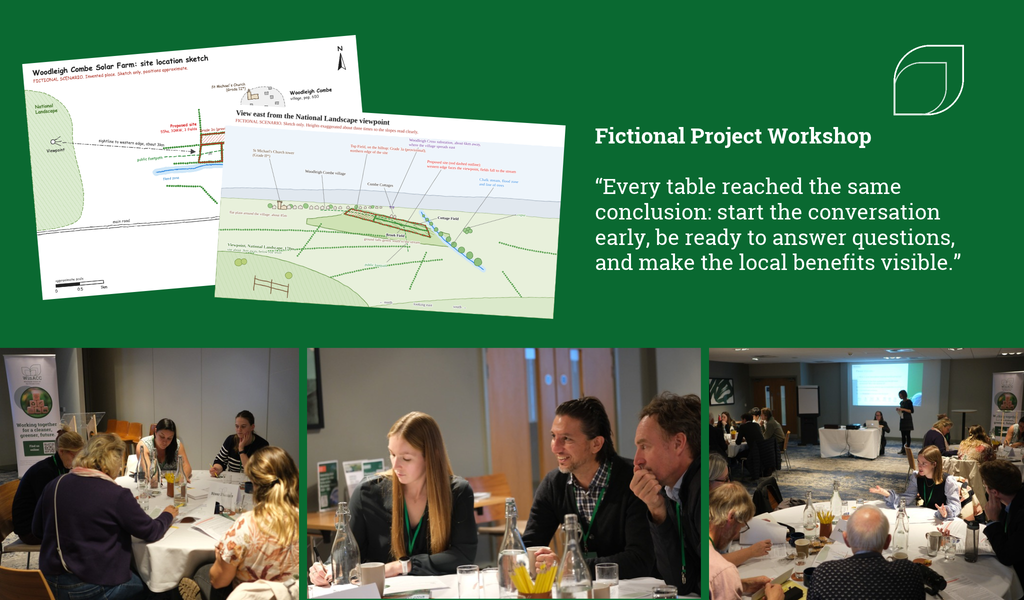
In the afternoon workshop, delegates worked in mixed tables of developers, planners, grid specialists and community members on Woodleigh Combe, a fictional solar farm site. Each table took the scheme from first idea to planning decision, seeing each stage from the other side. Local concern, and too little support to address it, came up as a common challenge.
The tables’ ideas focused on starting conversations sooner and involving more people in them. Developers could raise community benefits early and shape them with local people, working alongside supportive community groups. Setting aside proper resources for engagement, sometimes including a specialist, means questions get answered well and residents have a chance to learn how solar farms work and what they offer. Consultation events could bring in more of the organisations involved, such as SSEN, so people can put grid questions to the people responsible. Talking early to local influencers, such as the National Park Authority, and meeting direct neighbours one to one, would help, especially if schemes look for ways to improve the neighbours’ surroundings. Communities could also help shape practical plans like construction traffic management.
Many of the delegates found this workshop the most valuable part of the day.
What we learned, and what the day achieved
The big themes
One message ran through every session: start early. SSEN wants to hear about new schemes years before they need a connection. Planning officers find applications easier to assess when issues are raised at pre-application stage. At South Lynch, early conversations with neighbours led to real changes on the ground. The grid came up again and again as the biggest barrier, though recent reforms are now focusing the connection queue on projects likely to be built. Speakers also agreed that trust grows when developers are open about what’s planned, keep their promises after planning, and make sure local people can see how a solar farm benefits their area.
How we measured up
Jo opened the day with five objectives, and the strongest result was the chance for each group to see solar development from the others’ point of view. Developers heard what planning officers need from an application and what worries neighbours. Community members learned why grid connections take years, and planners heard what holds developers back. In the workshop, mixed tables worked through a fictional scheme together, which made those different pressures concrete. Winchester’s new Local Area Energy Plan gave everyone a shared picture of the district’s potential. New contacts made on the day, from SSEN’s connection surgeries to developers planning to approach REAG earlier.
The final objective was to create a model other districts can use. As far as we know, no other event in the UK has brought these groups together in quite this way, and we’ll be sharing a fuller guide to how we did it.
Get involved
Live in the Winchester district? Want to take action on climate change and nature where you live? 18 local groups are already part of our WeCAN network, with support from WinACC’s Climate Officers. Join or start a local WeCAN group
Interested in renewables and planning in Winchester? REAG’s volunteers bring experience in renewable energy, planning, ecology, mapping and local government. We’d especially love to hear from you if you know about solar, local energy planning, community engagement, communications, parish or community leadership, or farming and land management. Join our Renewable Energy Action Group (REAG)
Delegates told us the day was valuable. Many heard about developments and opportunities they wouldn’t otherwise have known about. Now we want to build on the connections made in the room. We’re exploring a space where everyone who attended can keep in touch and build those relationships further, and we hope to grow REAG’s capacity so it can keep pace with large-scale solar proposals across the district.
We’d also like to help other areas do the same. We’ll share the format with other districts, support anyone who wants to run a similar event, and publish a guide to what good community engagement looks like for large-scale solar.
Closer to home, we’ll build understanding of how solar development works. We’re planning a session for local councillors on solar farms and grid constraints, and we’ll help communities engage early and constructively with the planning process. This work will also link into the new Community Energy Network for Hampshire and the Solent, which WinACC is helping to build.
Thank you
Thank you to all our speakers and panellists for their time, their expertise and their openness on the day, and to WinACC trustee Gareth Jones for chairing the afternoon sessions. Thank you also to our volunteers: Peter Crocker for filming, Richard Murphy for photography, Anna Herron for facilitating the workshop and Sasha Connolly for running the welcome desk. And thank you to everyone who came and took part.
Bringing this model to your area
Every district in the country faces the same questions about how to get more solar farms built with local support. We think the approach we used in Winchester can work elsewhere. The day worked because a local charity offered neutral ground and kept the discussion on policy and process. A workshop built around a fictional site let developers, planners and community members work through a scheme together, without the pressure of a live application.
We’re keen to share what we learned, from planning and programming to the practical lessons from the day. If you’re part of a climate group, council or organisation thinking about running something similar, we’d love to hear from you. Email us at contactus@winacc.org.uk.