
Last year my wife and I flew to Iceland for our honeymoon. Icelandair told me that if we paid them to plant three trees, our flight would be net zero carbon – which seemed very unlikely. And so it turned out – last month, the CEO of Verra, the largest international carbon credit certifier, resigned after an investigation discovered that over 90% of their approved rainforest carbon offsets were worthless. Whereas research has found that the carbon footprint of a journey on a French high-speed train is about 15 times lower than air travel.
So this year we decided to travel by train (and ferry) – to Greece. To travel may be better than to arrive, but we did also want to spend some time relaxing in the Greek islands. With the help of The Man in Seat 61, we worked out that we could get to Athens in three days, via Paris, Milan and a ferry across the Adriatic from Italy.
Eurostar is a great way to travel to Paris – just over two hours after leaving London, you arrive in the Gare du Nord. A quick metro ride connects to trains going to Spain, Belgium, the Netherlands, Luxembourg, Germany, Switzerland, and Italy. Booking is easy – using Trainline (other apps are available…) means you don’t have to grapple with each country’s rail website.
The UK has only one high-speed railway – HS1, which opened in 2007 to link the 67 miles between St Pancras and the Channel Tunnel. France’s high-speed rail network now covers over 1,700 miles – by 2003, it had carried 1 billion passengers. Italy’s first high speed train service opened in 1977 and now few people there use internal flights.

We jumped on an Italian Frecciarossa (“Red Arrow”) express at Gare de Lyon which sped to Milan through the Alps at speeds of up to 180 mph, with views of mountain towns and snowy peaks. After a night in a hotel near Milano Centrale station, another express train took us to Bari for an overnight ferry to Patras – the views had now changed to olive trees and grapevines.
Slower paced travel also creates more opportunity for chance encounters – in this case, that meant an enjoyable liquid dinner in the ferry’s bar with a US army colonel touring Europe with his wife. The next morning they gave us a lift from the ferry port to Patras railway station, where a four-hour bus and train journey took us to Piraeus – leaving enough time for an evening walk around the sights of Athens.

Island hopping was not my only reason for coming to Greece – I also hoped to catch sight of one of my heroes, Yanis Varoufakis. In 2015, as Greek Finance Minister, he famously faced-off with the European Central Bank and the International Monetary Fund in an attempt to rescue the country from its debt crisis and externally imposed austerity measures. Since then he has set up a new political party and is now pushing for a European Green New Deal to tackle the climate crisis.
The closest I got to Yanis, while reading one of his books on Agistri island, was discovering that he now lives mainly on Aegina island. I realised that I was looking straight at Aegina, just a couple of miles away across the blue waters of the Saronic Gulf. But I found out later that he was probably in Athens that day, preparing for a snap parliamentary election that was set to take place in a few days’ time.
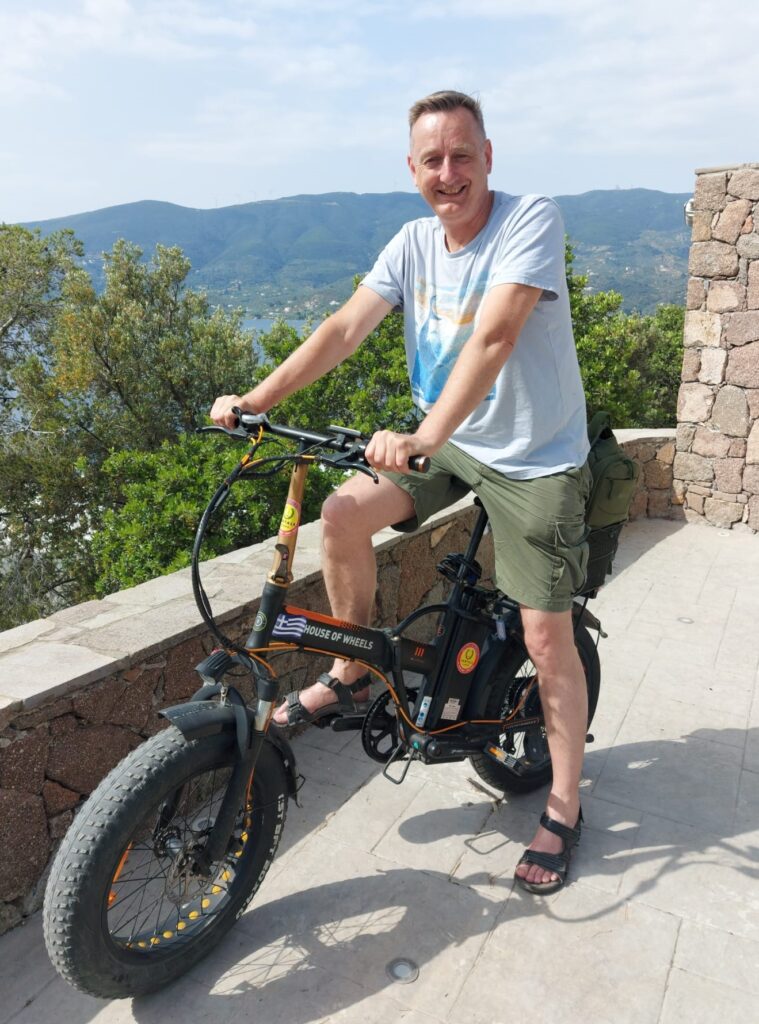
The ferries connecting Greek islands are mainly powered by fuel oil engines – a fossil fuel with a high carbon footprint. Electric ferries are coming, but as this (perhaps rather greenwashed) blog shows, travelling from Italy to Greece by ferry still creates less than half of the carbon emissions of flying. Electric bikes are available to hire on most islands – while using them on Poros, we hoped that they were charged with electricity from the line of wind turbines we could see along the high ridge of the mainland hills opposite.
Retracing our route on the journey home, I received an email from Trenitalia which included the dreaded word ‘cancellato’. Hugely destructive floods in northern Italy, exacerbated by the climate crisis meant that a section of the rail track from Bari to Milan was impassable. Fortunately for us, a hastily arranged ‘treno sostituziono’ (bus replacement service) allowed us to still make our connection to the Paris train.
I would encourage anyone to consider using trains to travel to and across Europe. Comfortable, fast and efficient, they allow you to both reduce your carbon footprint and also engage more fully with a country and its people while travelling to your destination. Plus you get to miss out on expensive airport transfers, hectic airport terminals, limited baggage allowances and a cramped, uncomfortable in-flight experience. And Trenitalia does much better coffee than any airline, budget or otherwise!
Stuart Mills, WinACC Climate Officer