
This page explains why WinACC supports high quality planning applications for solar farms in Winchester District. We also offer answers to your common concerns.
We encourage you to consider supporting new applications.
Reasons to support solar farms
Solar farms offer a solution during challenging times for climate action. They do not require public funding; they don’t affect our lifestyle, and they deliver clean, renewable energy quickly with carbon-saving results fast.
We have several solar farm applications currently in our District’s planning pipeline.
Every 100 megawatts of new solar farm capacity installed in Winchester District produces about 18% of the District’s total electricity consumption.*
Subject to the detail of each planning application, these are WinACC’s principal reasons for supporting solar farms:
- a rapid increase in UK-based solar and wind energy generation is part of the solution to the current energy crisis and the unaffordable price of electricity
- The City Council’s Carbon Neutrality Action Plan 2020-2030 includes “large scale renewable generation project(s), eg. solar farms” within its scope. The City Council’s Local Area Energy Plan shows how this can be achieved with detailed models.
- The government’s Solar Roadmap (2025) aims to nearly triple the UK’s solar capacity to 45–47 GW by 2030. With some of the best sunshine in the UK, Winchester district is well placed to deliver its fair share.
- A solar farm provides significant public benefits by quickly and substantially contributing to local and national climate plans without requiring capital costs from the local authority or central government. Additionally, the local authority gains a substantial boost in business rates.
- In a climate emergency, it’s time to generate our fair share of electricity, especially in a District where household carbon footprints are significantly above the national average
* assuming a load factor of 11.7% and based on the District’s domestic and commercial electricity consumption in 2021
Answering your concerns about Solar Farms
We’ve looked at the concerns raised in response to planning applications for solar farms and tried to address them here. We also recommend two publications by Solar Energy UK, the trade association for the solar industry:
Everything Under the Sun: The facts about solar energy – a briefing that addresses misconceptions about solar farms
Solar Farms: 11 Commitments – best practice guidance observed by solar farm developers who are members of Solar Energy UK
Will the views from our public footpaths and roads be spoiled?
Rural communities should be reassured that planning regulations, both national and local, fulfil a brief to protect visual amenity (how the landscape looks).

Solar farm sites must be well-screened by natural contours and vegetation (planting). The local planning authority will almost certainly require a Landscape and Visual Impact Assessment (LVIA) to be submitted with a solar farm application.
These assessments are compiled in accordance with professional guidelines. They will define a series of specific viewpoints, ranging from a footpath within the site to distant vantage spots. A structured methodology evaluates the impact of the solar farm on the visual amenity of each of these viewpoints, both initially and after a period of years. The assessment is likely to be supported with maps, photographs and photomontages.
The LVIA will then describe the measures to be taken to mitigate any harm to visual amenity. These may include planting of hedges, coppice and trees, and careful siting of the solar panels. And there should be reassurances that the screening benefits of existing vegetation and trees will be preserved.
A solar farm within the South Downs National Park is extremely unlikely to receive planning approval. The Park overlaps with about 40% of the area of Winchester District.
Shouldn’t farmland be used for farming?
Solar Energy UK has calculated that the amount of land required to meet the solar contribution to UK net zero by 2050 is less than the land currently occupied by golf courses.
The UK farm economy is particularly vulnerable. Leasing land for a solar farm provides farmers with a stable, long-term revenue stream, reducing the risk from volatile crop yields and prices, particularly those impacted by extreme weather events.
Solar farms are temporary structures, typically 30-40 years. There is no permanent loss of farmland. Indeed, many solar sites fulfil a dual role through seasonal grazing of sheep and other livestock.
National planning guidance for solar farms stipulates that any use of high quality farming land – called “Best and Most Versatile Agricultural Land” (defined as Grades 1, 2 and 3a) for solar farms must be justified by submitting a detailed report identifying and assessing alternative sites nearby.
In Winchester “most of the (open arable) agricultural land is grade 3,” according to the 2022 Landscape Character Assessment for Winchester City Council. Farming on low grade land can cause issues which have been identified as:
- increased risk of soil erosion resulting from exposed shallow soils and prolonged periods of arable cultivation
- harm to water quality and aquifers through the effects of run-off from agricultural pollutants including nitrate leaching
- low biodiversity value of land through widespread use of fertilisers, herbicides and pesticides
- loss of hedgerow and tree cover
Run-off pollution of our rare chalk streams is a recurring concern. The fields that we prize for their contribution to scenic views are not always as green as they seem.
For more information about the relationship between solar farms and food security, visit Solar farms: win-win for farmers, food and energy and watch this video.
Will wildlife and biodiversity be harmed?
Although it seems counter-intuitive, a solar farm will almost certainly enhance local habitat, for both passive and proactive reasons. The land is rested from the normal cycle of intensive farming. The long term degradation of soil and biodiversity described in the Landscape Character Assessment (above) will be halted for a generation.
The Winchester District Local Plan sets out its expectation that developments will deliver a net gain in biodiversity. Recent legislation stipulates that this net gain must be at least 10%, a threshold that solar farms should comfortably exceed.
Solar farm applications must therefore submit a biodiversity management plan that quantifies improvements and demonstrates how they will be achieved. Typically, measures will include installing bird boxes, selective seeding of grasses and wild flowers, and reinforcing hedgerows and wetlands.
The Natural Capital Value of Solar, from Solar Energy UK
Biodiversity Guidance for Solar Developments, from BRE
As industrial developments, shouldn’t solar farms be built on brownfield sites?
Owners of brownfield sites are more interested in housing development than a solar farm, for strong financial reasons. There is intense pressure on land for housing in Winchester District, as central government raises quota expectations. This pressure draws attention to brownfield sites for housing, increasing their value still further.
The City Council’s Brownfield Register 2022 contains 23 addresses, all of which are earmarked for residential development and all of which are too small to be viable for private sector investment, in current market conditions.
In its projections of future solar capacity, Solar Energy UK (representing the solar trade) does not recognise a separate category for brownfield sites.
Why can’t solar panels be put on buildings instead?
Rooftop solar is part of every plan for renewable energy, and we want to see it on every suitable building. But it can’t replace solar farms. The district needs both.
Solar farms buy panels, equipment and professional services at a far larger scale than rooftop installations, so each unit of electricity costs much less to produce. That’s why private investment is driving so many solar farm applications.
Rooftop solar costs more per unit of electricity, and the costs fall on individual homeowners and businesses. Many homeowners can’t afford the upfront cost. For businesses, rooftop solar usually only pays off if they use most of the electricity on site, and relatively few businesses are in that position.
Scale matters too. Winchester district has done well on rooftop solar, with about 35 MW (2025) now installed on homes and businesses, built up over 20 years. The 25 MW solar farm at Christmas Hill, in Headbourne Worthy parish, is a single site with nearly three quarters of that capacity. Together, the district’s solar farms already provide around 100 MW, nearly three times the rooftop total.
Winchester City Council’s Local Area Energy Plan calls for much more of both: rooftop solar growing to around 300 MW, and potential for nearly 300 MW of new large-scale renewable projects. Rooftops alone won’t get us there.
Will promises made by the developer be fulfilled?
Maintenance standards of some early generation solar farms have prompted concern about the implementation of planning conditions, in particular that the site will be cleared and returned to its original land use when the operational lifespan of the solar farm is complete.
Approved solar farms in Winchester District are both subject to several pages of planning conditions. Conditions begin with the agreed period of operation (35 and 40 years) and stipulates that a “decommissioning plan” must be submitted for approval by the local authority on expiry of this period. There is also a “catch-all” clause which commits the development to be consistent with the content of key documents submitted in the application.
These planning conditions are published on an open platform. According to government guidelines, any failure to comply “constitutes a breach of planning control against which enforcement action may be taken.” These guidelines make it clear that responsibility for enforcement lies with the local authority.
For certain requirements, the authority may strengthen a planning condition by executing a deed, known as a Section 106 agreement. For the solar farm at Locks Farm, Bishop’s Waltham, a Section 106 agreement has been executed between the City Council, landowner and developer, in relation to the long term implementation of the landscape ecological management plan.
What about the impact on the climate of manufacturing the solar panels, and what happens to them when they stop being used?
Life carbon assessment (the carbon emissions resulting from the materials, construction and the use of a product over its entire life, including its demolition and disposal) is important for all industrial products and developments, and solar farm installations are no exception.
Solar Energy UK puts the average carbon payback period for manufacturing solar panels at 1-4 years, a small fraction of their operational life expectancy which now stretches up to 40 years.
In operation, solar panels generate electricity with no moving parts, no emission of pollutants, and no residue waste. The action of sunlight on the panels is soundless and any electromagnetic radiation is far below levels that might be regarded as cause for concern. If the land beneath the panels is given a rest from farming, regeneration of the soil will capture carbon from the atmosphere.
The inverters that convert the solar energy into current suitable for feeding into the grid do create a humming sound, as does battery storage installation that is included in some plans. Studies have shown that these sounds do not exceed background noise levels beyond distances appropriate to the scale of a solar farm.
The UK has established capacity for recycling solar panels. Typical components are all suitable for recycling and reuse, apart from the encapsulant (a thin layer of protective coating).
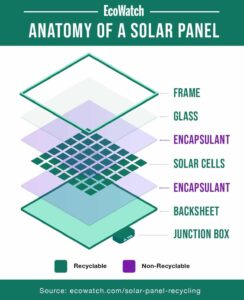
Solar panel life carbon assessment is the subject of frequent scientific reports, often with diverging conclusions. The topic is included in periodic reviews by the Intergovernmental Panel on Climate Change which continues to endorse solar photovoltaic technology as a vital contributor to the global transition to clean electricity.
Will our community be consulted?
Solar farm developers who are members of Solar Energy UK are expected to comply with its guidance for good practice. This includes an approach to the local community in advance of submitting a planning application, listening to concerns and suggestions, with an open mind to amending plans in order to secure local support.
WinACC is unlikely to support a planning application which overlooks this guidance, ideally through a village hall presentation of the plans, interactive online content and meeting the parish council.
Read: WinACC’s Renewable Energy Action Group (REAG)
Can we keep control of energy produced on land in our community?
Energy produced by a solar farm is normally fed into the national grid and sold by the developer on whatever terms it can negotiate, possibly packaged up with other solar farms that it controls.
The local community is unlikely to be in a position to influence these transactions. The developer has committed many millions of pounds to the investment and carries all the business risks involved.
There are smaller models of ground and roof-based solar pv which are within the scope of local ownership. Where it’s possible to share ownership through a cooperative “community energy” structure, the model creates investment opportunities for local households, alongside the potential to reinvest profits in community facilities.
WinACC encourages parishes to explore ideas for community solar projects, to operate in parallel with the solar farm model. We also encourage community discussion with developers of solar farms to explore whether there are ways in which the larger project can support the smaller. It may also be possible to negotiate a donation to a parish community fund, upfront or annually over the term.
Can we depend on solar energy when the sun isn’t shining?
The government aims for the UK’s electricity to come from clean sources by 2030, even as demand grows with the switch to heat pumps and electric cars.
Solar doesn’t generate at night and produces less in winter, so it works as part of a mix rather than on its own. The grid balances supply in several ways:
- A mix of sources. Solar generates most in summer and wind is strongest in autumn and winter, so together they cover more of the year.
- Battery storage. Batteries, including those now built alongside many solar farms, store daytime solar power and release it in the evening when demand peaks.
- A more flexible grid. Cables to other countries, smart meters and flexible tariffs help match supply and demand, for example by charging electric cars when power is plentiful.
The government is also investing in gas power stations fitted with carbon capture and storage (CCS) as backup for periods of low wind and sun. WinACC has concerns about how well CCS will work and what it will cost, and thinks investment in storage, a more flexible grid and cutting energy demand should come first.
Read: Our view on carbon capture and storage
Why do we need solar if the UK government is so committed to offshore wind?
Offshore wind will be the backbone of the UK’s clean electricity, but it can’t do the job alone. Powering homes is only part of the picture. Industry, businesses, public services, agriculture and electric transport all need electricity too, and demand will grow as more of us switch to heat pumps and electric cars.
The Climate Change Committee, which advises the government on climate targets, says we need both. Its Seventh Carbon Budget (2025) sets out a pathway where offshore wind grows to 88 GW and solar grows from about 20 GW to 82 GW by 2040.
Solar and wind also work well together. Solar generates most in sunny summer months, and wind is strongest in autumn and winter. Solar farms can be built in months rather than years, close to where the electricity is used.
How to comment on a planning application
You can comment on any open planning application on Winchester City Council’s website. The main consultation period is 21 days.
- Go to winchester.gov.uk/planning and click ‘Search Planning Applications’. This should take you to Simple Search. If not, select it from the Search menu in the top bar.
- Make sure ‘Applications’ is selected, and leave the Status box blank.
- Type in the application’s reference number exactly as it appears on the orange site notice or has been shared with you. The search is strict, so a small typo will return no results.
- Click the red ‘Comment’ tab or the ‘Make a Comment’ button.
- Fill in your name, address and email. Your comment is public, including your address. The system emails you a copy.
- Choose a commenter type, usually ‘Member of the Public’ or ‘Neighbour’.
- Choose your stance: ‘Support’, ‘Object’ or ‘Neutral’.
- Add your comment. There’s a character limit, so it helps to write it in a separate document first and paste it in. You do not have to leave a comment, you can simply record your support.
- Click ‘Submit’.