
1. Introduction
A quiet spot at Three Maids Hill has become the latest step in Winchester’s growing renewable energy system. After years of planning, a new anaerobic digestion facility is now up and running, turning local agricultural waste into biomethane gas that’s being fed directly into the national gas grid at Portsdown Hill.
Operated by Acorn Bioenergy, the plant has been fully operational since 1 August 2025. It’s already starting to turn local agricultural waste into useful resources that benefit the energy system, nearby farms, and local industry.
2. What the Facility Does & Why It Matters
Anaerobic digestion isn’t a new idea, but the Three Maids Hill facility shows how it can work at a local scale and fit neatly into existing energy systems. The process breaks down organic materials like straw, poultry manure and crop residues in sealed tanks, creating biogas that can then be upgraded into biomethane. It’s chemically the same as natural gas, but because it comes from renewable sources, its carbon footprint is much lower.
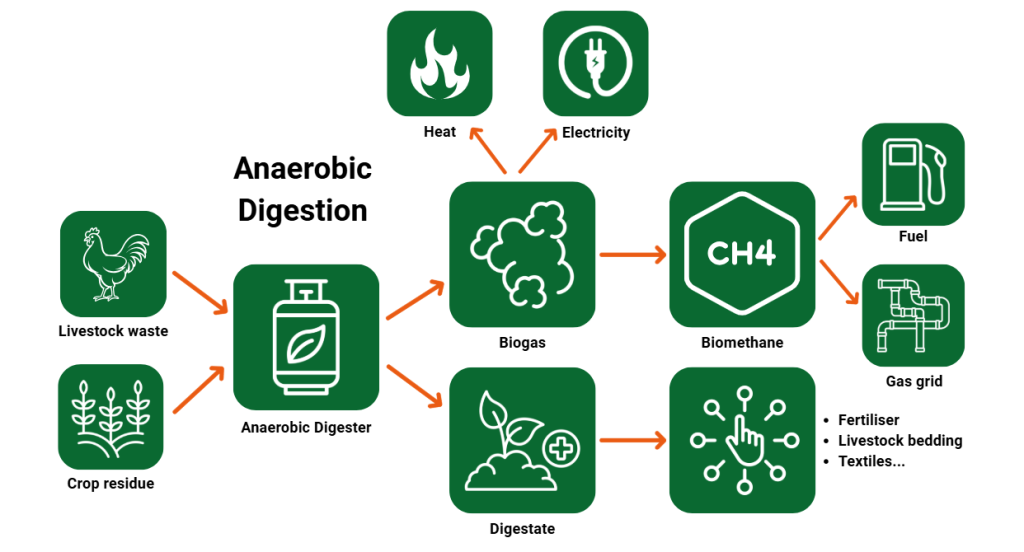
A nice feature of the site is how it links into the national gas network. Normally, biomethane has to be enriched – usually with a bit of propane – before it can go into the grid. Three Maids Hill doesn’t need this extra step because its output is relatively small, about two to three tanker loads each day. Scotia Gas Network can blend it straight into the system without affecting the energy content of the existing supply.
It’s also a very steady form of renewable energy. Unlike solar or wind, anaerobic digestion runs continuously and isn’t affected by weather or daylight. In practice, that makes it a dependable source of low-carbon gas at a time when the UK still relies partly on fossil fuel gas. It makes a clear, practical contribution to both decarbonisation and energy security.
3. The Environmental Impact
| ● Produces 9.75 million Nm³ of biomethane annually – enough to heat 9,000 homes. ● Cuts emissions by 31,000 tonnes of CO₂e per year – equivalent to removing 21,000 cars from the road. |
The environmental benefits of the Three Maids Hill plant are substantial and measurable. Once fully operational, it will produce around 9.75 million cubic metres of biomethane each year – enough renewable gas to heat approximately 9,000 homes! In doing so, it will cut greenhouse gas emissions by an estimated 31,000 tonnes of carbon equivalent annually, roughly the same as taking 15,000 cars off the road.
Because the feedstock used in the biodigester is sourced locally – primarily from nearby farms and agricultural businesses – the transport-related emissions are far lower than those associated with imported natural gas. This local circularity not only reduces carbon output but also strengthens regional energy independence.
| In an era of volatile global energy markets and lessons learned from the Ukraine crisis, the ability to produce a steady, homegrown supply of renewable gas is increasingly valuable. |
4. Cleaner Transport: Biomethane on the Move
Beyond heating and power, the biomethane produced at Three Maids Hill is also finding its way onto the road. Heavy goods vehicles (HGVs) transporting feedstock to the site, and those delivering refined gas to the injection point at Portsdown Hill, will be powered by the very fuel they help produce, a practical example of circular transport.
Compared with diesel, biomethane offers a major reduction in harmful greenhouse gas emissions, typically cutting carbon dioxide output by more than 80%.
Acorn Bioenergy and local farming partners are already exploring the next steps, including the potential to replace diesel tractors with biomethane-fuelled lorries or even methane- powered tractors such as the New Holland T6. Discussions are also underway about on- farm refuelling systems for larger agricultural operations, which, while initially expensive, could offer a long-term route to fully decarbonised fieldwork.
Acorn also commented that there are significant delays to ordering new vehicles in the current climate, and that for the specific biomethane powered model above, there will be a need to ensure maintenance is available to service those orders. They comment that the investment required will be significant, though they will need to engage with their contractors to discuss this.
5. Capturing and Reusing Carbon Dioxide
Another impressive feature of the Three Maids Hill facility is its approach to carbon capture. The process naturally generates carbon dioxide as a by-product, but instead of releasing it into the atmosphere, the plant captures carbon dioxide at a very high level of purity. This makes it suitable for commercial use in the food and drinks industry, reducing the need to rely on carbon dioxide (CO₂) produced from fossil sources. This capability has wider significance, particularly in light of recent CO₂ shortages that affected food processing and beverage production across the UK.
6. From Waste to Wardrobe: Sustainable Textiles from Digestate
Perhaps the most unexpected development to emerge from the project lies in the use of the solid digestate – the fibrous material left behind after anaerobic digestion. At Three Maids Hill, this material is composed mainly of well-broken-down cellulose from straw and crop residues. This material could serve as a base for sustainable textile fibres, similar in structure to viscose (rayon) but without the need for the harsh chemical treatments used in traditional wood-based fibre production.
“The potential for Viscose textiles is a fantastic opportunity considering all the energy and chemicals used elsewhere in the world to make that textile from timber.” – Tim Jackson, Chairman of the Renewable Energy Action Group.
Early-stage discussions with researchers, including those inspired by work at Chalmers University in Sweden, suggest that this byproduct could one day become part of a local sustainable textile industry. More information can be found in this article.
| If realised, this innovation could close yet another loop in the circular economy – transforming farm waste not only into clean energy, but into fabrics that could one day be worn by local residents. |
7. Conclusion
We’re pleased to see the Three Maids Hill facility up and running. It shows how local innovation can turn everyday agricultural waste into valuable resources – from clean energy and transport fuel to potential new materials – all while reducing emissions and supporting the local economy.
While biomethane won’t meet all our energy needs, it’s a practical option for things that are harder to electrify, like farm vehicles, some industrial processes, and heavy transport. By working with local farmers, businesses, and researchers, Three Maids Hill puts circular-economy thinking into practice: nothing is wasted, and the benefits stay close to home. It’s a good reminder that local, small-scale projects can genuinely move us forward on the path to net zero.
For more information on the anaerobic digester, you can visit Acorn Bioenergy’s website.
Naomi Briggs, Policy and Communications Intern on behalf of the Renewable Energy Action Group.